
At TheHealthBoard, we're committed to delivering accurate, trustworthy information. Our expert-authored content is rigorously fact-checked and sourced from credible authorities. Discover how we uphold the highest standards in providing you with reliable knowledge.
What are Lesions?
 Sally Foster
Sally Foster
Sally Foster
A lesion is any damaged or abnormal area of tissue in the body. Since they happen in so many different places and types of tissue, they have many different causes and means of diagnosis and treatment. Most lesions are broadly categorized by where they appear in the body — for example, skin and mouth lesions are some of the most common types — but there are also site-specific ways of categorizing them. The effects of any particular area of abnormality depends on its placement, type, and size.
Skin

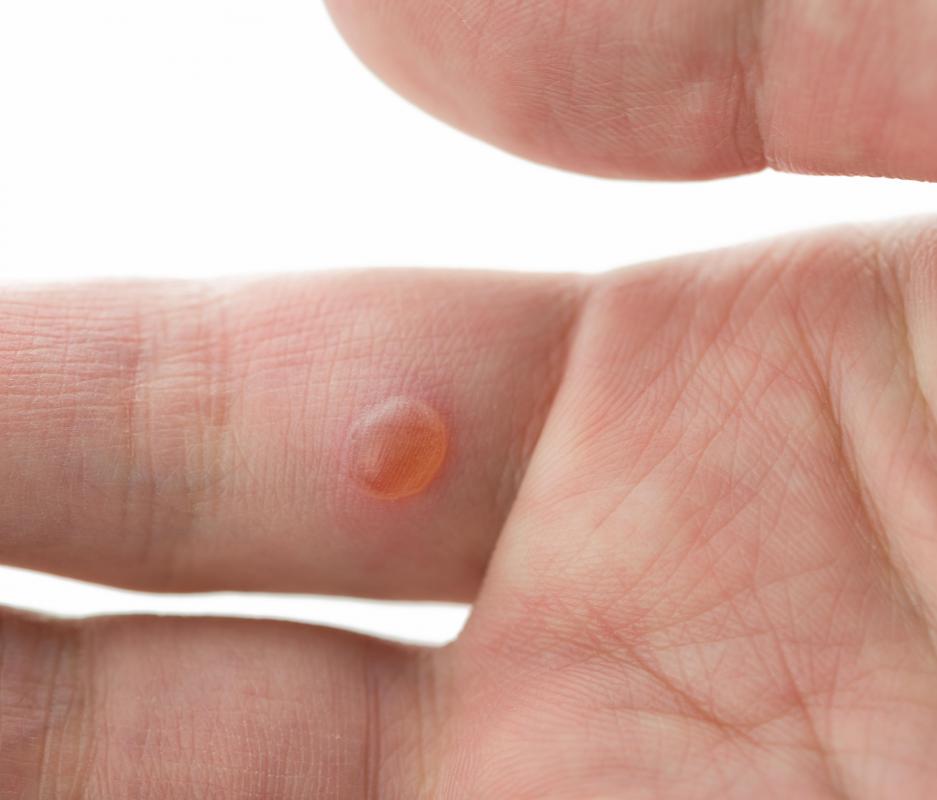
Skin lesions can be either primary, which means that they cause a variation in color or texture of the affected skin; or secondary, which includes things like the scabbing that naturally forms on an abrasion or peeling that follows a sunburn. Moles, birthmarks, warts, and hives are all common primary types, while skin ulcers, scabs, fissures, and lichenification are all common secondary types. Skin abnormalities can also be categorized by size, appearance, and whether they are cancerous or non-cancerous.

As this type of damage can be caused by so many different things, the way they're treated varies. If they're caused by an infectious disease, then doctors generally try to treat the underlying condition rather than the lesions themselves. Sometimes topical antibiotics can help prevent further infection. Other topical treatments, such as cortisol cream, can be applied to soothe itchy or irritated skin. In many cases, treatment for harmless skin damage is primarily cosmetic: for example, patients may resort to laser surgery to reduce the appearance of a mole.

Though the vast majority of skin lesions are harmless, some can be an indicator of skin cancer. Moles or birthmarks that have an uneven edge or have a change in color may be cancerous, particularly if they are larger than 0.19 inches (5 mm) in diameter.
Mouth
Oral lesions include any type of tissue abnormality in the mouth, like dental caries or cavities, herpes blisters, ulcers, gingivitis, and inflammation from yeast infections. People who smoke or chew tobacco are more likely than those who do not to get some types of oral problems, including oral cancers and hairy tongue. Good dental hygiene can be very effective in preventing many types of oral lesions.

As with skin damage, the treatment for oral abnormalities is generally focused on treating the underlying cause. Some oral conditions can be treated, like gingivitis and yeast infections, but others, like herpes blisters, cannot be fully cured. For conditions that can be treated, dentists may advise patients to use medicated mouthwashes, gels, and toothpastes, as well as tongue scrapers for conditions like hairy tongue. Lesions that affect the inner tissues of the mouth, like oral cancer, may be surgically removed. Debridement, a procedure in which dead tissue is removed, may also be used when the tissue is severely damaged, along with antibiotics to control infection.
Brain

Brain lesions are associated with a range of conditions, including Alzheimer's disease, meningitis, multiple sclerosis, and cerebral palsy. Tumors, physical trauma, and aging can also cause this type of damage, as can bleeding, like that from a stroke. Environmental factors, like exposure to toxins, can also cause brain abnormalities. Some remain small enough that they don't cause any symptoms. If this is the case, doctors often take a wait and see approach, monitoring the area to make sure that it doesn't start to cause damage, and treating it if it does.

Depending on the cause of the damage, doctors may be able to treat some types of brain lesions. For example, a brain abscess can often be treated with antibiotics or antifungal medications. Other abnormalities can cause permanent damage. Though there are sometimes ways to treat the symptoms caused by the damage, as in the case of a stroke, damage caused by other conditions, like Alzheimer's disease, are progressive and not treatable. The location of the damage can also have an impact on the treatment — for example, it's often more difficult to treat tumors that are deep in the brain than those that are closer to the surface.
Lungs

Most lung lesions are caused by either bacterial or viral illnesses or cancer. Sometimes cysts, holes, or scar tissue can form in the lungs as well. There are also several types of congenital lung abnormalities, including Congenital Cystic Adenomatoid Malformation (CCAM) and lung sequestrations. One of the most common types of lung lesion is a Solitary Pulmonary Nodule (SPN), which is typically a benign tumor, but can be malignant in about one in five cases. Tuberculosis also causes lung lesions, which may reactivate after treatment and cause another round of the disease.

Many people with this type of lung problem don't know they have it, and only find out when they get a diagnostic test like Magnetic Resonance Imaging (MRI) done for another condition. There are a variety of treatments available for these abnormalities, ranging from surgery and chemotherapy in the case of cancer to antibiotics in the case of tuberculosis. Not smoking and avoiding environmental factors like air pollution and asbestos can help prevent this type of lung damage.
Other
People can get a lesion essentially anywhere they can get a tumor, so the liver, pancreas, genitals, intestines, kidneys, bones, eyes, and gallbladder can all be affected as well. Kidney and pancreas cysts are particularly common. Cells and molecules can also get lesions, as in the case of sickle-cell disease.
Sally Foster
Sarah is a freelance writer living in Istanbul, Turkey, where she has taught numerous English language courses and runs a blog focusing on the expat community. Since joining the TheHealthBoard team several years ago, Sarah has become a veritable fount of knowledge on many obscure topics. She has a B. A from the University of Oregon, where she majored in Romance Languages (Spanish and Italian) and Linguistics and an M.A. in TESOL from the Middlebury Institute of International Studies at Monterey.
Learn more...
Sally Foster
Sarah is a freelance writer living in Istanbul, Turkey, where she has taught numerous English language courses and runs a blog focusing on the expat community. Since joining the TheHealthBoard team several years ago, Sarah has become a veritable fount of knowledge on many obscure topics. She has a B. A from the University of Oregon, where she majored in Romance Languages (Spanish and Italian) and Linguistics and an M.A. in TESOL from the Middlebury Institute of International Studies at Monterey.
Learn more...AS FEATURED ON:
AS FEATURED ON:


-
![A man's hand with skin lesions.]() By: Stephen VanHornA man's hand with skin lesions.
By: Stephen VanHornA man's hand with skin lesions. -
![Flat skin mole.]()
Flat skin mole. -
![Hives are primary lesions.]() By: Jürgen FälchleHives are primary lesions.
By: Jürgen FälchleHives are primary lesions. -
![A wart is a type of skin lesion.]() By: jjojaA wart is a type of skin lesion.
By: jjojaA wart is a type of skin lesion. -
![Chemotherapy is a possible treatment for cancerous lesions.]() By: Monkey BusinessChemotherapy is a possible treatment for cancerous lesions.
By: Monkey BusinessChemotherapy is a possible treatment for cancerous lesions. -
![Topical antibiotic creams can be used to treat or prevent bacterial infection.]() By: CopridTopical antibiotic creams can be used to treat or prevent bacterial infection.
By: CopridTopical antibiotic creams can be used to treat or prevent bacterial infection. -
![Dental cavities and gingivitis are just two types of oral lesions.]() By: Robert KneschkeDental cavities and gingivitis are just two types of oral lesions.
By: Robert KneschkeDental cavities and gingivitis are just two types of oral lesions. -
![A doctor may suggest laser surgery to remove a mole, which is a type of skin lesion.]() By: mkrberlinA doctor may suggest laser surgery to remove a mole, which is a type of skin lesion.
By: mkrberlinA doctor may suggest laser surgery to remove a mole, which is a type of skin lesion.




Discussion Comments
I'm currently doing a nail technician course and I have to learn all about the skin. I have been reading and looking up lesions and I'm finding it very hard to understand. The questions ask what type of lesion is a wheal. I don't know if I have to write what a wheal is or what. Can anybody help?
So what I am looking for is something on liver lesions. I have been to almost all these "web" sites that claim they are "medical" but I have found nothing! I have lesions on my liver and I want to know where you get them and what treatment is and all those types of questions.
I have got a lesion on back of my right shoulder, and I am a bit worried and scared. Just hoping it's not cancerous.
MRI scan of my brain has shown 3 lesions. The largest measures 8mm x 10mm on the frontal lobe adjacent to the frontal horn. what does it mean? I only went for the scan as I'm having problems with my trygeminal nerve!
I apparently have a lesion on my pancreas. Another scan will confirm it for sure. What should I be asking about it?
what is the best and safest between the two when it comes to cancer, cut or treat-it with chemo and radiation?
my husband has lesions on left lower lobe of lung, pancreas and adrenal gland all presumed to be cancer. He is having a needle biopsy on the adrenal gland and if malignant, will not treat any of the cancers. if benign he will have surgery on lung and pancreas. is this the right treatment?
i got some thing on my breast. it came with sunburn it's been almost eight months and the color is like green. The doctor told me it's a lesion but I'm not sure of it. What can you suggest to me?
CT scan has showed lesions in ascending bowel, should i be worried? I have had pain in that part of bowel for nearly one year and after having a ct scan they found these.
I was cured of an ulcer from the medicine prescribed by the doctor. But from thereafter if i take any medicine, I began to suffer from itching, vomiting, bowel, stomach pain. Please tell me what i should do.
I've been tould that I have a lesion on the frontal lobe. please let me know if this is true. Hard to swallow, not the mouth, the head. something showed up on ct scan.
when the doctor is doing aspiration in the breast and he starts talking about lesions what is he talking about? Thanks
how are lesions of the lining of the stomach caused from when bleeding occurs?
To anon2421:
Why don't you go with your mum to the doctor when she goes and ask questions? As an adult with elderly parents, I would want to know what is being done to me and why. But, my parents don't know to ask questions or think the doctor "knows" best so they don't ask. Go with her next time and ask the questions that her doctor could easily answer for you and for her.
I have had a chest/abdomen CT with dye. The report says I have adenomas on both adrenal glands and a lesion on my right adrenal gland. I also have a lot of pain under my ribcage and around to the side. The doctor says she will just monitor this. How can she monitor this lesion inside of me and know that it okay. Have any of you had this problem?
i am a diabetic for 10 years. oflate getting tiny lesions on foreskin. skin creams like candid give results but reappear when stopped. also getting burning sensation or itching. similar problem in rectum. using cream like sucral ano give the same result. randum blood sugar level is within limits. need advice
my mum has lesions on her leg and had a biopsy which advised she had inflammation of the blood and fat cells her doctor now wants her to have a chest x ray what would the meaning of this be?
Post your comments