
At WiseGEEK, we're committed to delivering accurate, trustworthy information. Our expert-authored content is rigorously fact-checked and sourced from credible authorities. Discover how we uphold the highest standards in providing you with reliable knowledge.
What are Kidney Stones?
Kidney stones are a very painful, and very common, urologic disorder, affecting 600,000 patients per year. The stones are a solid mass that develops from crystals that separate from urine and build up on the inner surfaces of the kidney. Urine usually contains chemicals that prevent stones from forming, but sometimes, they don't work. If the stones are tiny enough, they will travel through the body with urine and pass undetected. Even larger ones usually pass without any medical assistance, but there are various techniques to treat those that cannot be eliminated without help.
In many cases, a kidney stone, also called a renal calculus, contains chemicals such as calcium, which combines with other chemicals such as phosphate or oxalate. These chemicals come from a person's dietary intake and are required to maintain healthy muscles and bones. A rarer form is called a struvite; this is caused by an infection in the urinary tract. The medical term used to describe stones that appear in the urinary tract is urolithiasis.

Medical experts are not sure of exactly why kidney stones appear. Although ingestion of certain foods contributes to their development, it is not believed that any specific food is directly to blame. People who have a family history of this problem may be more likely to develop them as well. There is also a rare hereditary disease called renal tubular acidosis, and people with this disease are much more likely to develop the stones.

The first sign that a person has developed a stone in a kidney will be extreme pain when it blocks the flow of urine. He will feel an intense cramping or sharp pain in the lower back, side, or groin area. The individual may also suffer from vomiting and nausea. He may feel the need to urinate more often and may feel a burning sensation when he does.

As the stone or stones move or grow larger, blood may appear in the urine. If the person suffers from chills and fever along with the aforementioned symptoms, this is a sign of an infection and a medical professional should be called. He or she will take an X-ray or sonogram, and possibly perform a computed tomography (CT) scan. These tests will help the healthcare professional see an image of the urinary system to make a proper diagnosis.

Drinking plenty of water can help kidney stones to pass through the body. A medical professional may also prescribe medications to prevent uric acid and calcium stones from forming. For more severe cases, extracorporeal shockwave lithotripsy may be used, in which shock waves will be passed through the body to break up the stones into small particles that can be passed easily when urinating. The healthcare provider can advise the patient on future lifestyle changes that should prevent the stones from reappearing.
AS FEATURED ON:
AS FEATURED ON:









-
![A kidney with a kidney stone.]() By: p6m5A kidney with a kidney stone.
By: p6m5A kidney with a kidney stone. -
![Graph showing possible locations of kidney stones.]() By: bilderzwergGraph showing possible locations of kidney stones.
By: bilderzwergGraph showing possible locations of kidney stones. -
![Kidney stones next to a ruler to show the size.]() By: erik gouldKidney stones next to a ruler to show the size.
By: erik gouldKidney stones next to a ruler to show the size. -
![Nausea can be caused by kidney stones.]() By: ftlaudgirlNausea can be caused by kidney stones.
By: ftlaudgirlNausea can be caused by kidney stones. -
![Kidney stones affect 600,000 patients per year.]() By: Alila Medical MediaKidney stones affect 600,000 patients per year.
By: Alila Medical MediaKidney stones affect 600,000 patients per year. -
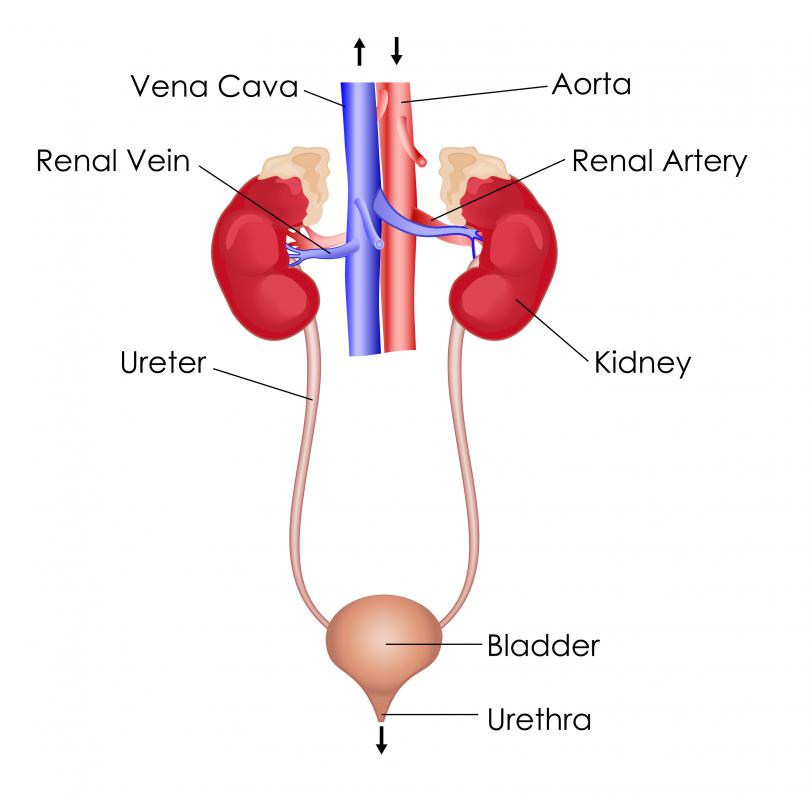
![If small enough, kidney stones will travel through the remaining urinary system and out of the body.]() By: snapgalleriaIf small enough, kidney stones will travel through the remaining urinary system and out of the body.
By: snapgalleriaIf small enough, kidney stones will travel through the remaining urinary system and out of the body. -
![If kidney stones are suspected, an individual may have to undergo a CT scan for confirmation.]() By: Konstantin SutyaginIf kidney stones are suspected, an individual may have to undergo a CT scan for confirmation.
By: Konstantin SutyaginIf kidney stones are suspected, an individual may have to undergo a CT scan for confirmation. -
![A urinalysis may be conducted to detect kidney stones.]() By: Mi.Ti.A urinalysis may be conducted to detect kidney stones.
By: Mi.Ti.A urinalysis may be conducted to detect kidney stones.




Discussion Comments
@starrynight - It does sound like getting surgery would probably be a lot less painful than passing the kidney stones. However, you also have to take into account that it takes longer to recover from surgery than it does from just passing the stones.
That being said, most of the time the patient doesn't get to pick which method the doctor uses though! Some kidney stones are just too big to pass naturally, and surgery is necessary, no matter how the patient feels about it!
I've known a few people over the years who have gotten kidney stones, and it definitely doesn't sound pleasant. I have to say, I think people who have the surgery are a little bit luckier though. I can't imagine trying to pass those kidney stones through my urinary tract.
It's unfortunate that doctors aren't completely sure why kidney stones symptoms appear in some people, and not in others. If they knew what the cause of kidney stones was, then people could do something to prevent them from forming.
I guess the only thing you can really do is try to stay healthy and keep your system in good working order by drinking enough water. And then just hope you don't end up with kidney stones!
@JackWhack - I don't think this is true for all kidney stone surgeries. My sister had surgery for kidney stones when she was in middle school, and she didn't have to wear a catheter attached to a bag when she came home after her surgery.
@burcinc-- These fruit juices do absolutely nothing to get rid of or prevent kidney stones. What they can do is prevent urinary tract infections. Sometimes people get both UTI and kidney stones and cranberry or pomegranate juice might be helpful for the infection. But it will NOT treat kidney stones.
You're much better off drinking water than pomegranate juice if you're suffering from kidney stones. The reason that kidney stones form in the first place (for most people) is because they don't drink enough water.
I wouldn't worry about drinking these fruit juices and just concentrate on drinking enough water.
People always say that cranberry and pomegranate juice is a good kidney stone treatment. But how?
I just don't understand how fruit juice can treat a health problem like this.
@Oceana-- I agree with you. My grandfather was the same, he drank a lot of water but still used to get kidney stones. He had several kidney stone operations because the stones grew to a size that he couldn't pass naturally. I mean, just look at the image on this page! They are huge! Can you imagine having those inside you in your urinary system?
My grandfather had other kidney issues as well, he actually eventually died from kidney failure. But I wouldn't want anyone to infer from this that kidney stones and kidney failure have anything to do with each other. My grandfather had some other issues going on so they weren't really related.
If you have a kidney stone operation, then you will most likely have to wear a catheter attached to a bag that will capture your urine. My cousin had to wear one of these, and they let him go home with it.
They told him he would have to change it out whenever it got almost full. He was supposed to be checking it for stones.
He was determined to go to church on Sunday, even with the bag. He hid it under his pants and a blanket that he kept in his lap. I can't imagine going out in public like that, but he was dedicated.
I've never had these myself, but I've always heard that passing kidney stones hurts just about as bad as anything possibly can. Judging from the looks of the ones in the photo beside the article, I believe it!
Those look like rocks with sharp edges. I cringe to even think about sharp objects passing through my urinary tract.
@wavy58 – I believe you are right. I have an aunt who drinks nothing but tea and coffee, and she has suffered multiple instances of kidney stones.
Hers were so bad that the doctor had to break them up surgically. Then, she had to wear a catheter so that she could pass them more easily.
However, I also believe that kidney stones can be somewhat hereditary. My aunt and her daughter are both prone to getting them, and her daughter drinks a lot of water. It seems that some people might just be born with a greater risk of getting them.
I think that ingesting too much caffeine is one of the causes of kidney stones. I have a friend who drinks caffeinated sodas all day long and rarely ever drinks water, and she has had numerous attacks of kidney stones.
She had to be hospitalized twice because the pain was so intense, and she could not pass urine. I told her that if she would just replace most of her sodas with water, she might not have to go through this again, but she is addicted to her caffeinated beverages. It's amazing that some habits are so hard to break that we will endure excruciating pain in order to keep them.
@Planch -- There are a lot of natural and home remedies for kidney stones.
I've never tried any of them, so I can't vouch for one over the other, but some I've heard of are pomegranate juice, eating lots of apples and watermelon, and a teaspooon of basil and honey.
I even saw one website that said a decoction of kidney beans was good for dissolving kidney stones!
That sounded kind of far out to me, but I don't know -- I think if I were in that situation I'd be trying everything I knew to get rid of them!
Does anybody know if there are any really good, effective natural remedies for kidney stones?
Those things are nasty! I remember my uncle used to get them all the time, and he said that it was absolutely the worst pain he had ever experienced.
He had a specific type of them called uric acid kidney stones, because of his gout.
Apparently this happened because he didn't excrete enough urine when compared to the uric acid in his bloodstream.
Just hearing about his pain makes me stock up on the cranberry juice!
Post your comments