
At WiseGEEK, we're committed to delivering accurate, trustworthy information. Our expert-authored content is rigorously fact-checked and sourced from credible authorities. Discover how we uphold the highest standards in providing you with reliable knowledge.
What are Iron Supplements?
 Tricia Christensen
Tricia Christensen
Tricia Christensen
Iron supplements can be either prescribed medication or over the counter dietary supplements that can help to make up for too little intake of iron through diet or poor absorption of iron. They are typically prescribed to treat iron deficiency or prevent it. People who may take iron supplements include those with some forms of iron deficiency anemia, poor ability to absorb iron due to their diet, and people with chronic coughs due to taking blood pressure medications. Other people who may temporarily need iron include those with severe burns, or with some conditions that cause chronic bleeding.
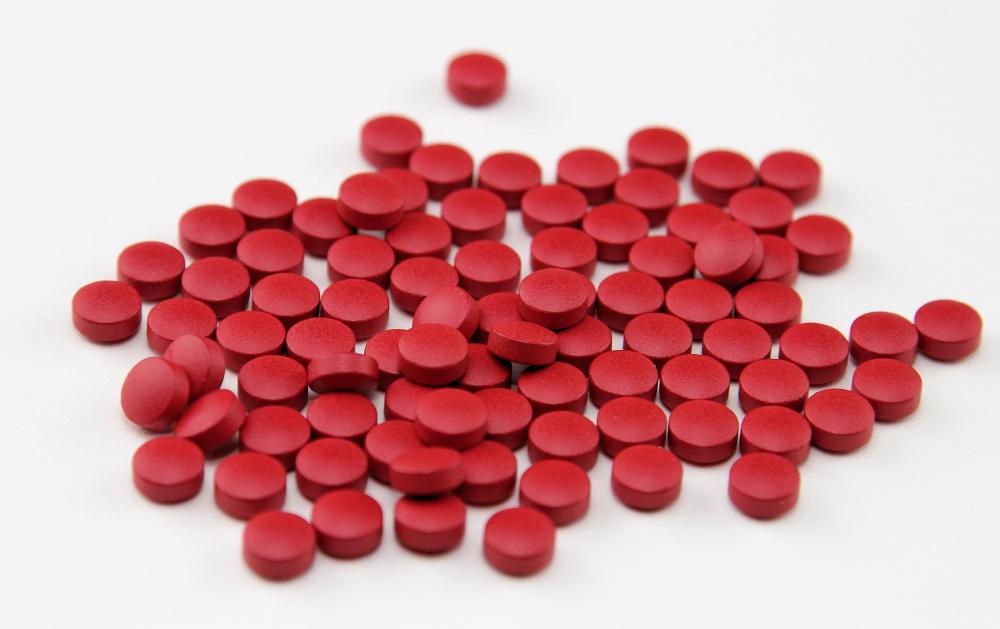
In prescription form, supplements are usually in tablets, though sometimes drops, shots or intravenous iron are used. A commonly prescribed source of iron is ferrous sulfate. Other iron sources include ferrous fumarate and ferrous gluconate. Some people tend to do better on one type of iron source, than they do another. Gastrointestinal upset may be greater with ferrous sulfate, for instance, than it is with ferrous fumarate.

Dosage of iron tends to depend on need, age, and size. With children, following dosing is extremely important and iron tablets should be kept well out of reach of children. Accidental poisoning due to iron is the leading cause of death in children under the age of six, and it is very important that children never have access to iron tablets or liquid iron, other than when it is prescribed by a doctor.

People may take over the counter supplements and prefer them to prescription brands. Doctors can make recommendations on dosing if patients bring in the over the counter brand they would like to use. Some people find it easier to take liquid iron supplements, but others avoid these because they can stain teeth.
Those who plan to take iron supplements as part of a dietary supplement should consult their physicians. There are a number of drugs that iron can interact with. Unless guided by a doctor, iron shouldn’t be used with aspirin or other non-steroidal anti-inflammatory drugs (NSAIDS) like ibuprofen. Iron supplements may also reduce effectiveness of certain antibiotics like tetracycline and may also affect some blood pressure medications.

Many people get adequate iron from their diets. It is available in two dietary forms. Heme iron is typically found in red meat. Nonheme iron is present in many vegetables, citrus fruits, beans, and cereal. People have more trouble metabolizing nonheme iron, but may do so better if they eat heme iron at the same time. Certain foods, especially those containing calcium can make it difficult to absorb iron of any source. A lot of foods are supplemented with iron, like many packaged cereals, breads and pastas.

Unless a doctor recommends a person take iron, they are probably best avoided. As previously stated, most people have enough iron from their diets, especially if they eat red meat. It’s fairly easy to check iron levels with a blood test if people are concerned they are not getting enough iron in their diets.
Tricia Christensen
Tricia has a Literature degree from Sonoma State University and has been a frequent WiseGEEK contributor for many years. She is especially passionate about reading and writing, although her other interests include medicine, art, film, history, politics, ethics, and religion. Tricia lives in Northern California and is currently working on her first novel.
Learn more...
Tricia Christensen
Tricia has a Literature degree from Sonoma State University and has been a frequent WiseGEEK contributor for many years. She is especially passionate about reading and writing, although her other interests include medicine, art, film, history, politics, ethics, and religion. Tricia lives in Northern California and is currently working on her first novel.
Learn more...AS FEATURED ON:
AS FEATURED ON:









-
![Iron supplements are often used by people who have trouble with chronic coughing.]() By: Lisa F. YoungIron supplements are often used by people who have trouble with chronic coughing.
By: Lisa F. YoungIron supplements are often used by people who have trouble with chronic coughing. -
![Supplements can help people who do not get enough iron because of diet or absorption problems.]() By: AndreiSupplements can help people who do not get enough iron because of diet or absorption problems.
By: AndreiSupplements can help people who do not get enough iron because of diet or absorption problems. -
![In prescription form, iron supplements are usually tablets.]() By: alinitaIn prescription form, iron supplements are usually tablets.
By: alinitaIn prescription form, iron supplements are usually tablets. -
![Iron supplements may reduce the effectiveness of certain antibiotics.]() By: robert lerichIron supplements may reduce the effectiveness of certain antibiotics.
By: robert lerichIron supplements may reduce the effectiveness of certain antibiotics.


Discussion Comments
@rallenwriter: a gentle iron supplement is Floradix Iron + Herbs. It is an herbal liquid (although it does come in a tablet) and has very few side effects. It sounds like you have a lot more going on that mere anemia, but this could help you. Make sure you contact a doctor perhaps write down all the symptoms and when they started and in what order. I find an outline form helps.
@rallenwriter -- You really should talk to your doctor before taking any kind of supplement, whether it's an herbal iron supplement for anemia or a calcium supplement for osteoporosis.
Many supplements are marketed as herbal or natural, but the truth is, medicine is still medicine, and when you put something that powerful into your body you have to be really careful.
Take some of the iron supplement side effects, for example. Too much iron can cause gastrointestinal disorders, including nausea, vomiting, irregular bowel movements and dark stools.
Other side effects include headaches, muscle pain, hives, swelling, and even an increased risk for certain cancers. Unfortunately, it is very easy to go from having an iron deficiency to having too much iron, especially since so many supplements are unregulated or mislabeled.
So if you are truly concerned about having an iron deficiency, then talk to your doctor. There's no need for you to suffer from the effects of anemia or iron deficiency, but you also need to be careful about what you put into your body.
Best of luck.
Are natural or herbal iron supplements any different from the regular ferrous iron supplements that you see on the market?
Iron is iron, right? So how can a supplement of a mineral be more natural in one form than in another? I guess they could process the supplement differently, but other than that, I can't really see how you could really find that much of a difference between a natural iron supplement and a regular one.
Anybody got any insight?
Hello -- I was wondering if you could give me some advice about iron supplements. For a few weeks now I have been experiencing many of the symptoms of anemia, and I was wondering if it might be a good idea to take an iron supplement.
I have been consistently tired with no other reason, my hair seems to be falling out like crazy, and I just feel really moody all the time.
From what I see online, those are all symptoms of iron deficiency. Now, I know you said that it's probably best not to take an iron supplement without a doctor's advice, but surely there are some good, safe iron supplements out there that anyone can take, right?
I mean, what if I got a really gentle herbal iron supplement? If it's made of natural materials, it can't be so bad, I would think.
Anyway, if anybody could give me some advice about this, I'd really appreciate it. Thanks all.
Post your comments