
At AllThingsNature, we're committed to delivering accurate, trustworthy information. Our expert-authored content is rigorously fact-checked and sourced from credible authorities. Discover how we uphold the highest standards in providing you with reliable knowledge.
What are Hummingbirds?
 Tricia Christensen
Tricia Christensen
Tricia Christensen
Hummingbirds are a group of birds containing over 300 different species in the family Trochilidae. Though each species has its own characteristics, as a group, the family is known for some remarkable things. It contains the animal with the highest metabolism of all animals, and the smallest of all birds, the Bee Hummingbird, which weighs about .06 ounces (1.7 g). Some hummingbirds can beat their wings 70 beats per second. Even the largest hummingbirds may beat their wings up to 8-10 times a second, which makes the wings look blurred to humans.
The family Trochilidae can only be found in the Americas, and many species of the birds migrate yearly. If you live in fairly mild climates, like those in Southern California, you may see hummingbirds year round. Other hummingbirds migrate to more temperate conditions. This explains the greater variety of hummingbirds nearer to the Equator in winter. Evolutionary biologists believe the hummingbird family originated in South America, and throughout the year, you'll spot more species there than anywhere else in the world. In summer and spring, North Americans are still thrilled by the number of species that may visit them.

As mentioned above, the metabolism of the hummingbird is the fastest of all animals. Their heart rates may reach over 1000 beats per minutes. This rapid rate may not exist at all times. Scientists have observed hummingbirds go through what is called torpor, mainly at night, when heart rate and respiration rate drop significantly. This could be called a nightly hibernation, since it reduces the need for the birds to seek food at night. Where food supply is limited, torpor may also be induced during daylight hours.

To sustain a high metabolism, hummingbirds rely primarily on sipping nectar from flowers, because sugar easily converts to energy. They also eat small bugs, and spiders. Hummingbirds are attracted to brightly colored flowers, so planting these in a garden will help attract the birds to the area. If you use a feeder, you should make sure to clean it regularly, and not fill it with artificial sugars since these won’t meet the hummingbird’s needs. Avoid using honey in feeders, which can contain bacteria that can kill the birds.
If you’ve ever watched a hummingbird at a feeder or in front of a flower, you’ll note it has the peculiar ability of being able to hover while feeding. Except for the blur of wings, the bird may look as though it is stationary in air. This ability is present because of the rapid beat of wings, which produce the hum sound for which the birds get their name. Hummingbirds are also the only family of birds able to fly backward.
In appearance, the birds usually have iridescent coloring that most people find attractive. They have long beaks, which may be straight or curved allowing them to delicately extract nectar from flowers. You may have to look hard to spot a hummingbird nest, where younglings are cared for only by the females. The nests are about equivalent in size to a pocket watch, and look like a rounded cup.
The lifespan of the hummingbird in the wild is approximately 3-4 years. In captivity, the birds may live well into their teens. They have no standard predators, though they can certainly fall victim to larger birds, like some of the raptor family, or to domestic pets.
The birds may run into trouble when they exist near human settlements, since they frequently get trapped in garages. If you have one trapped, gently remove the bird, when possible, to the outdoors by catching it in your cupped hands. It will always attempt to fly upward, since this is an instinctual escape mechanism, and if it is not found and released within an hour, it can die from lack of food.
Frequently Asked Questions
What distinguishes hummingbirds from other bird species?
Hummingbirds are unique in their ability to hover in mid-air thanks to their rapid wing flaps, which can average around 50 times per second. They are the only birds capable of flying backwards and have an extremely high metabolism to support their energetic flight, necessitating them to consume half their body weight in nectar daily.
How do hummingbirds feed and what is their diet?
Hummingbirds primarily feed on nectar from flowers, using their long, specialized bills and tongues to reach deep into blossoms. Their diet is supplemented with insects and spiders for protein. They require frequent feeding—sometimes every 10-15 minutes—and may visit hundreds of flowers daily to sustain their energy levels.
Where can hummingbirds be found geographically?
Hummingbirds are native to the Americas, with the greatest species diversity in South and Central America. According to the Smithsonian National Zoological Park, there are over 300 species of hummingbirds. North America has fewer species, with the Ruby-throated Hummingbird being the most common in the eastern United States.
How do hummingbirds contribute to their ecosystems?
Hummingbirds play a crucial role in their ecosystems as pollinators. As they feed on nectar, they inadvertently transfer pollen from one flower to another, aiding in plant reproduction. This pollination is vital for maintaining the health of ecosystems, supporting biodiversity, and ensuring the production of seeds and fruits.
What are some adaptations hummingbirds have for survival?
Hummingbirds have several adaptations for survival, including a high-powered metabolism that supports their energetic flight, the ability to enter a state of torpor to conserve energy at night or when food is scarce, and iridescent feathers that can serve as camouflage among flowers or as a display during mating rituals.
How do hummingbirds migrate, and what challenges do they face?
Some hummingbird species undertake long migrations, such as the Ruby-throated Hummingbird which migrates between North America and Central America, crossing the Gulf of Mexico in a single flight. These migrations present challenges like exhaustion, starvation, and predation. Climate change and habitat loss also pose significant threats to their migratory patterns.
Tricia Christensen
Tricia has a Literature degree from Sonoma State University and has been a frequent AllThingsNature contributor for many years. She is especially passionate about reading and writing, although her other interests include medicine, art, film, history, politics, ethics, and religion. Tricia lives in Northern California and is currently working on her first novel.
Learn more...
Tricia Christensen
Tricia has a Literature degree from Sonoma State University and has been a frequent AllThingsNature contributor for many years. She is especially passionate about reading and writing, although her other interests include medicine, art, film, history, politics, ethics, and religion. Tricia lives in Northern California and is currently working on her first novel.
Learn more...AS FEATURED ON:
AS FEATURED ON:









-
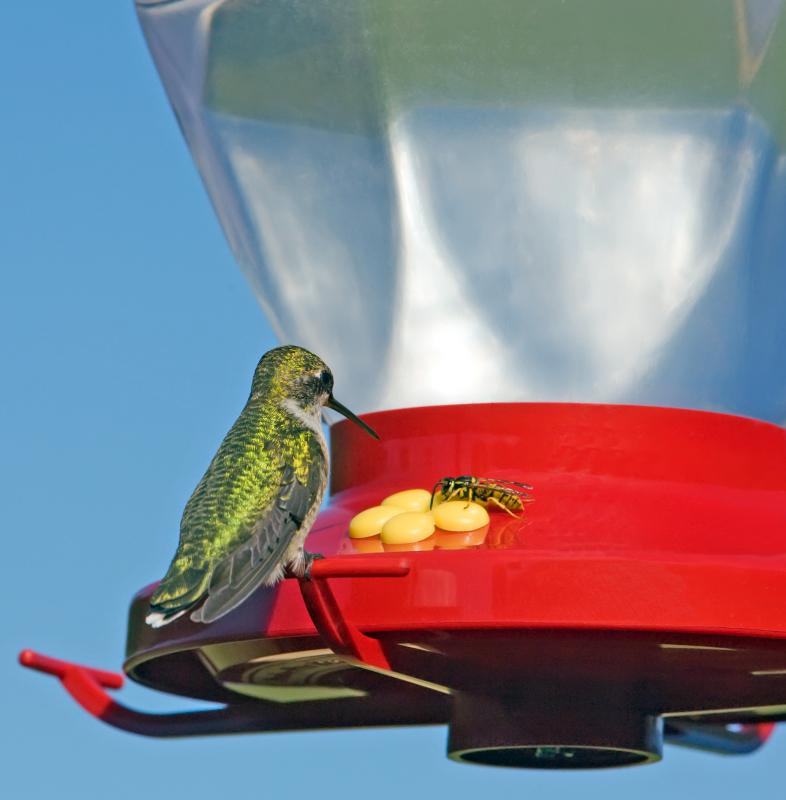
![A hummingbird on a feeder.]() By: Al MuellerA hummingbird on a feeder.
By: Al MuellerA hummingbird on a feeder. -
![Some hummingbird wings reach 70 beats per second.]() By: Steve BylandSome hummingbird wings reach 70 beats per second.
By: Steve BylandSome hummingbird wings reach 70 beats per second.

Discussion Comments
@Grivusangel -- Ever seen a hummingbird *moth*? I never had until I was visiting in Nevada. They look very similar to hummingbirds, and feed on nectar took, but they're moths! I just stood there and watched the moth go from flower to flower. It looked just like a hummingbird. My friend was completely clueless about what it was, so I looked it up, and lo and behold -- the hummingbird moth! They're fun to watch, too.
I love hummingbirds. They are so funny and so beautiful! I put up a feeder every year that I can see from my window, so I can watch them.
I need to find a good recipe for hummingbird nectar. I've heard the red dye in the commercial kind isn't really good for them, and that's not what attracts them, anyway. I'm also going to plant some flowers that attract them, too. I always love seeing the first hummingbirds of the season!
Post your comments