
At BeautyAnswered, we're committed to delivering accurate, trustworthy information. Our expert-authored content is rigorously fact-checked and sourced from credible authorities. Discover how we uphold the highest standards in providing you with reliable knowledge.
What are Hair Extensions?
Hair extensions, also called hair weaves, are lengths of real or synthetic hair that are closely attached to a person's scalp, adding length and/or thickness to the person's own natural hair. There are several different systems for attaching hair extensions, some of which are longer lasting than others. When well matched in color and texture, and professionally applied by a competent stylist, hair extensions are designed to mix in and move naturally with a person's own hair, making it difficult to tell the person is wearing them. They can provide volume, extend hair, and add highlights or lowlights. With the proper maintenance, some extensions can last up to a full year before they need to be removed.
Types of Extensions

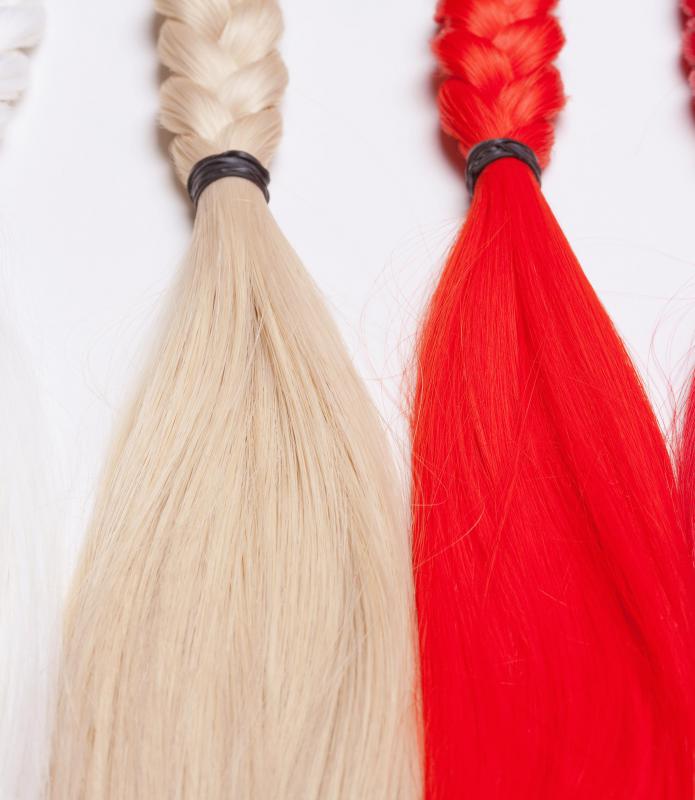
Both human and synthetic hair extensions are available, and both come in a variety of colors, textures, styles, and lengths. Each type has its own set of advantages and disadvantages. Natural or human hair extensions are usually significantly more expensive than their synthetic counterparts, though they are typically considered to be of higher quality. Synthetic hair is made from chemically processed fibers; although more affordable, it may not look as real and can be more difficult to style.
Human Hair

High quality, long-lasting human hair extensions are often available only through salons. The hair can be washed, conditioned, dried, and colored just like a person's own hair. It also tends to provide a great deal of styling freedom; heat styling at temperatures reaching 430°F (about 221°C) should not damage the hair. This typically results in faster and longer-lasting styles with more shine.
Synthetic Hair

Made from various types of synthetic fibers, these hair extensions are often available in a wider variety of beauty supply stores, drug stores, and other locations. The quality of synthetic hair can vary widely, but the two most common types are made of Kanekalon® and Toyokalon® fibers. Of the two, Kanekalon® is the most resistant to heat, and can be styled with curling irons and straighteners at up to 230°F (110°C) without melting or other damage. Toyokalon®, although less heat-resistant, usually tangles less and may last longer.
Application Techniques

Hair extensions can be attached in a number of different ways, depending on the type of hair, the amount being added, the budget of the consumer, and his or her lifestyle. When significant amounts of hair are to be attached, or the hair is expected to last for a long time, a professional stylist typically should be consulted.
Clip-on Extensions
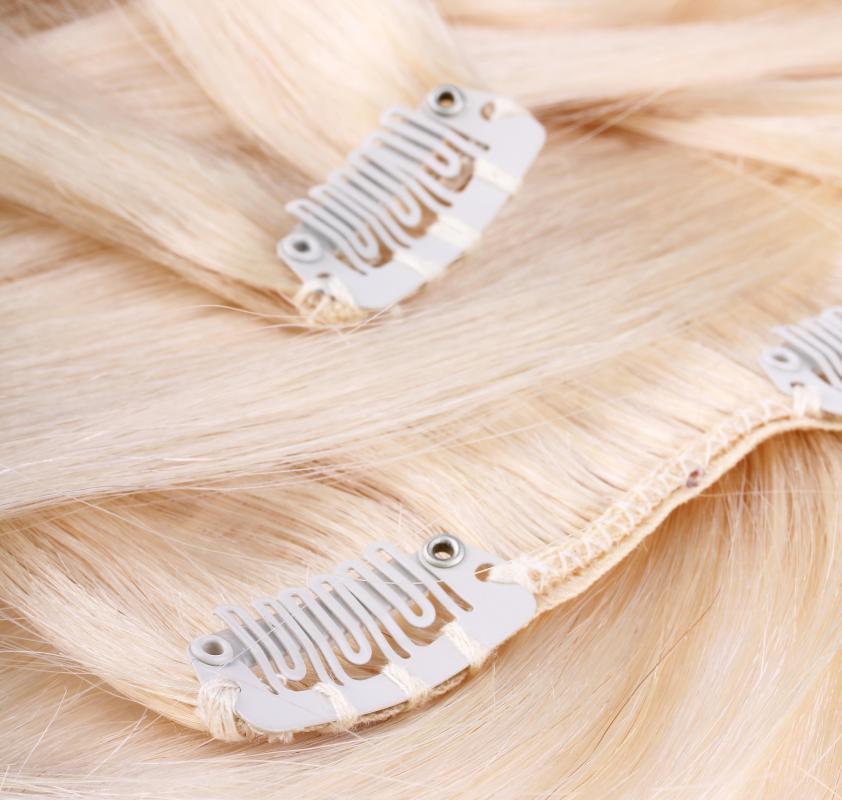
Smaller, temporary extensions usually don't require the services of a professional. The most basic type of extensions simply clip onto existing hair, a process that can usually be done at home without much effort, although a stylist may help attach them or dye the hair to better match the wearer's natural color. Hair attached this way usually only lasts for a day or a night, although they can be reused repeatedly.
Micro Links and Shrink Links

Longer-lasting extensions can be added to natural hair with metal rings or keratin tubing. In this process, the hair is attached to a small ring or tube, which is clamped onto pieces of real hair. This is a popular method, as damage to the natural hair is minimal, and no adhesives or solvents are used that could potentially irritate sensitive skin. They can, however, be difficult to remove, add additional weight to the hair, and can loosen after a few washings, releasing some of the strands. Experts don't usually recommend this method for fine hair.
Bonding
Bonding or gluing usually involves longer wefts of hair, tracks that can be up to 6 inches (15.24 cm) long. An adhesive is applied to the roots of the hair before the extension is applied. This method is usually relatively quick to do, but does not last as long as others.
Fusing
A special adhesive can also be used to fuse extensions into real hair. Small pieces of hair can be attached with this method. Hot fusion may involve braiding the extension into the natural hair and bonding them together with a wax adhesive. Less commonly, cold fusion methods may be used to attach the extensions.
Fusing usually takes several hours to apply, and will usually require a similar amount of time to remove, although it depends on the exact technique and adhesives used. There are products that allow fusion to be done at home but professionally fused extensions tend to last longer and cost more.
Weaving
Hair extensions can also be sewn into the hair. The person's natural hair is usually braided tight and close to the scalp in cornrows, and the weft sewn into the braid. The process can take a long time, as the person's own hair must be braided first, and some people find the entire procedure to be very painful. This method may also be quite expensive, although it usually lasts for a long time.
Choosing a Stylist
Making the decision to get hair extensions can represent a substantial financial and time commitment. The initial cost will be increased with professional products designed to keep the extensions, as well as the natural hair, healthy; extensions also typically require frequent trips to the salon for maintenance as existing hair grows out. An inexperienced stylist can make poor choices resulting in hair damage, so anyone considering hair extensions should choose one who has had the proper training and experience to maximize the investment required.
Hair extension professionals are typically licensed cosmetologists well trained in the many methods of applying hair extensions. When choosing a stylist, a person should ask about training, certification, and experience, as well as be specific about his or her needs and concerns. Some stylists keep a portfolio with photos of past customers, and will offer references upon request.
AS FEATURED ON:
AS FEATURED ON:


-
![Blonde hair extensions.]() By: pavel ChernobrivetsBlonde hair extensions.
By: pavel ChernobrivetsBlonde hair extensions. -
![A stylist putting in hair extensions.]() By: RTDSA stylist putting in hair extensions.
By: RTDSA stylist putting in hair extensions. -
![Hair extensions allow people to have long hair instantly.]() By: soup studioHair extensions allow people to have long hair instantly.
By: soup studioHair extensions allow people to have long hair instantly. -
![Bonding hair extensions usually involves longer wefts of hair that can be up to six inches long.]() By: courtyardpixBonding hair extensions usually involves longer wefts of hair that can be up to six inches long.
By: courtyardpixBonding hair extensions usually involves longer wefts of hair that can be up to six inches long. -
![Synthetic hair extensions can be economical, but they also tend to look less realistic than human hair.]() By: Laurent HamelsSynthetic hair extensions can be economical, but they also tend to look less realistic than human hair.
By: Laurent HamelsSynthetic hair extensions can be economical, but they also tend to look less realistic than human hair.



Discussion Comments
I personally love my Karmin Easy Clips.
What hurts the most: bond or the bead links?
Most keratin glue/wax bonds are best removed with acetone which you can buy from Sally's.
There are other different types of removers available for different bond materials but most hair extensions which are a you or i tip bond can be removed with acetone pretty easily. Just soak the bond in acetone, keep rubbing in and crack with pliers, and they will slide out.
To remove any residue in the hair, just soak and comb through with acetone.
Wash the hair after this, and condition, combing through and your hair should then be completely free of glue.
I have the wax extensions in at the moment and have had them in for almost four months. They have grown out so much, but I don't want to pay a hair dresser to get them out when I can do it myself for a quarter of the price.
My hair is almost like dreadlocks between my scalp and the wax because it has grown out so much. Should I buy pure acetone or nail polish remover with acetone in it? Please help!
I'm glad that I have full thick hair and don't need extensions.
Sometimes having lots of super thick hair is a pain in the butt, but I just can't ever imagine paying so much for some hair extensions.
Can I fuse my human hair extensions in using proclaim bonding glue?
Help please! Someone used superglue to bond my braids, only they did it in the middle of my hair shaft. How do I get super glue out of my hair without having to cut it all off?
I am a licensed cosmetologist and had wax bonded extensions. Well I went to take them out with the remover and I even went and bought new remover for bonds at sally's. Well neither one worked! So I used straight acetone and did one at a time soaked the glue and then used pliers to break up the wax.
I still lost a lot of hair to the mats that were between my scalp and the bond. I used everything I was supposed to and still had a bad experience. I don't recommend any hair extension that has a bond. Glue, wax, hard plastics -- they're all bad.
Instead, I would recommend the bead or clip in version. The lady who put mine in has done the wax extensions for 20 years. So to remove any kind of wax or glue bond, use acetone.
My mother had got her hair extensions from Martens Tomas and the products they sell are really good- they make a specially formulated bond and bond remover and also shampoo and conditioners that are great.
I want to get extensions at Beauty/Women. My hair could really use some volume.
I use effortless extensions! I love them and it is so easy. Everyone should have one as a hair staple.
i have my hair glued in all the time and trust me, the best way to get the glue out is to soak her hair in baby oil and comb it through gently. it comes out really easy because the oils breaks down the glue. hope this helps.
what is the easiest way to remove glued in weave?
That helped me a lot! Exactly what I was looking for. Thanks again!
I've been using hair extensions for about three years. I've found the best way to remove them is with any kind of conditioner. Leave it in five minutes then just loosen them with fingers. Leave the conditioner in and brush through hair with a fine toothed comb. hope this helps you, girls!
I used Liquid Gold Bond A Weave Quick and Easy Dissolver and now my hair has been super oily for a long time, and i can't make it go away.
A note about sweet orange oil in Comment #13: last summer I used sweet orange oil to take out six or eight extensions I had put in a couple inches above my neck. The process took much longer than acetone.
With the last couple of extensions, I got some on my scalp which caused some hair to fall out. That was six months ago, and the hair has grown back in and is now a couple inches long. My hair is very hardy. I have only lost hair one other time in my life when a hairstylist put in three chemical applications in a row because she messed up the coloring (and I only lost a little hair from that).
It has been six months since I used the sweet orange oil, and the hair that fell out has grown back and is a couple of inches long. I also have psoriasis in that area, so maybe my experience with sweet orange oil is the exception.
Then again, the hairstylist in Comment 13 never said to let the sweet orange oil get on your scalp.
Buying clip in hair extensions from internet is cheaper. Also you need to ask if extension is 100 percent human or not. 100 percent human hair extensions are amazing to see.
Besides Proclaim Super Bond Remover I also used Motions Weightless Conditioner. I used coated and covered my whole head with the condition because the super bond remover alone made my sticky and matted. I left the conditioner on for a lengthy period of time. Then I lathered my hair with motions weightless shampoo. I do not suggest blowdrying your hair due to the tendency that it may be too weak for heat.
Ack! Before you use all sorts of crazy chemicals to try getting out your bonded extensions try simply Sweet Orange Oil.
It is non-toxic & will break up keratin glue!
You get it at the health food store (Whole Foods, Wild Oats, Herbs Etc). Or you can order it online.
1. Dab some of the Sweet Orange Oil onto the glue. It causes the glue to break apart easily.
2. Use pliers to break up the glue. Very carefully! (sounds weird, best to have someone help you) The pliers will break up the glue into sand size pieces which can then be combed out.
3. Repeat dabbing the Sweet Orange Oil on the glue if necessary. Then do the pliers again.
Whatever you do - don't yank or pull the extension out in a rush. Try putting the Sweet Orange Oil on a whole row of extensions then use the pliers to break up the glue.
This is how we take out extensions at my salon. If you have to take extensions out on your own I want to at least help make it less damaging.
What I use to remove my extensions is liquid gold remover. It's pretty inexpensive. You just apply it to the bond and then heat it with a flat iron and it gets everything out. It works for most types of bonds, and if the hair is matted it gets the glue right out so you can comb out the matted areas. I don't lose any hair with this method. Hope this helps!
i was removing my extensions and i thought it would be smart to pour the whole bottle of sheen spray on my head >:]
yeah and it wasn't @ all.. the once stiff glue is now sticky and it won't dry so i can't pick it out, and no i can't pick it out sticky because it pulls over 50 strands of hair every time. i have 4 inch glue chunks in my hair. its like super duper bad!
I have hair extensions, and my cousin got me to baby sit her daughter without telling me that she has nits. so now i am in a predicament cause i can't go to the hairdresser to take them out and i can't treat my hair for nits either!!!! help
Try the Take Down removal cream for Braids, hair extensions and locks. It is the only answer to safe, easy and fast removal of add on hair or matted/tangled hair.
The best way that I found out is using OilSheen Hair Spray! Spray the hair spray on the glue && all you gotta do it rub it to loosen the glue up && it's gone. It works. This is the best way using the glue remover is not working for me and it's too messy!!
Go to a beauty supply store and buy the hair bond remover!!! it will dissolve the glue and you won't lose any hair.. when ever you buy hair glue you should always buy the same brand of remover!!!!!
Removing Extension Tangles:
I found the best way to get rid of hair extension tangles is to use lots of Biosilk while your hair is wet..
i had the same problem, mine was matted for ages! you need to soak the bonds in olive oil and it loosens them and they just slide out after that however the matted parts are almost impossible to get out without losing some hair!
EMERGENCY
OK, well i have a cousin that loves playing with her hair, she bought extensions from a store that are made from real hair. she had a friend put them on with no experience using glue. DONT KNOW WHAT TYPE OF GLUE ALL I KNOW ITS GLUE MEANT FOR EXTENSIONS. that all she stated to me. but now her hair is very very tangled and seems that in her tangled there is still glue in there. what suggestion can be giving to be able to remove those very bad tangles that seem to have glue in them as well? PLEASE HELP SHE HAS HAD HER HAIR LIKE THAT FOR MORE THAN A WEEK
I need to remove my hair extensions, i have wax bonded extensions in my hair what chemicals or product can i buy to remove the glue from my hair??
Post your comments