
At WiseGEEK, we're committed to delivering accurate, trustworthy information. Our expert-authored content is rigorously fact-checked and sourced from credible authorities. Discover how we uphold the highest standards in providing you with reliable knowledge.
What are Goose Bumps?
 Mary McMahon
Mary McMahon
Mary McMahon
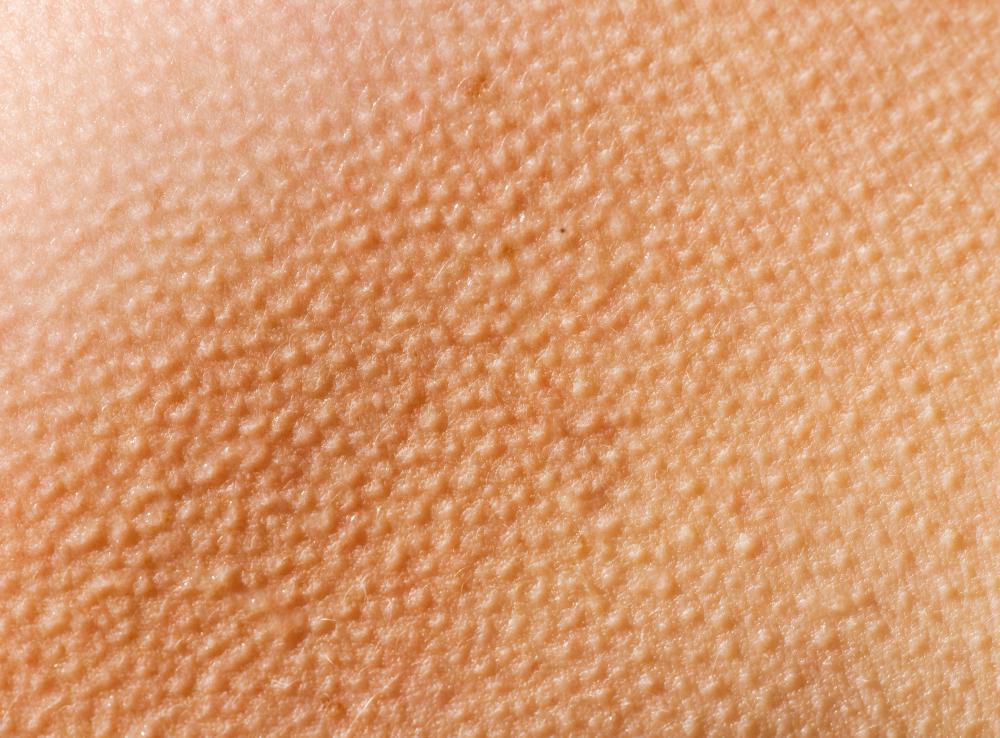
Goose bumps are small bumps in the skin that are caused by tightening muscles, which pull body hair into an erect position. In humans, these bumps are a vestigial reflex, left over from a time when humans had more hair; a wide variety of animals demonstrate this interesting reflex in response to certain stimuli. Many people have experienced goose bumps at some point in their lives, and some may have wondered why they appear.
There are two main reasons why goose bumps manifest: cold and fear. In animals that actually have fur, standing individual hairs on end in cold weather is a sensible course of action, since the erect hairs can trap air, adding a layer of insulation to protect the animal from the cold. In the case of fear, goose bumps in an animal with fur would cause the animal to look larger, potentially intimidating the animal that is threatening it, giving the animal a chance to run or fight.

The medical term for this reaction is cutis anserina, and the term “horripilation” is sometimes used to refer to the act of raising goose bumps. This reflex is part of the body's “fight or flight” system, meaning that it is entirely involuntary. It is triggered by a signal from the autonomic nervous system, which tells the muscles around the hair follicles to tighten, raising the hairs and creating a distinctive tight lump. They are common on the arms and legs, but goosebumps can technically appear anywhere, including on the face, scalp, and chest.

A number of colorful slang terms are used to refer to goose bumps, including gooseflesh, goose pimples, chill bumps, and chicken skin. The abundance of avian-related slang is a reference to the skin of plucked geese and chickens, which often has a similar raised pattern. Because birds don't actually have hair, technically geese don't get goose bumps.

As a general rule, goose bumps are not a cause for alarm, although the situation which is causing them could be a potential source of worry. However, sometimes they are associated with certain medical conditions, particularly those involving the brain, so someone who gets them a lot or for no apparent reason may want to seek medical attention. They are also common in people experiencing drug withdrawal.
Mary McMahon
Ever since she began contributing to the site several years ago, Mary has embraced the exciting challenge of being a WiseGEEK researcher and writer. Mary has a liberal arts degree from Goddard College and spends her free time reading, cooking, and exploring the great outdoors.
Learn more...
Mary McMahon
Ever since she began contributing to the site several years ago, Mary has embraced the exciting challenge of being a WiseGEEK researcher and writer. Mary has a liberal arts degree from Goddard College and spends her free time reading, cooking, and exploring the great outdoors.
Learn more...AS FEATURED ON:
AS FEATURED ON:









-
![Goose bumps are usually triggered by the nervous system when it's cold or during fear or some type of stimulation such as sexual arousal.]() By: Tyler OlsonGoose bumps are usually triggered by the nervous system when it's cold or during fear or some type of stimulation such as sexual arousal.
By: Tyler OlsonGoose bumps are usually triggered by the nervous system when it's cold or during fear or some type of stimulation such as sexual arousal. -
![Goose bumps may occur as a result of heat exhaustion.]() By: luluGoose bumps may occur as a result of heat exhaustion.
By: luluGoose bumps may occur as a result of heat exhaustion. -
![Someone who is cold or chilly may experience good bumps.]() By: Subbotina AnnaSomeone who is cold or chilly may experience good bumps.
By: Subbotina AnnaSomeone who is cold or chilly may experience good bumps. -
![Goose bumps can sometimes be associated with certain medical conditions.]() By: JackFGoose bumps can sometimes be associated with certain medical conditions.
By: JackFGoose bumps can sometimes be associated with certain medical conditions.


Discussion Comments
I also getting goosebumps on my left outside thigh. It started once in a while but get more often. It happens any place, any time. Normally I am relaxed when I get it. At the beginning it went away when I practice but now that I'm exercising regularly, it's back again. Is it something to be concerned about?
I am getting goosebumps on my left outside-thigh region once and a while, and it only seems to happen in specific places. For example, i never get them when i am at home. Could this just be fear related? because i also never get them when i am walking or concentrating really hard on something.
I am able to control goosebumps. I am not alone, there are several postings on facebook. Is this ability a bad symptom? I can do it at will by just thinking about it.
Thank you to who ever wrote this. It really helped me in my school science project.
I think goosebumps are related to the sensory function of hairs. When something like insect or puffs of air causes hairs to move or vibrate we feel it. Hairs extend our sense of touch beyond our skin and goosebumps, by causing our hairs to be more erect, extend that to the maximum distance. By causing them to separate there is less dampening from being laid against each other so sensitivity is enhanced. --Ken F.
Since geese don't have hair and thus can't experience horripilation, what it is called when they make their feathers stand out straight? -JKS
Post your comments