
At WiseGEEK, we're committed to delivering accurate, trustworthy information. Our expert-authored content is rigorously fact-checked and sourced from credible authorities. Discover how we uphold the highest standards in providing you with reliable knowledge.
What are Gel Pens?
 Michael Pollick
Michael Pollick
Michael Pollick
Gel pens are specialized writing instruments favored by many graphic artists and teachers for their bold colors and solid lines. They use the same basic mechanism as roller-type ballpoint pens, but the ink inside is noticeably thicker than standard ballpoint ink. The bright inks used in these pens are often augmented with aluminum sparkles for added visual punch.
The first gel pens were marketed by the Sakura Color Products Corporation of Osaka, Japan in 1984. Sakura also developed the first water-based gel inks, seeking a modern recreation of the free-flowing inks used in fountain pens. The pens soon became popular among graphic artists and architects, who could use the control of a ballpoint pen while getting the brilliant colors of a marker.

Gel pens with oversized bodies for smaller hands also became popular with children. Crayon companies such as Crayola began marketing pens with fluorescent colors and metallic sparkles. Art teachers encouraged children to use them to create posters on construction paper. The added sparkles and fluorescent chemicals allowed student to experiment with dark/light effects and black backgrounds.

These pens can have a few quirks, however. Leaving the protective caps off gel pens can cause the ink inside to dry quickly, unlike ballpoint pens. A small silicone ball inside the tip of the cap must be in place to form an airtight seal. The mechanism which draws ink through the pen and into the tip is prone to damage if not handled with care. Users may try to renovate a dry pen by tapping on the top or bottom- this is never a good idea. The roller ball assembly could get hopelessly jammed from the impact. Certain paper surfaces are better than others when it comes to using gel pens. It's best to experiment with different types of paper to see how the pen and ink will respond.

If gel pens should go dry, experts suggest rolling the tip in small circles until the ink flows again. Some find that rolling the pen on a thumb or opposite palm will renovate the pen, but results may vary and the ink should be washed off immediately to prevent staining. Gel pens do not work well on greasy surfaces, so users should wash and dry their hands thoroughly before using them.
Michael Pollick
A regular WiseGEEK contributor, Michael enjoys doing research in order to satisfy his wide-ranging curiosity about a variety of arcane topics. Before becoming a professional writer, Michael worked as an English tutor, poet, voice-over artist, and DJ.
Learn more...
Michael Pollick
A regular WiseGEEK contributor, Michael enjoys doing research in order to satisfy his wide-ranging curiosity about a variety of arcane topics. Before becoming a professional writer, Michael worked as an English tutor, poet, voice-over artist, and DJ.
Learn more...AS FEATURED ON:
AS FEATURED ON:









-
![Gel pens can be used to create posters on construction paper.]() By: eden04Gel pens can be used to create posters on construction paper.
By: eden04Gel pens can be used to create posters on construction paper. -
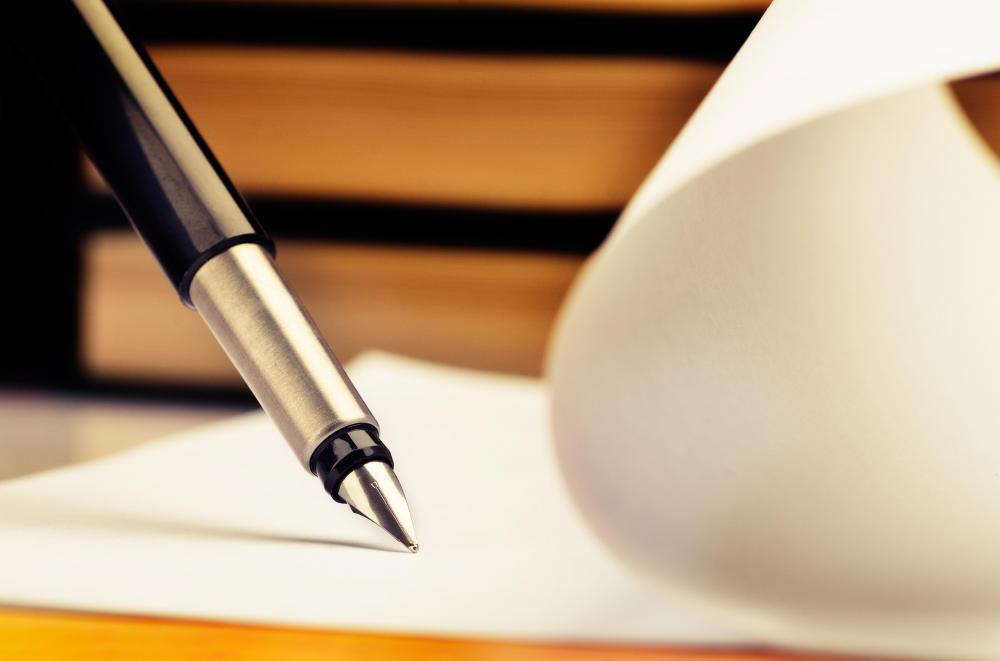
![The first water-based gel inks were inspired by the free-flowing inks of fountain pens.]() By: pogoniciThe first water-based gel inks were inspired by the free-flowing inks of fountain pens.
By: pogoniciThe first water-based gel inks were inspired by the free-flowing inks of fountain pens. -
![Hands should be washed and dried thoroughly before using gel pens.]() By: wollertzHands should be washed and dried thoroughly before using gel pens.
By: wollertzHands should be washed and dried thoroughly before using gel pens.


Discussion Comments
Are gel pens the same as fountain pens?
@anon46269: No, gel pens aren't the same as permanent markers. Permanent markers are usually classified as "porous-tipped" or "felt-tipped" pens, along with highlighters, whiteboard pens, magic markers, chalk pens, etc. They work through a different mechanism than gel pens. Gel pens work very much the same way that ballpoints do, only with a wetter ink.
I love gel pens but I can't find a way to scan or print the drawings I do using gel ink. Nobody can reproduce those amazing shiny colors. Help!
I have about 30 beautiful colored gel pens that all seemed to dry up on the same day. How can I get them going again? Should I warm them up, or open them up and poke them - what?
As an artist, how can I dry the gel pen on my canvas?
does it dry on its own after a while? All my pastel
colored and metallic pens dry. What about using a hair dryer -- will that dry the gel pens on canvas?
are gel pens the same as permanent markers?
What makes the gel move toward the point as though it were being pulled by gravity?
Are all gel pens acid free?
No. Sadly gel pens and liquid-based ink pens (AKA rollerball pens) use ink way faster and therefore run out more quickly. Oil-based ink pens (ballpoint pens) last longer, because they use less ink as they write.
do gel pens last longer than normal ballpoint ink pens?
Post your comments