
At AboutMechanics, we're committed to delivering accurate, trustworthy information. Our expert-authored content is rigorously fact-checked and sourced from credible authorities. Discover how we uphold the highest standards in providing you with reliable knowledge.
What are Galvanized Nails?
Galvanized nails are a special type of nail used in construction. They have undergone a special galvanization process, which involves covering them with a zinc coating in order to form a protective barrier. This barrier also works as a sacrificial anode, which means the coating will dissolve before the metal inside does, if the barrier itself becomes damaged.
Zinc oxide, which is a fine white dust, is used to coat nails because it does not breakdown the surface of the metal beneath and does not destroy the integrity of the nails. The protective barrier that the zinc provides has many advantages, including preventing oxidation from occurring. In this way, galvanized nails are highly resistant to rust and corrosion.

Many galvanized nails receive a thin layer of galvanizing through a process called electroplating, which is also referred to as electro-galvanization. With this process, the electrically conductive metal is galvanized with the help of an electrical current. This results in a smooth and even coat of zinc. Nails that have been galvanized through electroplating, however, are not capable of withstanding continual exposure to corrosive materials such as saltwater. Therefore, nails needed for this purpose should be created with the hot dipped process, which results in a much thicker layer of zinc.

Traditionally, the method used to test the effectiveness of a coating of galvanization is to determine its resistance to a salt spray. Galvanized nails with thin coatings are unable to withstand these types of surface abrasions for long periods of time, but they are generally all that is necessary for most residential purposes, though a few precautions should be kept in mind.
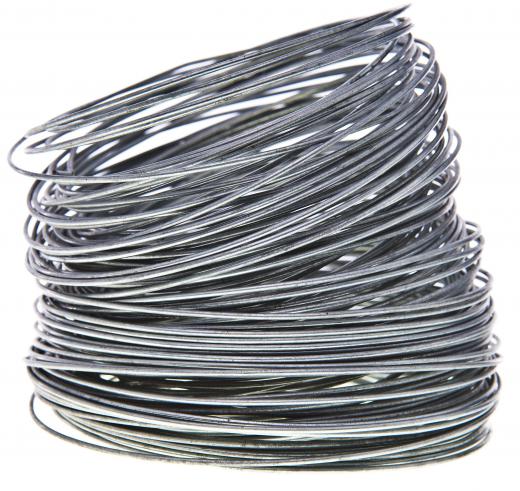
Galvanized nails are typically used by homeowners for outdoor projects, and those made with electroplating are often bright and shiny. They are not a good choice to be used with redwood, cedar, or treated lumber, because the acids and chemicals in these woods will eat away at the zinc coating. This will cause the nails to rust and leave black streaks around the nail in the wood. Instead, mechanically galvanized nails, which are dull gray, should be used.
AS FEATURED ON:
AS FEATURED ON:









-
![Galvanized nails are covered with a protective zinc coating.]() By: Denis DryashkinGalvanized nails are covered with a protective zinc coating.
By: Denis DryashkinGalvanized nails are covered with a protective zinc coating. -
![Galvanized nails won't rust easily, making them preferred for construction.]() By: creative soulGalvanized nails won't rust easily, making them preferred for construction.
By: creative soulGalvanized nails won't rust easily, making them preferred for construction. -
![Hot dip galvanizing is often used to coat steel cable, sheets and nails.]() By: Jon Le-BonHot dip galvanizing is often used to coat steel cable, sheets and nails.
By: Jon Le-BonHot dip galvanizing is often used to coat steel cable, sheets and nails. -
![Galvanization -- the applying of protective zinc coatings to steel or iron -- is often performed using special machines at production factories.]() By: Moreno SoppelsaGalvanization -- the applying of protective zinc coatings to steel or iron -- is often performed using special machines at production factories.
By: Moreno SoppelsaGalvanization -- the applying of protective zinc coatings to steel or iron -- is often performed using special machines at production factories.


Discussion Comments
Zinc electroplated nails are not galvinised nails.
does zinc prevent salt corrosion?
The A 153 spec applies to a broad range of hot dipped products. The Class D rating applies primarily to driven fasteners. Each hot dip product has its own class.
Oxygen321- I will use zinc and copper nails in my science project! Thanks for the help!
If you put galvanized nails into salt water the salt in the water will break down the zinc oxide and make the nail rust.
No rust!
does galvanised steel make a difference when you make a DIY battery?
hey dude are the nails an alloy thingy ma bob or what? peace out
Is it true that the zinc reacts with oxygen, water, and carbon dioxide to form zinc carbonate, which makes up the tough, impermeable coating on galvanized nails?
With the new chemicals in pressure treated wood and the higher corrosion factor, I see that the rating of G which used to be G-85 with CCA was raised to G-185. On the Hot-Dipped nails box, it is rated as ASTM A 153 Class D. Is the 153 the G rating and what does the class D mean?
Thanks
Mike
Post your comments