
At WiseGEEK, we're committed to delivering accurate, trustworthy information. Our expert-authored content is rigorously fact-checked and sourced from credible authorities. Discover how we uphold the highest standards in providing you with reliable knowledge.
What are Flat Feet?
 Tricia Christensen
Tricia Christensen
Tricia Christensen
Flat feet once were considered enough of a disability to bar people from entering the armed forces, but they now are considered a normal variant of human foot shape. Adults may develop a condition called pes planovalgus, or fallen arches or, in some cases, children simply don’t develop an arched foot. Common thinking held that corrective shoes in children might develop an arch, but studies among people who regularly go barefoot suggest shoes on young children are more likely to promote flat feet rather than to cure them.
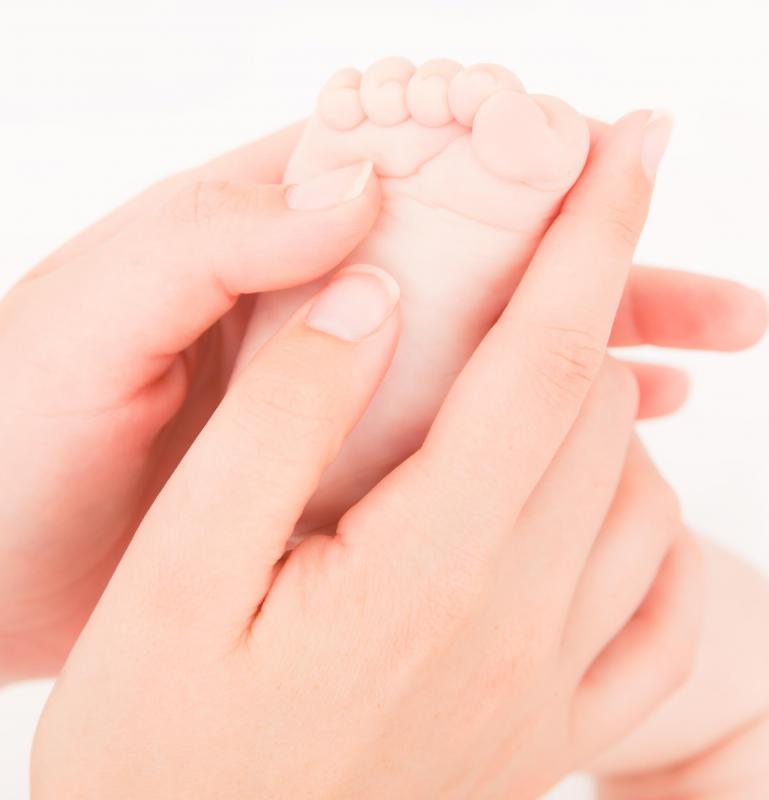
Most infants begin with flat feet, which should be no cause for concern among parents. Arches develop as children learn to walk and as less baby fat covers the feet. For many children who don’t develop an arch, this isn't a problem; however, in some cases, the flatness can be associated with other feet problems. In particular, children who have anklebones that lean inward may require corrective shoes. Feet that are inflexible and painful may be caused by a condition called tarsal coalition.

Tarsal coalition occurs when two bones in the foot fuse together. This results in a highly inflexible foot and pain during walking, and shoes with arches may make the condition even worse. Children who have flat feet and complain frequently of foot pain should be evaluated by a medical professional, and normally undergo surgical treatment in their pre-teen years to correct the fusing. Surgery needs to be cone while the foot is still growing in order to be effective.

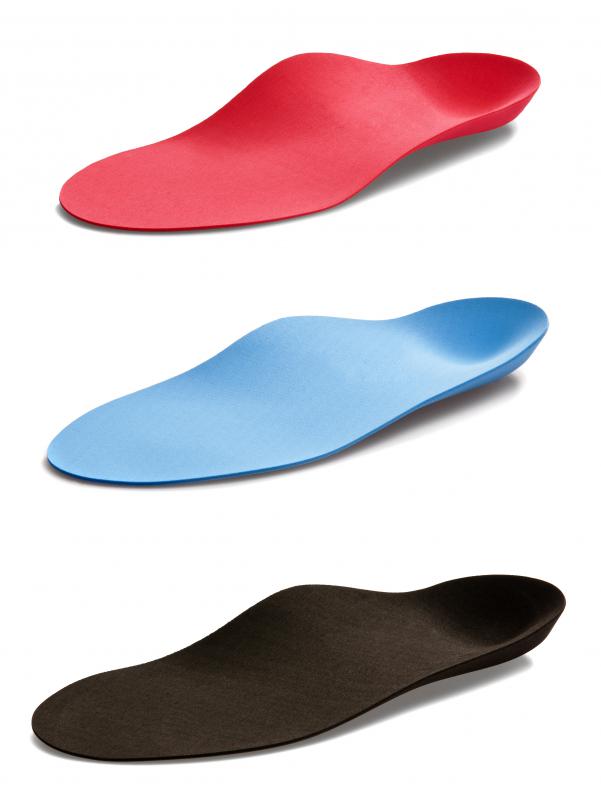
Feet that become flat in adulthood may be called fallen arches. This often happens to women who are pregnant and others who are carrying more weight. Adult-acquired foot changes tend to be permanent, but they may not be related to any specific complications. When this condition does cause painful walking, using specially designed orthotics in shoes and performing foot exercises often helps. Surgery can correct a flat foot, but it is seldom the treatment of choice.

While flat feet were once considered a sign of poor health, the opposite may in fact be true. Most top track stars have feet that are very flat. People with a higher arched foot are four times as likely to turn or sprain an ankle. Feet that are flat are no longer a reason to be excused from army service, and in many cases, create no problems for the person who has them.
Tricia Christensen
Tricia has a Literature degree from Sonoma State University and has been a frequent WiseGEEK contributor for many years. She is especially passionate about reading and writing, although her other interests include medicine, art, film, history, politics, ethics, and religion. Tricia lives in Northern California and is currently working on her first novel.
Learn more...
Tricia Christensen
Tricia has a Literature degree from Sonoma State University and has been a frequent WiseGEEK contributor for many years. She is especially passionate about reading and writing, although her other interests include medicine, art, film, history, politics, ethics, and religion. Tricia lives in Northern California and is currently working on her first novel.
Learn more...AS FEATURED ON:
AS FEATURED ON:









-
![Shoe insoles are one of the most common treatments for flat feet.]()
Shoe insoles are one of the most common treatments for flat feet. -
![Flat feet is a condition that is also known as fallen arches.]() By: soupstockFlat feet is a condition that is also known as fallen arches.
By: soupstockFlat feet is a condition that is also known as fallen arches. -
![Most infants are born with flat feet.]() By: detailblickMost infants are born with flat feet.
By: detailblickMost infants are born with flat feet.

Discussion Comments
I was told i had flat feet as a small child and was told to go barefoot as much as possible. I now, as an adult have 'normal' arches, so I'm a believer in going barefoot.
Does anyone know if having flat feet is an inherited condition? My dad and my brother both have flat feet and other foot problems. I'm getting ready to start a family and I'm wondering if this is something I should be concerned about?
@otatop-You've heard correctly, for the most part.
The military won't take someone with flat feet *if* they have to wear special shoes or devices in their shoes, or if their condition causes them pain.
Since he does wear orthotics, your son would not be accepted. If you contact your local recruiting office, they can tell you more.
I've heard that the military will not accept a recruit who has flat feet. Is this true? My son wants to enlist when he turns eighteen, but he has problems and has to wear orthotics for flat feet.
Post your comments