
At DelightedCooking, we're committed to delivering accurate, trustworthy information. Our expert-authored content is rigorously fact-checked and sourced from credible authorities. Discover how we uphold the highest standards in providing you with reliable knowledge.
What are Fingerling Potatoes?
 Mary McMahon
Mary McMahon
Mary McMahon
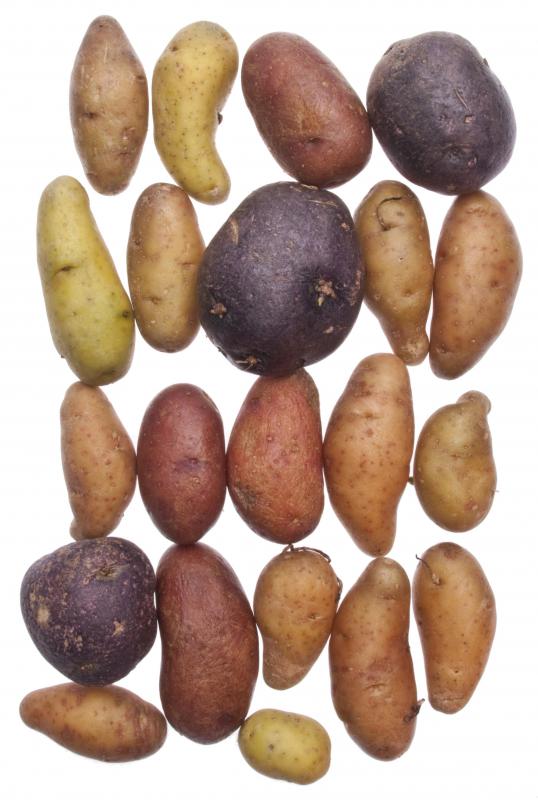
Fingerling potatoes are a family of heritage potatoes that naturally grow much smaller than conventional potatoes. They also tend to be elongated and slightly knobbly, making them very finger-like in shape. The unusual looking, flavorful potatoes can be used just like regular potatoes in an assortment of roasted, broiled, baked, grilled, or boiled dishes. Many grocers stock fingerlings in season, and they can also be grown at home, in temperate climates.
Like other potatoes, fingerling potatoes are tubers, and their roots can be found in South America, where Native Americans first domesticated them. Just as there are numerous conventional potato varieties, there are a wide range of fingerlings on the market. They run the gamut from creamy white to rich purple, and they come in waxy and starchy varieties, suitable for different dishes.

Some people confuse this family with new potatoes, which are young potatoes harvested before they fully mature. While both share a small size and thin skins, fingerling potatoes have a more complex flavor, and they are fully mature. Just as is the case with regular potatoes, fingerling farmers allow the green upper portion of the plant to die back before harvesting the tubers.

When selecting fingerlings in the store, shoppers should look for specimens without obvious soft spots or mold. Dirt is not an issue, as the potatoes can simply be washed when there is need for them. In a root cellar, they can keep for months, although they may undergo flavor and texture changes. They can also be kept in a cool dry place for a few months, depending on how widely the ambient temperature fluctuates.
Many cooks use fingerling potatoes in dishes that will showcase their small size. Potato salads may feature half-fingerlings, for example, while the potatoes roast and broil very well for side dishes. They are usually eaten whole, skin and all, since the skin is thin and very tender.
To grow this type of potatoes, gardeners should plant seed potatoes in rows in loose, loamy soil after the last risk of frost has passed. Lots of room should be left between the plantings, as many varieties like to spread out. Gardeners should make sure to keep the soil well moistened, and mulch after the plants have established themselves to help retain water in the soil, keep weeds down, and keep the tubers from getting too hot while they grow. Once the plants have died back, the tubers can be harvested, with gardeners brushing the dirt off but not washing them until they are going to be cooked.
Mary McMahon
Ever since she began contributing to the site several years ago, Mary has embraced the exciting challenge of being a DelightedCooking researcher and writer. Mary has a liberal arts degree from Goddard College and spends her free time reading, cooking, and exploring the great outdoors.
Learn more...
Mary McMahon
Ever since she began contributing to the site several years ago, Mary has embraced the exciting challenge of being a DelightedCooking researcher and writer. Mary has a liberal arts degree from Goddard College and spends her free time reading, cooking, and exploring the great outdoors.
Learn more...AS FEATURED ON:
AS FEATURED ON:


-
![Fingerling potatoes.]()
Fingerling potatoes. -
![Fingerling potatoes are well-suited for roasting.]() By: Marco MayerFingerling potatoes are well-suited for roasting.
By: Marco MayerFingerling potatoes are well-suited for roasting.

Discussion Comments
Does anyone know when the season for fingerling potatoes could be found in a grocery stores? I have yet to find them in Ohio. I have made lemon roasted potatoes several times from a recipe out of a bon appetit magazine. I would really like to try these potatoes. Please help. --jeff
Fingerlings are also fashion accessories. They can be found at the Dadeland Mall in Miami! And they were invented by a little kid! How awesome! I love Fingerlings!
Fingerlings are great when you sauté them with a little extra virgin olive oil, chicken stock, parsley, and fresh garlic. When fingerlings are small and fresh, they cook quickly, making them easy to sauté without boiling or roasting them first.
I usually wash the potatoes, cut them lengthwise, and then cut them diagonally at 3/4 inch intervals. I heat the olive oil in a pan and sweat the garlic. Next, I add the potatoes and about a half cup to cup of chicken stock. I cook the potatoes and garlic in the stock until the stock evaporates, then I sauté until slightly crispy, and toss with parsley just as I take the potatoes off heat.
The texture of Fingerling potatoes is more waxy and firm, similar to White Rose or Red Bliss potatoes, as opposed to Russet potatoes which are a little more floury.
Post your comments