
At WiseGEEK, we're committed to delivering accurate, trustworthy information. Our expert-authored content is rigorously fact-checked and sourced from credible authorities. Discover how we uphold the highest standards in providing you with reliable knowledge.
What are Fever Blisters?
 Nicole Madison
Nicole Madison
Nicole Madison
Fever blisters, commonly referred to as cold sores, are caused by the herpes virus and occur in or around the mouth. They often appear to be raised and filled with a yellowish liquid, and although generally small, they can be quite painful. Some individuals develop a mild fever with active blisters.
The herpes virus that most often causes fever blisters is herpes simplex type 1, which is quite common. Within the United States, most individuals are infected with this virus before they reach 20 years old.

When a person is initially infected, he or she may not immediately develop fever blisters, and some people never get them at all. The herpes virus takes up residence in nerve tissues located in the face, and when it reactivates, the blisters may appear. They often recur in the same place, but they generally don’t cause any serious health issues.

Another form of the herpes virus, herpes simplex type 2, is more commonly responsible for genital herpes. This virus also inflicts babies born to herpes-infected mothers at the time of birth. This type can also cause fever blisters, however, if it infects the face.
Herpes viruses are highly contagious, and any direct or indirect contact with a blister can cause an infection. As such, kissing and sharing items such as dishes, towels, and personal-care items with someone who has an outbreak may lead to infection. Sometimes, fever blisters can be caused by oral-to-genital contact with a person infected with herpes simplex 2. Likewise, genital herpes can be contracted through the same type of contact with a person suffering from active blisters.

The lapse of time from the initial virus infection to the eruption of blisters is usually about a week or two, although it may take up to three weeks for the first flare-up to become obvious. Usually, the blisters last for about a week to ten days. After the initial infection, the herpes virus may remain dormant within the nerve cells, only occasionally causing an outbreak.
After the initial eruption, new flare-ups tend to be mild. Many individuals develop symptoms before flare-ups, including burning sensations, localized sensitivity, itching, or tingling. These signs may occur up to two days before an outbreak.

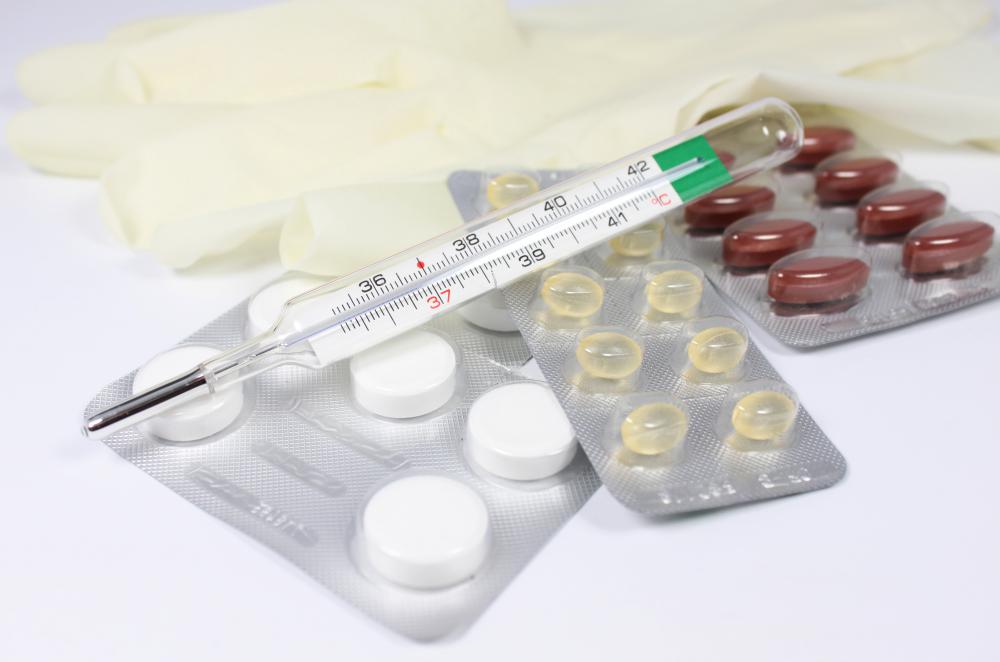
Fever blisters usually go away on their own without treatment, although there are antiviral medications that may help to reduce pain and shorten the duration of symptoms. Some individuals also find pain relief by applying cold or warm compresses to the area.
Nicole Madison
Nicole’s thirst for knowledge inspired her to become a WiseGEEK writer, and she focuses primarily on topics such as homeschooling, parenting, health, science, and business. When not writing or spending time with her four children, Nicole enjoys reading, camping, and going to the beach.
Learn more...
Nicole Madison
Nicole’s thirst for knowledge inspired her to become a WiseGEEK writer, and she focuses primarily on topics such as homeschooling, parenting, health, science, and business. When not writing or spending time with her four children, Nicole enjoys reading, camping, and going to the beach.
Learn more...AS FEATURED ON:
AS FEATURED ON:









-
![Antiviral medications may be required to treat fever blisters.]() By: liveostockimagesAntiviral medications may be required to treat fever blisters.
By: liveostockimagesAntiviral medications may be required to treat fever blisters. -
![Fever blisters may be spread through sharing towels.]() By: gosphotodesignFever blisters may be spread through sharing towels.
By: gosphotodesignFever blisters may be spread through sharing towels. -
![Some people get a mild fever with the blisters.]() By: MASTSome people get a mild fever with the blisters.
By: MASTSome people get a mild fever with the blisters. -
![Fever blisters can be spread through kissing.]() By: bercFever blisters can be spread through kissing.
By: bercFever blisters can be spread through kissing. -
![The herpes virus that most often causes fever blisters is herpes simplex type 1.]() By: LoloStockThe herpes virus that most often causes fever blisters is herpes simplex type 1.
By: LoloStockThe herpes virus that most often causes fever blisters is herpes simplex type 1.




Discussion Comments
It burns at first, but salt is a great remedy to heal fever blisters. It helps blisters heal faster and prevents them from ulcerating.
You may have been infected with herpes at any time. It can lie dormant for a very long time. When the immune system has weakened, the virus becomes active and results in fever blisters.
Just take good care of yourself, take your vitamins and keep your lips moisturized, particularly in winter. I don't know any remedies, but maybe someone can give you ideas for treating fever blisters.
I had my first ever fever blister on my lip this winter. It was a huge shock and I am still not over it. I have no idea how I got it. I don't know anyone who has herpes. I just hope I don't get these blisters often because it's so painful and embarrassing.
living with herpes does not mean you're alone. 1 in 4 people do have herpes.
Post your comments