
At WiseGEEK, we're committed to delivering accurate, trustworthy information. Our expert-authored content is rigorously fact-checked and sourced from credible authorities. Discover how we uphold the highest standards in providing you with reliable knowledge.
What are Different Types of Nonstick Cookware?
Nonstick cookware, first made available in the 1960s, has become ubiquitous due to its easy cooking and cleaning properties. It requires less oil or grease to keep food from sticking, it disperses heat evenly, and cleanup is a breeze with soap and water. Over the years, improved techniques for adhering nonstick coatings to pans have led to different grades of nonstick cookware.
The least expensive type of nonstick cookware features a single, thin layer of nonstick coating. This type of cookware tends to scratch easily, and in some cases might even begin to peel off after repeated use, particularly if abused. This is most often generic nonstick cookware intended for mass-market use. A better grade of this type of cookware has a dual layer coating: the nonstick layer is followed by a sealer that helps adhere the first layer and protect it. Dual layer nonstick cookware is more resistant to scratching and peeling, and with proper care should last longer than single layer cookware.

As price increases, so should the layers of coating. Triple-layer nonstick coating is incrementally more durable than dual-layer, and so forth up to four or more layers. A high quality finish is easy to tell from a single layer coating. The better finish feels smooth to the touch, unlike a single layer in which one can feel tiny ridges. If the finish is shiny, it has likely been coated with silicone. This is fine for bakeware, but is not recommended for cookware.

Nonstick coating is made with chemicals that have been deemed carcinogens or likely carcinogens by the Environmental Protection Agency (EPA). Though a nonstick surface is inert, as it heats up, it can begin releasing harmful gases that can be fatal to pet birds and cause flu-like symptoms in humans. It is recommended to cook with low-to-medium heat with nonstick cookware. Do not leave empty nonstick cookware on a burner, as it will get hot quickly and may begin to release harmful fumes.

An alternate type of nonstick cookware that does not use potentially harmful coatings features a baked enamel or porcelain finish. Baked enamel cookware is inert at any temperature, does not scratch or peel, and cooks food evenly and deliciously. Baked enamel can be applied to cast iron and other metals and is heavier than most types of cookware.
AS FEATURED ON:
AS FEATURED ON:









-
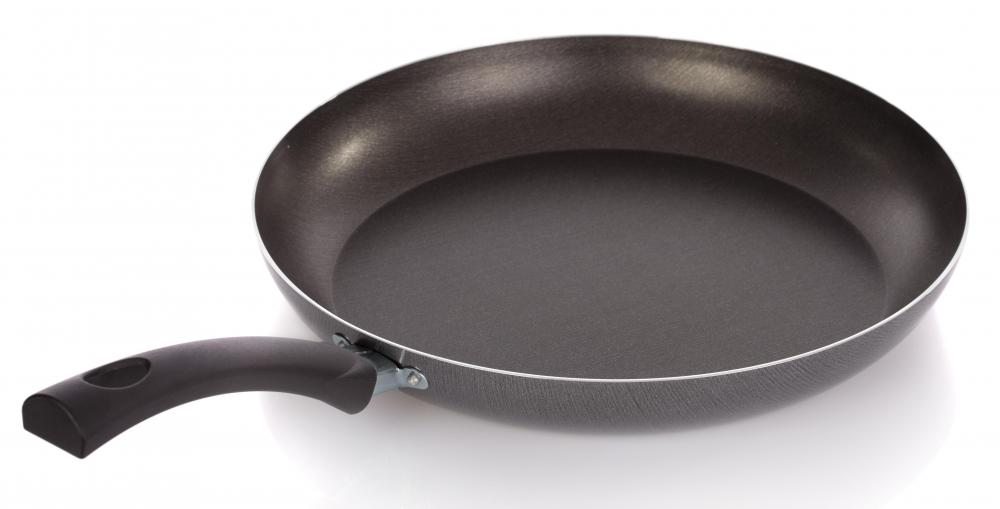
![A nonstick cookware frying pan.]() By: LusoimagesA nonstick cookware frying pan.
By: LusoimagesA nonstick cookware frying pan. -
![A pan with a single layer of nonstick coating will scratch easily.]() By: VolkOFF-ZS-BPA pan with a single layer of nonstick coating will scratch easily.
By: VolkOFF-ZS-BPA pan with a single layer of nonstick coating will scratch easily. -
![Nonstick coating can release harmful gases when it heats up and can cause flu-like symptoms in humans.]() By: robyelo357Nonstick coating can release harmful gases when it heats up and can cause flu-like symptoms in humans.
By: robyelo357Nonstick coating can release harmful gases when it heats up and can cause flu-like symptoms in humans.


Discussion Comments
@KaBoom - I've never heard of this either, but I find it kind of disturbing. I think I might just go back to using stainless steel instead of using nonstick cookware. If it's harmful on high heat, shouldn't it also be kind of harmful on low heat? I don't want to risk it.
I had no idea that nonstick cookware could be harmful to humans and animals. I've been using my Cuisinart nonstick cookware on high heat for years, and I've never experiences any problems. I also don't remember seeing anything on the box about not using the pots and pans on high heat (although I did buy the set quite awhile ago.)
I think from now on I'm going to cook everything over medium heat. It just doesn't seem worth it to risk my health to cook my food a little bit faster.
@dautsun - Buying a few pieces of high quality Farberware nonstick cookware sounds like a really good alternative to shelling out a lot of money for a whole set. I know I have a few thing I use in the kitchen more than anything else, so I'm probably going to replace those items with nonstick cookware that has multiple layers.
@cloudel - I've had the same experience with stainless steel cookware. I have a whole set that my mom gave me, but I don't cook with the skillet anymore. I still use the pots though, because you don't have to worry about stuff sticking if you're just warming up a pot of soup or making some pasta.
I replaced the skillet with a high quality non-stick skillet. It was expensive, but I thought it was worth it to have a non-stick skillet so I can make eggs and brown meat without having to worry about it sticking to the skillet.
@seag47 – That cheap stainless steel variety does not work well at all, at least in my experience. I had a set like this when I got my first home, and I had to keep adding more and more oil to the pan as I cooked, because the food kept sticking.
The outer crust of meat would stick to the pan and peel off. Smaller vegetables would become fused to it and burn.
I bought an expensive nonstick aluminum cookware set years later, and I was very happy with it. I didn't have to fight the pan to get my food out, and it was much easier to clean.
I know it may not be the best nonstick cookware, but how well does a cheaper stainless steel set work? I've seen some that claim to be nonstick, but the set is under $20. Can I trust this?
@Perdido – Nonstick cookware sets don't include baking dishes. They only include items you use on the eyes of the stove.
My first nonstick cookware set included a small saucepan, a medium-sized saucepan, a big pot for cooking soup, and a saute pan. The set also included a steamer basket and a couple of spatulas.
What all is included in a nonstick cookware set? Are baking pans and baking sheets a part of the set, or is it limited to stuff you use on top of the stove?
@anon41384: That's not true. The area of overheated teflon on equally-sized cookware is the same, no matter the number of layers, so the toxic gases are produced at the same rate. Gases aren't emanating from all volumes of teflon layers, just from the surface.
On the contrary, the more-layered cookware also tend to be of higher quality, so more layers are better (although still killing you slowly).
Dear B. Watson, You should be grateful that your electric skillet only has one layer of Teflon, since the product is harmful to your health, as US authorities (the EPA) are purportedly examining the risks of Teflon amid consumer concerns. So stick to something besides Teflon, and if Teflon, then less is better! --
George
Very good article. Learned a lot. I can't find electric skillet with more than one layer of teflon. You recommend multi layers. Can you supply a brand that has more than one layer?
Post your comments