
At WiseGEEK, we're committed to delivering accurate, trustworthy information. Our expert-authored content is rigorously fact-checked and sourced from credible authorities. Discover how we uphold the highest standards in providing you with reliable knowledge.
What are Crayons?
 Mary Elizabeth
Mary Elizabeth
Mary Elizabeth
The word crayons is a generic term that refers to a drawing medium in stick form, including chalk, charcoal, conté crayon, grease crayon, litho crayon, wax crayon, and pastel.
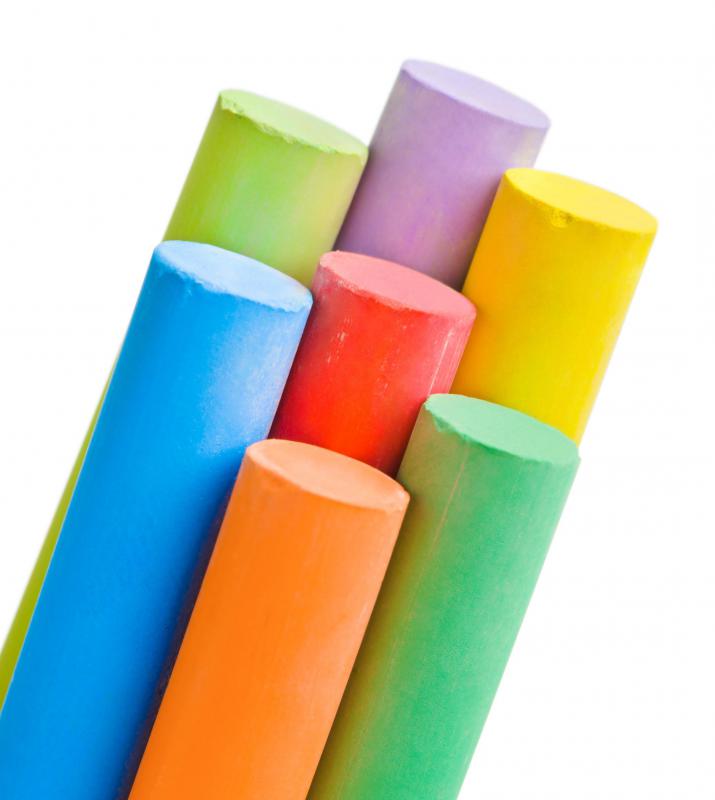
Chalk Crayons. Round and square chalk crayons are both available in pastel and vibrant hues. They can be blended by rubbing with the fingers. There are two types of this kind of chalk: chalk specially formulated for use on chalkboards, and drawing chalk for paper and sidewalk chalk drawings.
Charcoal. Charcoal had been used for drawing in simple stick form before the charcoal crayon, made of compressed charcoal with little or no binder, was developed in the 19th century. Charcoal sticks are often used by caricaturists.

Conté Crayons. These drawing sticks are named after their inventor, Nicolas-Jacques Conté, who developed them in 1795 in response to the shortage of graphite that resulted from the Napoleonic Wars. Conté made the graphite go farther by combining it in powdered form with clay and kiln-firing the results. Today, Conté crayon refers to a hard pastel in square stick form. They are often found in colors like black, gray, white, dark brown or bistre, and red brown or sanguine. Artists who worked in this medium include Georges Seurat.
Grease Crayons. Grease crayons can be makeup sticks that dispense like lipstick and are used to apply theater makeup or clown faces. They are also used in lithography: see Litho Crayons below.

Litho Crayons. This drawing medium is designed for lithographic use for delicate drafting, but is also used in other areas, such as rubbings. To make a rubbing, a depiction is made on a slab with grease crayons or other special media. When the slab is inked, the ink stays on the greasy marks and is picked up by paper pressed against the slab. Litho crayons come in seven levels of hardness and in 0.25-inch (0.64 cm) and 0.5-inch (1.3 cm) thicknesses.

Pastel Crayons. Pastels can be traced back to Leonardo da Vinci. They can be soft, hard, or oil-based, the first two of which are chalky, and the last of which is “buttery” in texture. They are available in a wide variety of colors and in round and square shapes.
Wax Crayons. Wax crayons, sticks of pigmented wax often with a paper wrapper, are a popular art medium for children. Crayola® brand, the most popular, were first created by Edwin Binney and C. Harold Smith in 1903. They also gained fame from the book Harold and the Purple Crayon by Crockett Johnson.
Mary Elizabeth
Mary Elizabeth is passionate about reading, writing, and research, and has a penchant for correcting misinformation on the Internet. In addition to contributing articles to WiseGEEK about art, literature, and music, Mary Elizabeth is a teacher, composer, and author. She has a B.A. from the University of Chicago’s writing program and an M.A. from the University of Vermont, and she has written books, study guides, and teacher materials on language and literature, as well as music composition content for Sibelius Software.
Learn more...
Mary Elizabeth
Mary Elizabeth is passionate about reading, writing, and research, and has a penchant for correcting misinformation on the Internet. In addition to contributing articles to WiseGEEK about art, literature, and music, Mary Elizabeth is a teacher, composer, and author. She has a B.A. from the University of Chicago’s writing program and an M.A. from the University of Vermont, and she has written books, study guides, and teacher materials on language and literature, as well as music composition content for Sibelius Software.
Learn more...AS FEATURED ON:
AS FEATURED ON:









-
![Chalk crayons are available in a variety of colors.]() By: Nikolai SorokinChalk crayons are available in a variety of colors.
By: Nikolai SorokinChalk crayons are available in a variety of colors. -
![Grease crayons are used to apply clown faces.]() By: apopsGrease crayons are used to apply clown faces.
By: apopsGrease crayons are used to apply clown faces. -
![Pastel crayons can be traced back to Leonardo da Vinci.]() By: JuulijsPastel crayons can be traced back to Leonardo da Vinci.
By: JuulijsPastel crayons can be traced back to Leonardo da Vinci.


Discussion Comments
This is very helpful for my invention project on crayons. Thank you for making this. I know it was not made especially for me, but it seemed like it was.
Did lithographic crayons have any inspiration in the making of modern crayons?
Post your comments