
At TheHealthBoard, we're committed to delivering accurate, trustworthy information. Our expert-authored content is rigorously fact-checked and sourced from credible authorities. Discover how we uphold the highest standards in providing you with reliable knowledge.
What are Bunions?
A bunion is a painful bump on the side of the foot at the base of the big toe. This is where the joint of the big toe, called the metatarsophalangeal joint, meets the foot. Over time, poor conditions can cause this joint to build into a sore, bony protrusion. Calluses or corns can form on it, adding to the discomfort, and the surrounding tissue may be red and swollen.
When this protrusion develops, it can cause the big toe to grow inward towards the second toe and — in extreme cases — can even force it beneath the second toe. This can push the remaining toes out of place and cause further discomfort. In extreme cases, bunions can cause disfigurement, correctable only by surgery. Though this is outpatient surgery in most cases, recovery can be lengthy.

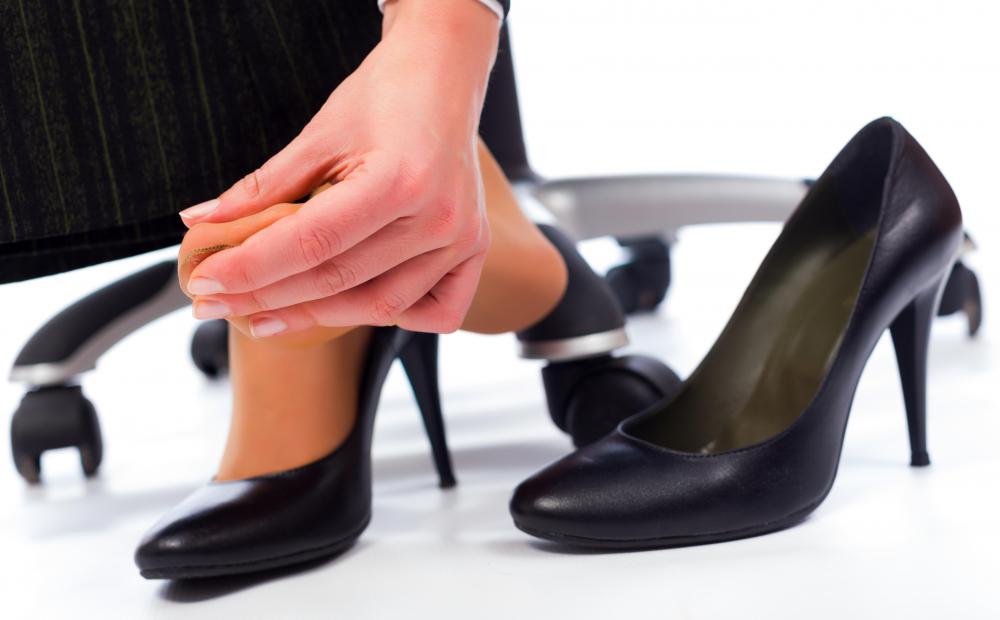
The most common cause of bunions is applying unnatural pressures to the foot over a period of years by wearing shoes that are too tight. As a result, women who wear pointed dress shoes like high-heels are more prone to this condition. A hereditary factor is also present in the sense that the natural shape of the foot can be an added stressor. Other people likely to develop bunions are those who spend a lot of time on their feet, including athletes, mail delivery people, dancers, and so on.

Advanced bunions can lead to bursitis, an inflammation of the watery sac or bursa that protects the joint. Arthritis can also develop as the big toe becomes inflexible. These conditions make simple walking very painful, as the big toe’s joint must bend with every step taken.
In most cases, this condition is treated conservatively and allowed heal on its own by switching to roomier shoes with a wide box toe and flat soles. Some people might need to pad the area or wear shoe inserts so that they can walk more comfortably. Surgery is generally only recommended in cases in which the growth has been allowed to progress into a more serious condition. A surgeon is then required to realign the toe’s bones, tendons and ligaments to repair the damage.

Teenagers with a hereditary predisposition or foot injuries can get bunions even at this early age. Generally, changing to better-fitting shoes that are more comfortable can heal them, and they will continue to worsen if the conditions that created them do not change. According to the American Academy of Orthopedic Surgeons, the best way to prevent this condition is to avoid narrow, pointed shoes, shoes that are too tight, and heels that exceed 2.25 inches (5.7 cm) in height.

Though this article provides general information, it is not medical advice and should not be substituted for such. If you are experiencing a painful orthopedic condition, see a qualified medical professional for a professional diagnosis and treatment.
AS FEATURED ON:
AS FEATURED ON:


-
![Tight shoes are the most common cause of bunions.]() By: Photographee.euTight shoes are the most common cause of bunions.
By: Photographee.euTight shoes are the most common cause of bunions. -
![Women who wear high heels may be more prone to bunions.]() By: Sandor KacsoWomen who wear high heels may be more prone to bunions.
By: Sandor KacsoWomen who wear high heels may be more prone to bunions. -
![The medical name for the big toe is the metatarsophalangeal joint.]() By: MASTThe medical name for the big toe is the metatarsophalangeal joint.
By: MASTThe medical name for the big toe is the metatarsophalangeal joint. -
![Repeatedly wearing shoes that are too tight for several years can cause bunions.]() By: winstonRepeatedly wearing shoes that are too tight for several years can cause bunions.
By: winstonRepeatedly wearing shoes that are too tight for several years can cause bunions. -
![Bunions can cause pain when walking.]() By: chuugoBunions can cause pain when walking.
By: chuugoBunions can cause pain when walking.



Discussion Comments
I found this page because I googled specifically asking why bunions are usually only on one foot.
I don't believe bunions are caused by tight shoes, although that can contribute if there is a predisposition, which I think is most likely congenital (a virus or whatever can be passed from mother to fetus). I believe it has to do with the joint, and most joints are affected by pathogens in the body. If there is a bone deformity because of the joint problem, that joint leans outward and will obviously rub against any shoe.
I knew a 16 year old male lifeguard who had a bunion, so don't blame it on the shoes.
Why is it usually one foot more than the other? The left and right sides of our bodies are a little different anyway, so that small difference in bone structure is why. I have bunions, and have been curious about this for a long time. The body can heal itself in many ways, and I know someone who used foot braces and fixed her bunions.
Like everything else, there's lots of money to be made in treating these things.
@burcidi-- You know, she can get bunion foot surgery. It's a really easy surgery. They trim down the bone so that it doesn't stick out. It does take some months for it to completely heal and she won't be very mobile during that time. But once it's healed, life will be a lot easier.
My wife had bunion surgery last year. I think she used clutches for about three months and then slowly started walking on her own. But she was so happy about the surgery once she was back on her feet. She can actually walk without pain now.
@MikeMason-- I don't have any foot bunions but my mom does and hers is also on one foot, on her left foot. I have no idea why that is.
She says that she got it from wearing tight shoes when she worked as a nurse. She was a nurse for close to twenty years and of course had to stand a lot for her job. I guess that's when the bunion formed.
On some days, she has a lot of pain from it. She can't wear tight shoes at all anymore, she has to buy loose, wide and comfortable shoes. When she buys sandals, she has to make sure that the shoe doesn't enclose the bunion because that's painful.
Because I know how much trouble my mom has because of her bunion, I'm trying very hard not to get one. I don't wear high heels much and I never wear tight shoes.
Okay, so toe bunions are not genetic deformations, but genetic factors can influence them. I'm glad I have this clarified because I've heard contradictory things from different people about this. Some have told me it's because of shoes and others that it's genetic.
Also, considering that we wear the same shoes on both feet, why do bunions only form on one foot sometimes?
I have a bunion on my right foot but not the left. Shopping for shoes is really annoying because shoes usually feel great on my left foot but hurt the right one because of the bunion.
Does anyone else have a bunion on just one foot?
Post your comments