
At TheHealthBoard, we're committed to delivering accurate, trustworthy information. Our expert-authored content is rigorously fact-checked and sourced from credible authorities. Discover how we uphold the highest standards in providing you with reliable knowledge.
What are Active Ingredients?
 Mary McMahon
Mary McMahon
Mary McMahon
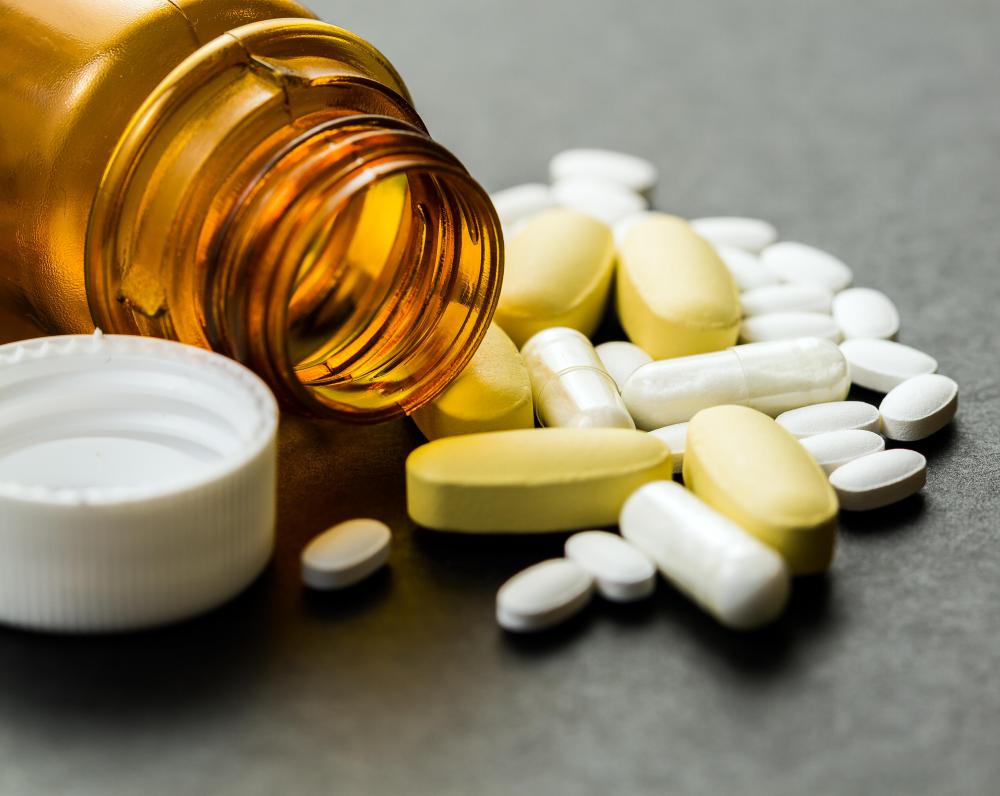
Active ingredients are components in a drug that provide some pharmaceutical value, in contrast with the inactive ingredients, which act as carriers to make the drug easier for the body to process. The term is also used in the pesticide industry to describe the active pesticides in a formulation. In both cases, these ingredients are literally “active,” performing a specific function upon application or ingestion.
Many drugs combine several active ingredients, and the interaction between them may be critical to the function of the medication. In synthetically compounded pharmaceuticals, manufacturers can tightly control the potency of their ingredients, because they are formulated under controlled conditions. Herbalists and companies that use naturally sourced products must be careful with their formulations, because the potency of the active ingredients can vary widely, depending on factors that are out of the control of the manufacturer.

Brand name drugs rely on carefully patented and controlled active ingredients. Once patents expire and competitors can make generic versions, the generics typically use the same ingredients, often in a formulation identical to that of the original drug. Sometimes, however, manufacturers make small changes that can have a profound impact on the effectiveness of the drug. For example, using a different inactive ingredient might inadvertently change the potency of the drug, or using a different source for the ingredients could result in a drug with slightly different effects.

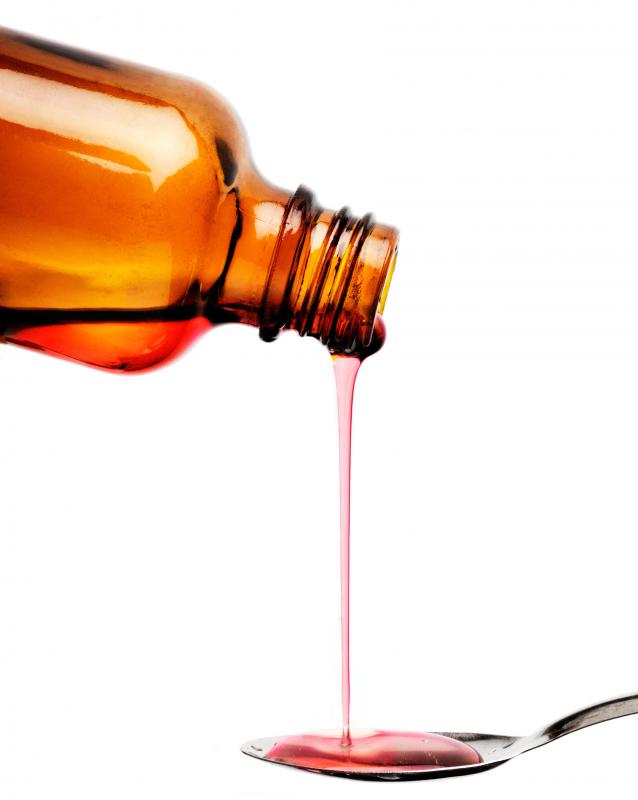
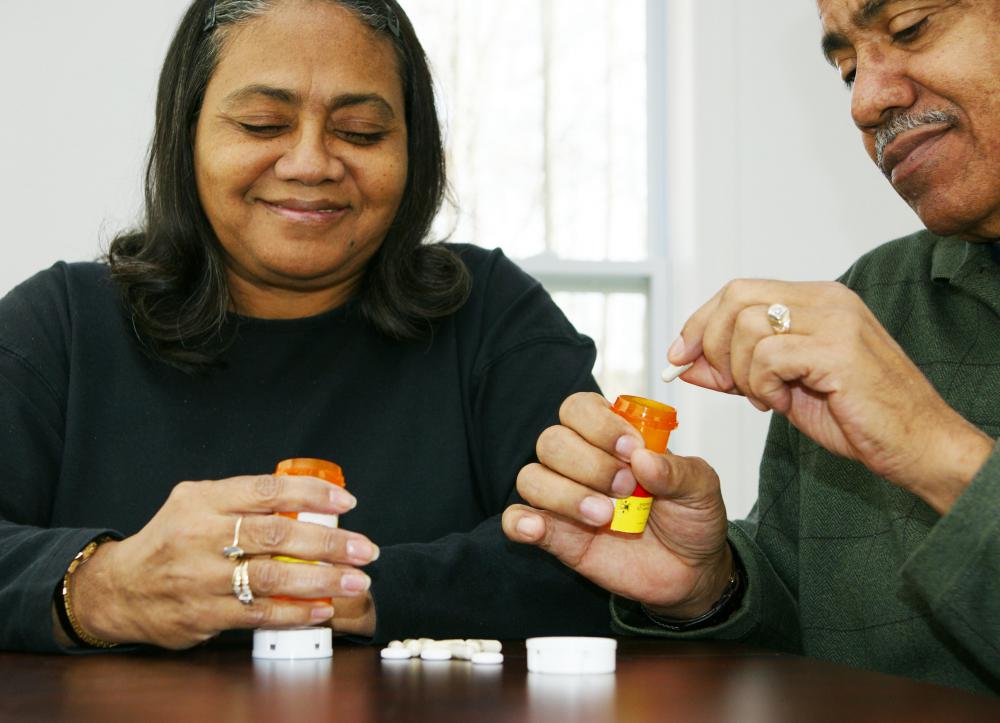
In the case of over-the-counter pharmaceuticals, the active ingredients are always listed on the back. It can be a good idea to compare them when considering which medication to buy, as generic brands are often identical and much less expensive than brand names. Cough syrup, for example, might be priced radically differently depending on the manufacturer, but the ingredients that help a patient stop coughing will be the same. Comparing pharmaceuticals before purchase can save money for savvy shoppers.

Inactive ingredients, also known as excipients, can perform a number of functions. For example, some active components cannot be absorbed very well by the body, so they must be combined with a soluble excipient so that the body can process them. In other cases, active ingredients are very strong, and combining them with an excipient allows greater control over the dosage; without an excipient, a powerful pill might be the size of a pinhead, but with one, it can be formulated into a larger and more manageable size.
Mary McMahon
Ever since she began contributing to the site several years ago, Mary has embraced the exciting challenge of being a TheHealthBoard researcher and writer. Mary has a liberal arts degree from Goddard College and spends her free time reading, cooking, and exploring the great outdoors.
Learn more...
Mary McMahon
Ever since she began contributing to the site several years ago, Mary has embraced the exciting challenge of being a TheHealthBoard researcher and writer. Mary has a liberal arts degree from Goddard College and spends her free time reading, cooking, and exploring the great outdoors.
Learn more...AS FEATURED ON:
AS FEATURED ON:


-
![Active ingredients provide the pharmaceutical value in drugs.]() By: Gennadiy PoznyakovActive ingredients provide the pharmaceutical value in drugs.
By: Gennadiy PoznyakovActive ingredients provide the pharmaceutical value in drugs. -
![Comparing the active ingredients of two products can often reveal an identical recipe, making generic products just as effective their pricey brand name counterparts.]() By: pogoniciComparing the active ingredients of two products can often reveal an identical recipe, making generic products just as effective their pricey brand name counterparts.
By: pogoniciComparing the active ingredients of two products can often reveal an identical recipe, making generic products just as effective their pricey brand name counterparts. -
![Many drugs combine several active ingredients, and the interaction between them can impact the function of the medication.]() By: Rob ByronMany drugs combine several active ingredients, and the interaction between them can impact the function of the medication.
By: Rob ByronMany drugs combine several active ingredients, and the interaction between them can impact the function of the medication. -
![Inactive ingredients in drugs can perform a number of functions, including the aiding of absorption and processing by the body.]() By: Lambros KazanInactive ingredients in drugs can perform a number of functions, including the aiding of absorption and processing by the body.
By: Lambros KazanInactive ingredients in drugs can perform a number of functions, including the aiding of absorption and processing by the body. -
![Doctors typically prescribe medications based on the active ingredients that they contain.]() By: KurhanDoctors typically prescribe medications based on the active ingredients that they contain.
By: KurhanDoctors typically prescribe medications based on the active ingredients that they contain. -
![Drug carriers -- the inactive ingredients of medicines -- often include coatings and fillings.]() By: nikesidoroffDrug carriers -- the inactive ingredients of medicines -- often include coatings and fillings.
By: nikesidoroffDrug carriers -- the inactive ingredients of medicines -- often include coatings and fillings. -
![Brand name drugs rely on carefully patented and controlled active ingredients.]() By: BurlinghamBrand name drugs rely on carefully patented and controlled active ingredients.
By: BurlinghamBrand name drugs rely on carefully patented and controlled active ingredients. -
![When considering which medication to purchase, it may be helpful to compare the active ingredients in each drug.]() By: RobWhen considering which medication to purchase, it may be helpful to compare the active ingredients in each drug.
By: RobWhen considering which medication to purchase, it may be helpful to compare the active ingredients in each drug. -
![The active ingredients are always listed on the back of over-the-counter pharmaceuticals.]() By: DeklofenakThe active ingredients are always listed on the back of over-the-counter pharmaceuticals.
By: DeklofenakThe active ingredients are always listed on the back of over-the-counter pharmaceuticals. -
![A pharmacist can help a patient understand the active ingredients inside a specific medication.]() By: Monkey BusinessA pharmacist can help a patient understand the active ingredients inside a specific medication.
By: Monkey BusinessA pharmacist can help a patient understand the active ingredients inside a specific medication.






Discussion Comments
Generic drugs are required to have some type of clinical trial to prove bioequivalence.
It doesn't matter where the generic drug is produced, it still has to meet FDA standards - Yes, they do have a say, and they do perform inspections overseas. If the foreign company is found to produce a "bad" drug, the FDA will block their products from entering the US and work with local authorities to shut it down if necessary.
I agree on this issue of excipients (inactive ingredients). These ingredients are very often playing a vital role in the effective delivery, absorption, and metabolism of the active drug; their "inactivity" doesn't make them freely interchangeable constituents.
So how is complete bioequivalence of a generic drug to a brand drug established when any of the inactive ingredients of the brand formulation are changed (given that no further human trials are required)? Even if the interchanged inactive ingredients "should" have equivalent results from a knowledge-of-chemistry perspective, they don't always show equivalence in real life outcomes.
So my question is what can a consumer do to confidently take advantage of generics without having to go through a personal (and sometimes quite unpleasant) "human-trial-of-one" in order to find out whether or not a generic will really perform like the brand?
I have been taking Fluoxetine since 1981. They have always green and white. About two months ago I got my prescription refilled and got pills of a much different color and size. I have felt horrible for the past month (mentally), like I was not taking my regular Fluoxetine.
I called the pharmacist and she assured me that they are the same, just from a different supplier. Does anybody out there have a similar problem? Thanks in advance.
How do you explain or convince some doctors you don't see too often that the inactive ingredient may be bothering you or causing the drug to be less effective? Better yet, where does the consumer get a list of the inactive ingredients of a brand name drug and a generic once a generic is available?
I'm having this problem now, and it may be that more than one company is making the drug, or that the inactive ingredients have changed, and how do we get help to begin to advocate for ourselves?
I'm all for generic drugs, if they work, but what happens when they don't for someone, say taking something for seizures? Knowing the pharmaceutical company invested time and money on research and quality it seems there should be either a middle step to buy name brand (at a reduced rate with all ingredients and quantities the same). Or a cap on the initial charge while a drug is name brand only, allowing a profit, but not a crucification.
That aside, it's my understanding, once a drug has gone generic, it can be produced overseas, or many of the components, where the FDA has no say in quality control of strength, shelf life, etc.
Post your comments