
At DelightedCooking, we're committed to delivering accurate, trustworthy information. Our expert-authored content is rigorously fact-checked and sourced from credible authorities. Discover how we uphold the highest standards in providing you with reliable knowledge.
Is Salmon Skin Edible?
 Mary McMahon
Mary McMahon
Mary McMahon
Salmon skin is in fact edible, although it may not be terribly exciting, depending on how the salmon was prepared. The scales are not edible, however, so if a cook plans to eat the skin, he or she should make sure that it is well scaled. While the scales are unlikely to kill a diner, they can cut the mouth or become lodged in the throat, causing extreme discomfort.
Many cooking techniques for salmon create moist, flavorful fish and rather boring skin. Like the skin of poultry, salmon skin tastes best when it has been cooked to be light and crispy, rendering out the fat underneath and creating a crunchy, flavorful food. In some regions of the world, the skin is actually eaten on its own as a crispy snack, and some sushi restaurants will put it in rolls when this delicacy is available.

Grilled salmon skin is often quite tasty and flavorful, because the grilling process crisps it. It is also possible to make broiled salmon with skin that tastes good, although the skin of roasted, poached, and steamed salmon tends to be rather flaccid and rubbery. Leaving the skin on during the cooking process, however, will ensure that the meat stays moist and tender by providing a layer of insulation between the flesh and the heat of the cooking medium.

When a shopper purchases salmon with its skin on and knows that the skin will be eaten, he or she should check it carefully to make sure that the scales are removed. Although most fish that is sent to market is scaled, it is always possible to miss a few, especially when fish is being harvested on a large commercial scale. A cook may want to run a fish scaler or knife over the salmon to remove any errant scales; the fish should be scaled over a garbage can or in the yard, as they can clog a drain.

To make skin more flavorful, the chef can marinate the salmon overnight to ensure that the skin and flesh absorb the flavor. He or she may also want to baste the skin as the fish grills, encouraging it to crisp up. Cooks who are broiling or baking the salmon should position the fish on a rack for cooking to encourage liquids and fats to drain off, so that the skin becomes crisp without any soft, soggy spots.
Mary McMahon
Ever since she began contributing to the site several years ago, Mary has embraced the exciting challenge of being a DelightedCooking researcher and writer. Mary has a liberal arts degree from Goddard College and spends her free time reading, cooking, and exploring the great outdoors.
Learn more...
Mary McMahon
Ever since she began contributing to the site several years ago, Mary has embraced the exciting challenge of being a DelightedCooking researcher and writer. Mary has a liberal arts degree from Goddard College and spends her free time reading, cooking, and exploring the great outdoors.
Learn more...AS FEATURED ON:
AS FEATURED ON:


-
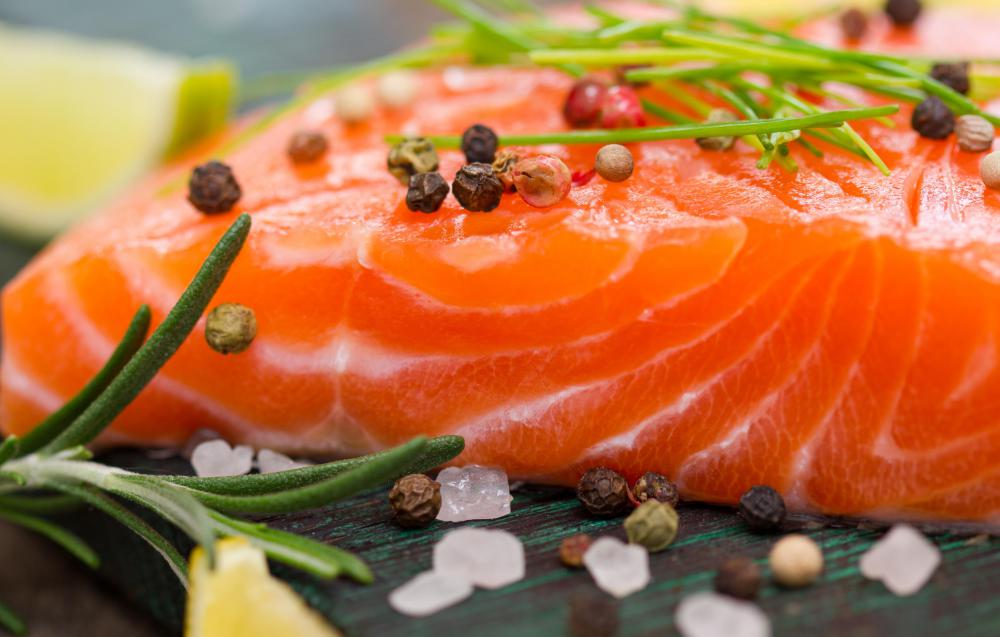
![Salmon fillets ready to be cooked with the skin on.]() By: alex555Salmon fillets ready to be cooked with the skin on.
By: alex555Salmon fillets ready to be cooked with the skin on. -
![Grilling salmon makes the skin crispy and flavorful.]() By: Tiramisu StudioGrilling salmon makes the skin crispy and flavorful.
By: Tiramisu StudioGrilling salmon makes the skin crispy and flavorful. -
![While it may not be popular to eat in the U.S., salmon skin is edible, but the scales are not.]() By: pilipphotoWhile it may not be popular to eat in the U.S., salmon skin is edible, but the scales are not.
By: pilipphotoWhile it may not be popular to eat in the U.S., salmon skin is edible, but the scales are not. -
![Salmon skin is often added to sushi rolls.]() By: T.TulikSalmon skin is often added to sushi rolls.
By: T.TulikSalmon skin is often added to sushi rolls. -
![Salmon skin may become lodged in the throat, causing great discomfort.]() By: stokketeSalmon skin may become lodged in the throat, causing great discomfort.
By: stokketeSalmon skin may become lodged in the throat, causing great discomfort.




Discussion Comments
The skin adds nice flavor to the salmon. I once grilled salmon and it was awesome. But I couldn't get that awesome flavor repeated again. Until I realized that it had the skin still intact. Now I would never eat it without the skin.
I just recently started eating the salmon skin. It is very flavorful and packed with omega 3 acids and the nutrients of the salmon flesh but concentrated. Cringed the first time I ate it although it was admittedly extremely tasty. I will not stop doing it now!
I eat salmon with crispy skin, but I do not de-scale it. It tastes perfectly fine to me and I don't have scale poos the next day!
When I first started eating at sushi restaurants, I was surprised to see how expensive some of the higher-end offerings could be. I found a much less expensive alternative-- salmon skin. The salmon skin is fried crisp, then rolled into sushi. I find that I still get the intense fish flavor of more expensive seafood, but I'm not paying the extra money for it. I actually like eating the skin of a lot of fish, like salmon, perch and rainbow trout.
I eat salmon with skin on because skin has more omega 3 fatty acids. I pan fried it with the skin side down, start with medium-low heat and you don't need to put any oil. after a while, when the skin is cooked, it will render lots of oil. the skin is crispy and tasty.
I always eat the salmon with the skin on. I guess a lot of it depends on how you cook it. I put mine in a baking pan and add fresh basil, sundried tomatoes, and parmesan cheese. It is really good.
I grew up in a region where fish was abundant, caught at night and eaten the next day. Always fresh, from the clean, blue sea.
My mother would usually prepare the small fish, blue and white fish, by removing the top part, head and insides that are attached to the head and the underside of the fish. Small fish would be prepared, usually fried, and the bones would be removed while eating. Medium size fish that had scales would be cleaned similarly, however, the scales would be scraped of, and the skin would be eaten too. On larger fish, the skin was usually not eaten. I don't think it was because it was not edible, but because it was tougher and not as tasty.
So these days when I eat salmon for example I do not eat the skin. Not because it is not edible, but it does not taste that good, of course it depends on the method of preparation.
Post your comments