
At WiseGEEK, we're committed to delivering accurate, trustworthy information. Our expert-authored content is rigorously fact-checked and sourced from credible authorities. Discover how we uphold the highest standards in providing you with reliable knowledge.
Is Pink Eye Contagious?
 Michael Pollick
Michael Pollick
Michael Pollick
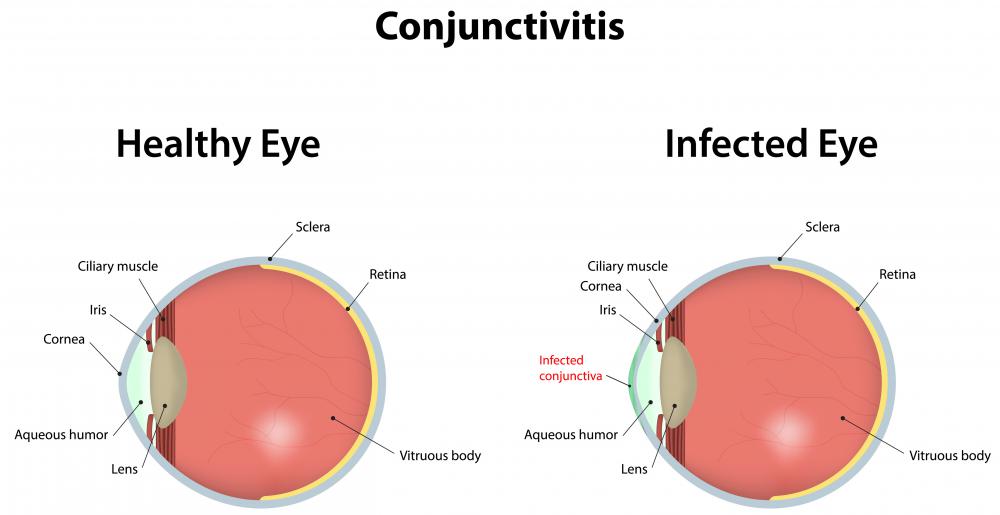
The condition known as pink eye or conjunctivitis is an infection of the eyelids and a protective layer of the eye called the conjunctiva. It can be caused by bacteria that naturally reside in the eyelid, viruses which find their way to the eye area, or natural allergens which trigger an allergic response. Of these three main causes, only bacterial or viral infections are actually considered to be contagious. Conjunctivitis caused by hay fever or other allergic reaction is not generally contagious, but it is not always easy to tell the difference between the three forms.
The most common form of conjunctivitis is bacterial. This is because the eye does not have the usual defense mechanism for destroying harmful bacteria, like those that reside in the roots of eyelashes and along the rims of the eyelids themselves. A natural chemical present in the conjunctiva is supposed to neutralize bacteria, but it is not always successful. When colonies manage to overwhelm the defenses of the conjunctiva, the result is the infection we know as pink eye.

The bacterial form of pink eye is indeed contagious, and approximately 50% of all the reported cases are bacterial. The treatment is usually some form of antibiotic eye drops and scrupulous hygiene practices until the condition clears up. While the bacterial form is still producing infected fluids, however, the possibility of infecting someone else through casual contact is still present. A classroom full of students or an office full of co-workers could easily be exposed through casual contact with an infected person.

Pink eye can also be triggered by a virus, but this form only accounts for 20% of all cases. Antibiotic eye drops would have little effect on a person with viral conjunctivitis, but there are treatments available that help to neutralize the virus. This form is also very contagious, so the same hygienic protocols should be in place. Patients should avoid direct contact with others, and any medical waste products such as bandages, tissues, and eye droppers should be disposed of properly.

Allergens such as pollen and pollutants such as house dust can trigger a third form of conjunctivitis, which accounts for the remaining 30% of all cases. Treatment of allergen or pollutant-based pink eye is generally part of a larger treatment for the underlying allergy or reaction. The itchy, swollen eyes that often accompany hay fever, for example, would be considered an allergen-based form of conjunctivitis. This form is not contagious, since the excess fluids do not contain either bacteria or viruses, only natural lachrymal fluids and flushed-out irritants.

Although nearly a third of all cases are not considered contagious, it is not easy for an average person to distinguish contagious from non-contagious conjunctivitis. If a schoolmate or co-worker appears to have some form of an active eye infection, it is still best to err on the side of safety and avoid any casual contact or possible transfers from handling communal objects like telephones or toys. When in doubt, people should use antibacterial wipes or disinfectant sprays to prevent the spread of infection. People should avoid touching the face or eyes after coming in contact with anyone who shows signs of an eye infection, with or without accompanying symptoms of a cold or flu.
Michael Pollick
A regular WiseGEEK contributor, Michael enjoys doing research in order to satisfy his wide-ranging curiosity about a variety of arcane topics. Before becoming a professional writer, Michael worked as an English tutor, poet, voice-over artist, and DJ.
Learn more...
Michael Pollick
A regular WiseGEEK contributor, Michael enjoys doing research in order to satisfy his wide-ranging curiosity about a variety of arcane topics. Before becoming a professional writer, Michael worked as an English tutor, poet, voice-over artist, and DJ.
Learn more...AS FEATURED ON:
AS FEATURED ON:









-
![Hand wipes may be useful in preventing the spread of pink eye.]() By: Scott MillessHand wipes may be useful in preventing the spread of pink eye.
By: Scott MillessHand wipes may be useful in preventing the spread of pink eye. -
![Eye drops are often used to remedy the effects of pink eye.]() By: Alexander RathsEye drops are often used to remedy the effects of pink eye.
By: Alexander RathsEye drops are often used to remedy the effects of pink eye. -
![Most individuals are not contagious during the pink eye incubation period.]() By: Stacy BarnettMost individuals are not contagious during the pink eye incubation period.
By: Stacy BarnettMost individuals are not contagious during the pink eye incubation period. -
![Pink eye, also known as conjunctivitis, is an infection, inflammation, or irritation of the conjunctiva, the outermost tissue layer of the eye.]() By: joshyaPink eye, also known as conjunctivitis, is an infection, inflammation, or irritation of the conjunctiva, the outermost tissue layer of the eye.
By: joshyaPink eye, also known as conjunctivitis, is an infection, inflammation, or irritation of the conjunctiva, the outermost tissue layer of the eye. -
![Those infected with pink eye can reduce the chance of spreading the virus by regularly washing their hands.]() By: peacebutsThose infected with pink eye can reduce the chance of spreading the virus by regularly washing their hands.
By: peacebutsThose infected with pink eye can reduce the chance of spreading the virus by regularly washing their hands.



Discussion Comments
My son goes in and out of cold storage a lot. Can this cause pink eye?
I think I might have pink eye. I have crusts around my eyes when I wake up and a occasional white mucus in the corner of my eye. My eyes aren't watering but they are a pinkish red in the white area. I took allergy medicine and put in eye drops and it's partially cleared and the burning has stopped but I am still concerned. What should I do?
most cases of bacterial pinkeye (which most of them are) come from rubbing your eyes with your fingers, so knock that off! Afterward, it's best to clean everything you're touch with an anti-bacterial. I've had two kids with it and I've had it three times now, one of the many joys of having children.
Remember your drops, and either cold or warm compresses depending if there are styes. Do your drops, and most of all, do what the doctor tells you until he says its gone. Don't let it become an ongoing problem.
How long can pink eye last?
I'm 15 and not sure if i have pink eye or not.
my left eye is bloodshot but only on one side. also, when i wake up in the morning my eyes are stuck shut. i can open them but it's really annoying! do any of you guys think that it is pink eye? thanks. jess
I'm a teen in high school, and i also have pink eye. I believe it is my third day having it.
It all started on New Years Eve and I had to go home early because it felt like there was something in my eye, and my eye was all gunky/gooey.
The next morning my eyes were pasted shut with eye goo and then once i got them opened I could see that they were red. I'm now on antibiotics and special red eye eye drops.
I now don't feel any pain, or experience any redness. But on top of this I have had the worst cold in my life! haha, but seriously. Cough, runny/stuffy nose, congestion, sneezing, you name it!
If you have pink eye, go to the doctor's office and get it checked out. The results will probably show fast! (:
My boss has pink eye today and swears it is not contagious. I have had pink eye before and do NOT want it again. Also, I am pregnant. Advice?
Yes! Most parents won't keep their children at home. We are their babysitters- right?
I just found out my mom has pink eye. I am concerned because I am going in for knee surgery next week. how can i prevent myself from catching this. The last time i went i had both my knees replaced and my right knee got infected. i don't want that to happen again. Thank you. Joe V.
i'm deathly afraid of pink eye and i might have it. Will I die?
im like really concerned that like my eye like has a weird thing. its turning red and green and i have heard that these symptoms are like that thing called green eye. i have also been petting my dog, will he get it? OMG if he dies my life is over! Please help me!
I've been touching my eye and touching everything in my house. Does that mean my house is like a huge biohazard?
When taking an antibiotic for pink eye, how long should one remain contagious?
If taking an antibiotic, how long should you stay away from others?
Can pink eye be spread within hours?
As a teacher, I know that it is VERY important to keep your child home from school if he or she has pink eye. It can spread really quickly and before you know it, the whole class has pink eye. It's much better to keep your child home for a few days than to start an epidemic!
Post your comments