
At TheHealthBoard, we're committed to delivering accurate, trustworthy information. Our expert-authored content is rigorously fact-checked and sourced from credible authorities. Discover how we uphold the highest standards in providing you with reliable knowledge.
Is Hair Loss Inherited from the Mother's Family?
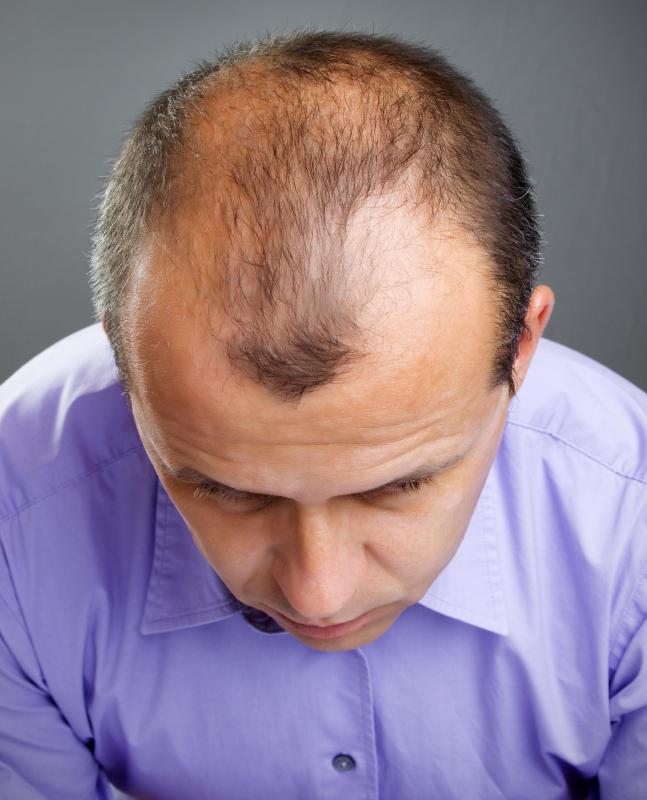
Hair loss is a condition where hair, usually on the top of the head, starts to fall out and ceases to grow back fully. The most common type is referred to as male pattern baldness, or more technically as androgenic alopecia, where hair thins until it is eventually gone from the head. Although it was long believed that this condition was inherited from the mother's side of the family, researchers now think that it is likely that any genetic factors can come from either parent.
Hair grows on the head from a number of different hair follicles. The average person has about 100,000 follicles, each of which can grow somewhere around 20 distinct hairs over the lifetime of the person. When these follicles stop producing hair, the most common types of hair loss occur.

For years it has been thought that hair loss was inherited from the mother’s side of the family. Some studies have suggested that it is caused by the presence of excess androgen receptors on the scalp. This was seen as the result of a genetic difference, which caused either more androgen receptors to form or for those that formed to be more stable and less susceptible to breaking down.

The androgen receptor gene resides on the X chromosome, which men inherit from their mother. As a result, it was thought that a tendency to lose hair in certain ways was passed down through the mother, and could usually be traced to the maternal grandfather. If the maternal grandfather lost his hair, common wisdom holds, the grandson will too.
The truth, however, seems to be that hair loss is inherited no more often from the mother than from the father. The amount of data available on the issue is surprisingly sparse, with most evidence for inheritance through the mother’s side coming from a 1916 study with fairly shaky methodology. The actual genetics are not well understood. Androgen receptor genes appear to be a somewhat simplistic explanation, and don’t necessarily hold up to large sample studies.

The data now seems to show that whatever the cause or causes of hair loss in men, they have a few characteristics that people can be fairly certain of. First, because of the range of people who lose their hair and the correlations between both father-son and maternal-grandfather-grandson baldness, it appears the genes responsible are actually autosomal, residing on neither the X nor the Y chromosome. It also appears that the genes have variable penetrance, since full siblings don’t necessarily have the same frequency of hair loss. The genes responsible seem to be dominant as well, and not recessive as was once thought.

It is surprising that an issue discussed so frequently has so little data available. In the past few years, however, especially since the mapping of the genome, more large-scale studies have begun on hair loss in men. Although as of yet inconclusive, it is likely that within the next few years the genes responsible will finally be pinned down, and researchers may be able to say once and for all whether the mother or the father is more responsible for passing the gene along.
AS FEATURED ON:
AS FEATURED ON:


-
![Men inherit their baldness more from their mother's relatives than their father's.]() By: diego cervoMen inherit their baldness more from their mother's relatives than their father's.
By: diego cervoMen inherit their baldness more from their mother's relatives than their father's. -
![The androgen receptor gene resides on the X chromosome, which men inherit from their mother.]() By: Giovanni CancemiThe androgen receptor gene resides on the X chromosome, which men inherit from their mother.
By: Giovanni CancemiThe androgen receptor gene resides on the X chromosome, which men inherit from their mother. -
![Hypothyroidism and hormonal imbalances can lead to hair loss in women.]() By: vladimirfloydHypothyroidism and hormonal imbalances can lead to hair loss in women.
By: vladimirfloydHypothyroidism and hormonal imbalances can lead to hair loss in women. -
![Researchers now believe that any genetic factors can come from either parent in the family.]() By: weimResearchers now believe that any genetic factors can come from either parent in the family.
By: weimResearchers now believe that any genetic factors can come from either parent in the family. -
![Male pattern baldness -- a receding hairline at the forehead and a bald patch at the back of the head -- can be caused by genetics and related to the hormone testosterone.]() By: draganicaMale pattern baldness -- a receding hairline at the forehead and a bald patch at the back of the head -- can be caused by genetics and related to the hormone testosterone.
By: draganicaMale pattern baldness -- a receding hairline at the forehead and a bald patch at the back of the head -- can be caused by genetics and related to the hormone testosterone.


Discussion Comments
I have a question. I am 21 years old. On my father's side there is no baldness. On my mother's side, one of my uncles is bald, but his brother and his two brothers are not bald yet.
My maternal grandfather is also not bald and die at the age of 75 with a full head of hair. My head structure, they say, is the same as my uncle who is bald. My relatives scare me that I'm going to be bald. Am I be going to be bald?
The balding trait can only be passed on by the mother in the family. I know this because I was in biology yesterday an we talked about it.
I am the only son in my family. On my mom's side, all nine of them have full heads of hair, including my grampa. My dad and his brother have full heads of hair, but my grampa on dad's side is bald and so am I. In my case, it comes from dad's side, unless my grandma on mom's side is hiding something.
I am a 60 year old male with a really full head of dark brown hair. My mother's father had tons of hair (He always said we had hair like a god, a god-blank goat). I have three daughters and they have three boys. Their hair resembles a goat's. I am going with the mother's father theory.
Is a receding hairline considered the same thing as male pattern baldness? My husband started out with a receding hairline in his late 20's. Now in his late 50's, he is almost totally bald.
My son is currently in his late 20's and his hairline is starting to recede just like his dad. He is not at all happy about this, and is hoping to find some kind of hair loss remedy that will slow this down or stop it altogether.
@Mykol -- I have always found it interesting that men bald so much more often than women. I am very thankful for that, as I don't think I would handle going bald very well. The women I know who have lost their hair because of chemotherapy often grow back hair that it thicker than it ever was.
I know some men who aren't bothered a bit by going bald and will just shave their head and be done with it. Other men really struggle with this and spend a lot of money trying to prevent hair loss. I have also seen brothers who are completely different when it comes to the amount of hair they have.
One may have thick hair all over his head and the other one may be almost bald. This would support the theory that both male and female genes are responsible for hair loss.
I have a female friend who has very thin hair and patches where she is balding on top. I think this would be really hard as a female to cope with. She has tried some hair loss treatment programs, but hasn't found anything that really works.
Another thing that is so frustrating for her is that her brother doesn't have any trouble with this at all. Neither her mom or her dad have any trouble with baldness. In her situation I wonder if it has something to do with genetics or if something else is the cause.
My husband has always said that men get their hair genes from them mother's side. His dad was bald at a young age and his mother had a thick head of hair until the day she died. My husband has two brothers and all of them have thick hair and are not showing any sign of male pattern baldness. I find this interesting how this information has been passed down so long with very little research being documented on it.
There are three genes on the x-chromosome linked to baldness: AR, EDA2R and Xq11-q12. This pretty much solidifies the maternal link.
However, just because it's maternal does not mean it always comes from the maternal grandfather. So if balding guys have a bald dad and maternal granddad with hair, it still doesn't mean he got it from dad. Mom has two X-chromosomes so a man could also get a baldness gene from the mother's mother's father and so forth.
@Renegade
I don't doubt that this is the case for many people, but the fact is, there is little scientific evidence pointing to the idea that hair loss is strictly from the mothers side. Four cases of consistency are simply not enough to back up the large percentage of examples on a large scale necessary to prove or disprove this phenomenon.
I have like four friends whose maternal grandfathers went bald early and now they are also going bald. I've noticed that it is an obvious fact that men lose hair based on their mothers side.
It is surprising to see how much of urban legend and traditional folklore is without a solid basis. Hearsay spreads much faster than the evidence to deny or support it, but with the advent of the internet, people are now able to easily quell false ideas easily, and to test them for veracity.
Post your comments