
At WiseGEEK, we're committed to delivering accurate, trustworthy information. Our expert-authored content is rigorously fact-checked and sourced from credible authorities. Discover how we uphold the highest standards in providing you with reliable knowledge.
In Law, What Is a Writ?
In law, a writ is basically a written document issued by a court to some lower court or other official agency or office, normally requiring that party to take a specified action, to avoid taking some sort of prohibited action, or, in rarer cases, granting access to something. These sorts of documents originated in English common law, and are most commonly used in courts that follow that tradition, particularly the United States but also India, Australia, and other current and former Commonwealth nations. There are many different varieties and formats, some of which are specific to certain courts or legal systems and others that are more universal. Not all carry the “writ” name, either; warrants are often grouped into this category, for instance, as are subpoenas. The implications of what the documents can do normally vary as well. What all have in common is that they’re documents, from a court, that compel or permit some named action of some official actor.
Basic Concept

Court-issued documents come in many forms. Writs are usually most unique when it comes to their addressees: most of the time, a document won’t carry this name unless it’s intended for an official audience. They aren’t normally issued to individuals in their personal capacities, for instance, though people can often request them. Some of the most common examples include habeas corpus, through which a person can ask a court for relief from what he or she believe to be unlawful detention; documents focusing on garnishment also allow for a court to order the seizure of property that is in the possession of one party but belongs to another, normally the government or some government agency. This happens often when a court issues a judgment in favor of a debtor.

Sometimes courts will compose and issue these documents on their own, normally as a matter of course after a judgment has been rendered. They can also normally be requested, usually through a petition. The petition process varies from place to place and even from court to court, and are usually submitted by attorneys or other trained legal counselors.
Common Law Origins

In England, the usage these tools as methods of court-ordered activity began in the times when common law was the law of the land. Originally, the document was a letter from an authority with jurisdiction, indicating that some action needed be taken. Back then, a petition had to be issued so that a case could even be heard by the royal courts. The Woolf Reforms, passed in 1999, replaced the use of these form to start a civil action with a more simplified claim form. The goal and core function is about the same in most cases.
In U.S. Law

The United States also uses this form of court documentation as a means of effecting certain actions or changes, and originally the process mirrored that of England’s courts — although over time the two systems' uses evolved in different ways. In the U.S., the All Writs Act allowed federal courts in the country to issue the documents and orders necessary to aid their jurisdictions. In 1938, however, the Federal Rules and Civil Procedures abolished certain formats in certain cases, such that certain relief is now available instead through lawsuits and motions of the court in pending cases.
Indian Courts

The Indian legal system also uses writs. In fact, the country's constitution awards its courts the right to use them. In this country, one of the most common is that related prohibition, in which a higher court prohibits a lower court from taking a case, stating that the court does not have appropriate jurisdictional power. The writ of certiorari is another common one, and directs a lower court to send any records pertaining to a case to a higher court for review. That same name is used in the U.S. when the Supreme Court grants petitioner’s requests to rehear a case from another court.
AS FEATURED ON:
AS FEATURED ON:









-
![Subpoenas are one type of writ.]() By: Marzky Ragsac Jr.Subpoenas are one type of writ.
By: Marzky Ragsac Jr.Subpoenas are one type of writ. -
![The United States Supreme Court issues a writ of certiorari when it agrees to hear arguments related to a case.]() By: BastosThe United States Supreme Court issues a writ of certiorari when it agrees to hear arguments related to a case.
By: BastosThe United States Supreme Court issues a writ of certiorari when it agrees to hear arguments related to a case. -
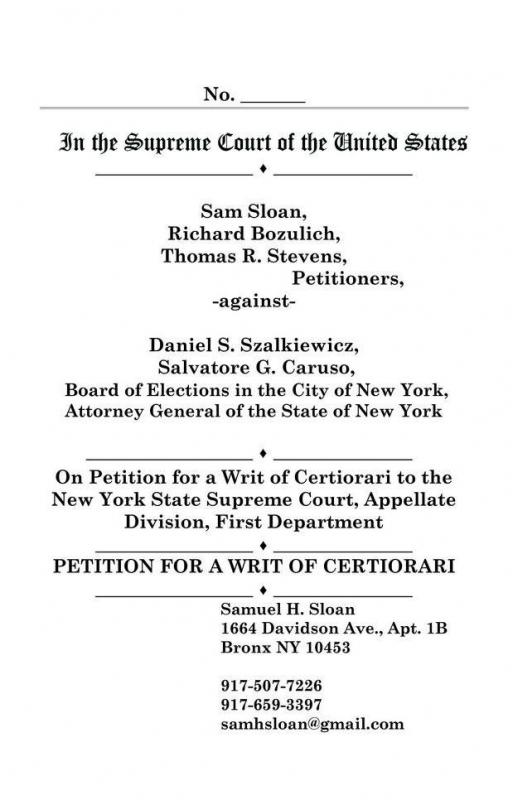
![A writ of certiorari seeks Supreme Court review and decision in a case that has exhausted its appeals and is otherwise at the end of the line.]() By: samhsloan@gmail.comA writ of certiorari seeks Supreme Court review and decision in a case that has exhausted its appeals and is otherwise at the end of the line.
By: samhsloan@gmail.comA writ of certiorari seeks Supreme Court review and decision in a case that has exhausted its appeals and is otherwise at the end of the line. -
![A writ is a written, legal document issued by a court ordering a person to take an action or forbidding that person from taking an action.]() By: uwimagesA writ is a written, legal document issued by a court ordering a person to take an action or forbidding that person from taking an action.
By: uwimagesA writ is a written, legal document issued by a court ordering a person to take an action or forbidding that person from taking an action. -
![An arrest warrant is considered a court writ.]() By: ivanfffAn arrest warrant is considered a court writ.
By: ivanfffAn arrest warrant is considered a court writ.




Discussion Comments
@JimmyT - You are right. The Constitution does grant habeas corpus but only to American citizens. At least that is the reasoning being used as to why terrorists could be detained without a trial.
There have been a couple of times during wars where writ of habeas corpus was suspended, but that is expressly allowed by the Constitution. I believe the terrorism issues started after the Oklahoma City bombing and said that anyone suspected of terrorism could be held. Of course, this become much more common after 9/11.
I don't know where the issue stands now, but I guess all American citizens are still supposed to be granted habeas corpus regardless of whether they are suspected terrorists. Courts are divided on whether non-citzens should have this right, though. That is where Guantanamo Bay came into the argument, because people were being kept there for years without going to court (among other things).
I seem to remember hearing something not too long about about writ of habeas corpus being able to be suspended if you were suspected of being a terrorist. I think it caused a bit of an uproar, because people thought that it would allow the government to hold be indefinitely without giving them a trial.
If this is true, it sounds like it could lead to a lot of problems. If habeas corpus is in the Constitution, how can the government take the right away from people without it being illegal?
It seems like I remember the argument being centered around Guantanamo Bay somehow. Does anyone remember what the exact story was and whether or not people can be detained without a trial?
@cardsfan27 - It seems like most writs fall into certain categories, so one term might be used to cover a lot of different things. A couple writs that I remember are writ of attachment which would be like a creditor taking property. There is also writ of capias, which is the formal term for an arrest warrant.
I think it is interesting how writs are used differently in other countries. They are common in the United States, but it seems like other countries may rely on them more often for various things.
I think part of it is the fact that the U.S. Constitution doesn't really lay out much groundwork for the courts. They have mostly just formed by using the English system and modifying them to work for American law.
I had heard of writ of habeas corpus but didn't know what exactly a writ was. It sounds like they are a pretty common part of law whether or not we use the word very often.
Because the article talks about writs also being applied to things like warrants and forced payments, does that mean that most common legal things actually have a formal name that uses the word "writ?" I would be interested to know if anyone else knows of any common legal practices that have more formal names like that.
Post your comments