
At Sports&Hobbies, we're committed to delivering accurate, trustworthy information. Our expert-authored content is rigorously fact-checked and sourced from credible authorities. Discover how we uphold the highest standards in providing you with reliable knowledge.
In Hockey, what is the Blue Line?
Ice hockey requires a rink that is separated into three sections, which are delineated by the blue line. There are two lines in a hockey rink that indicate the transition from the neutral zone and the offensive zone of each team. For example, if an offensive player is carrying the puck in the area between the two blue lines, he is in the neutral zone. If he carries the puck over the line toward the opposing team’s goalie, he is said to be in his offensive zone. If he carries that puck back over the opposite line toward his own goalie, he has entered his defensive zone.
The blue line is important in determining whether a player is off-sides, meaning that the player has entered the offensive zone before the puck has. If the player has, in fact, crossed before the puck does, the referee blows the whistle and the play is dead. In addition, if an offensive player enters the offensive zone, leaves it, then re-enters while some of his teammates remained there, the referee whistles off-sides and the play is again dead. If a player crosses the blue line and is off-sides, the play is taken outside the offensive zone to a face-off dot just inside the neutral zone. The play is now considered neutral, with neither team in control of the puck until the referee drops it at the face off.
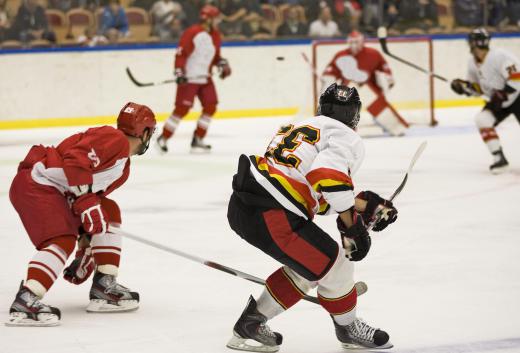
This line is also important in determining strategy for play. Defensemen often plant themselves by the blue line while their team is in the offensive zone in order to protect against a turnover. If the other team steals the puck away from the offensive team, the play shifts in the other direction of the ice and the defensemen are then in good position to back up and help defend their goal. Because defensemen often stay by the line, they are commonly known as "blue liners."
AS FEATURED ON:
AS FEATURED ON:


-
![In hockey, the blue line is important in determining if a player is offsides or not.]() By: modestilIn hockey, the blue line is important in determining if a player is offsides or not.
By: modestilIn hockey, the blue line is important in determining if a player is offsides or not.

Discussion Comments
I think hockey fans consider the blue line rule something only true hockey fans would ever understand. It's more of a technical foul than anything else, like traveling in basketball. Every offensive play violates it once in a while, but it's up to the officials to actually call it.
Post your comments