
At Sports&Hobbies, we're committed to delivering accurate, trustworthy information. Our expert-authored content is rigorously fact-checked and sourced from credible authorities. Discover how we uphold the highest standards in providing you with reliable knowledge.
In Football, what is a Hail Mary?
 Michael Pollick
Michael Pollick
Michael Pollick
In football, a Hail Mary is a long pass thrown toward the end zone in desperation, usually in the final seconds of a half or a game. Although it is rarely successful, a team often will try this type of play when it might be the team's best chance of scoring before time runs out. Even if an offensive player does not catch the ball, there also is a chance that the defensive team will be penalized for pass interference or another penalty, giving the offense another chance to score. The nickname for this type of play comes from the traditional prayer recited most commonly by Catholics. It has been used at least since the 1920s to refer to passes that have little more than a prayer of succeeding.
A key element of this type of play is that the ball basically is thrown up for grabs, meaning that there is about as much chance of a defensive player intercepting the ball as there is of an offensive player catching it. Both teams typically try to have more than one player in position to catch the ball or to prevent the opponent from catching it. The defense usually can have more players there, which is why these plays are rarely successful. If the offense is close enough to the end zone to try a normal-length pass — usually one that is thrown directly to a particular receiver — it is not considered a Hail Mary, even if it occurs in the final seconds.
Strategy
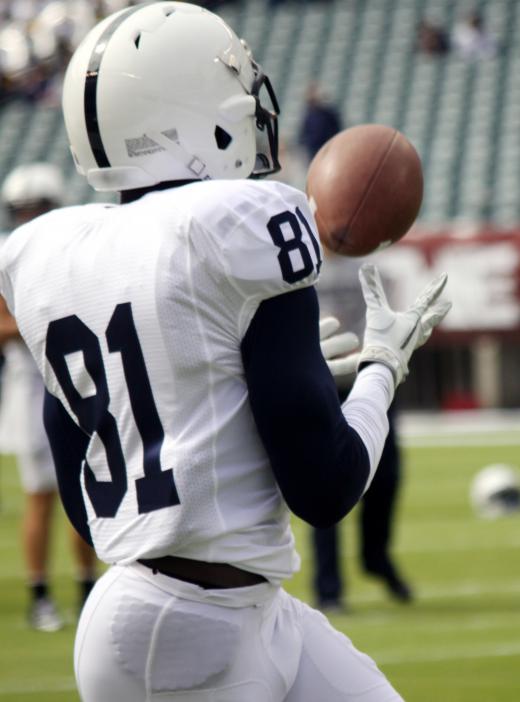
A team might try a long desperation pass instead of another type of play when there is very little time left on the clock. If the team tried a running play or completed a pass that was not caught in or near the end zone, the ballcarrier or receiver might be tackled before reaching the end zone, and time might expire before the team could run another play. This is especially true if the team has no timeouts remaining. If a team has at least one timeout and there is enough time remaining, it might be able to run a shorter play and then call timeout to stop the clock.
Situations

There are two main situations in which the offense might try a Hail Mary. One is when there are only a few seconds left on the clock and the team is too far from the opponent's end zone to try kicking a field goal. This usually is more than 40 yards (36.6 m) or so, which would mean that the field goal would be at least a 57-yard (52.1-m) attempt — too far for most kickers to have a reasonable chance of making it. In high school or youth football, a Hail Mary might be the best option even if the offense is inside the opponent's 40-yard (36.6-m) line, because kickers at those levels typically cannot kick as far as college or professional kickers.
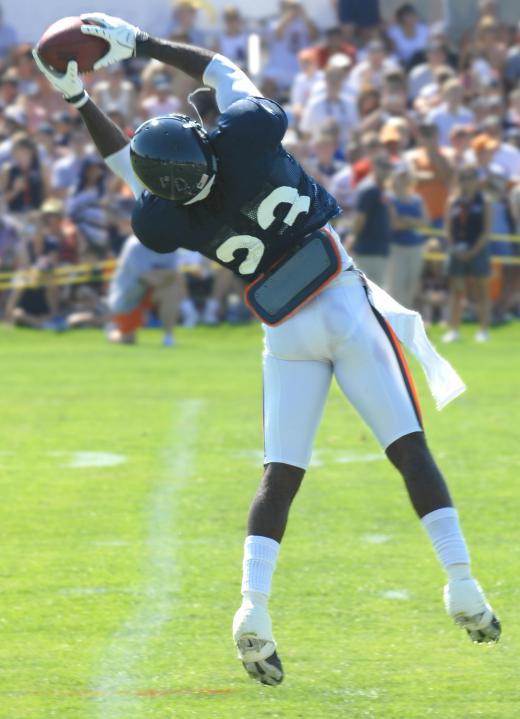
The second situation in which a team might try this type of play is when it is behind by more than three points — the value of a field goal — in the final seconds of a game. This is because a successful field goal would still leave the team behind on the scoreboard. Even if time remained, the team would have to find score again before time expired, or it would lose. Trying to score a touchdown, therefore, would be the better option.
A team that is behind by more than a touchdown in the final seconds is likely to lose no matter what it does. The team might try a Hail Mary just to score as many points as possible. In other cases, if the team has no chance of winning, it might run a different type of play, even if it is unlikely to score.
Execution
On a Hail Mary play, the offense usually tries to send all five of its eligible receivers into the end zone. Some teams will send all five to one spot, and others will send two or three to each side of the end zone so that the defense will have to guard more than one area. The offense might also have one receiver stop a short distance before the others and watch for the ball to be deflected, either by a teammate who is unable to catch it or by a defensive player who is trying to knock it away from a receiver.
The quarterback typically tries to hold onto the ball long enough to give the receivers a chance to run to the end zone before he throws the ball. After getting the ball from the center, the quarterback will often run toward the sideline to help him avoid being tackled by a defensive player before he can throw the ball. The offensive linemen try to block their opponents long enough for the quarterback to have a chance to throw the ball.
When the offense is trying this type of play, the defense knows that it has to defend only the areas in or near the end zone. The defense typically will have several players rush the quarterback, and the rest will be in or near the end zone. Sometimes, the defense also will have some of its players try to disrupt the offense's receivers as they try to run toward the end zone.
After the ball is thrown, players on the offense and defense try to judge where it will land, and they run to that spot. When the ball is close enough, they usually will try to jump high enough to catch it or deflect it. For the offense to score a touchdown, one of its players must catch the ball in the end zone or catch it and carry it into the end zone. Defensive players do not need to catch the ball, they simply need to prevent an offensive player from catching it.
Penalties
In football, if the defense commits a penalty on the final play of a period, the period can be extended for another offensive play. This means that if the defense commits a penalty, such as pass interference, on a last-second play, the offense could get another play from a spot on the field that is closer to the end zone. The location from which the extra play occurs depends on the penalty that was called and the rules being followed in the game. It is rare, however, for a penalty to be called on this type of play unless the foul is especially flagrant.
Famous Hail Mary Passes
Perhaps the most well-known example of this type of play occurred during an National Football League (NFL) playoff game between the Dallas Cowboys and Minnesota Vikings on 28 December 1975. With 32 seconds left in the game, Cowboys quarterback Roger Staubach threw a 50-yard touchdown pass to teammate Drew Pearson, giving Dallas a 17-14 victory. Afterward, Staubach told reporters that after throwing the ball, he closed his eyes and said a Hail Mary. Staubach's quote is often cited as the source for the nickname of this type of play, but many other documented references prior to 1975 have been found.
In college football, the most famous example is considered to be the one thrown by Boston College quarterback Doug Flutie against the University of Miami on 23 November 1984. Boston College trailed 45-41 with six seconds left in the game before Flutie threw a 48-yard (43.9-m) touchdown pass to Gerard Phelan on the final play, giving Boston College a 47-45 victory. This play is sometimes referred to as the Hail Flutie play.
Michael Pollick
A regular Sports&Hobbies contributor, Michael enjoys doing research in order to satisfy his wide-ranging curiosity about a variety of arcane topics. Before becoming a professional writer, Michael worked as an English tutor, poet, voice-over artist, and DJ.
Learn more...
Michael Pollick
A regular Sports&Hobbies contributor, Michael enjoys doing research in order to satisfy his wide-ranging curiosity about a variety of arcane topics. Before becoming a professional writer, Michael worked as an English tutor, poet, voice-over artist, and DJ.
Learn more...AS FEATURED ON:
AS FEATURED ON:


-
![In American Football, a Hail Mary is a desperation pass into the end zone.]() By: Richard KaneIn American Football, a Hail Mary is a desperation pass into the end zone.
By: Richard KaneIn American Football, a Hail Mary is a desperation pass into the end zone. -
![Touchdown is the result of a successful Hail Mary.]() By: Michael FlippoTouchdown is the result of a successful Hail Mary.
By: Michael FlippoTouchdown is the result of a successful Hail Mary. -
![A Hail Mary offers the best chance of scoring when a team runs out of time.]() By: Rick SargeantA Hail Mary offers the best chance of scoring when a team runs out of time.
By: Rick SargeantA Hail Mary offers the best chance of scoring when a team runs out of time.


Discussion Comments
I remember seeing a successful Hail Mary during a Chiefs game when I was a kid. I can't remember who we were playing or how the play got set up, but I do remember watching the ball sail through the air for what seemed like miles and then lading in the center of a huge mass of players. After the dust had cleared, it wound up in the hands of a Chief. The stadium went wild. It felt like everyone was screaming and clapping as loud as they could all at once. The energy in the stadium at that moment was incredible.
One of the biggest challenges of executing the Hail Mary is protecting your quarterback while the receivers run all the way down the field. In some cases this can take 6 or 7 seconds, which is an eternity when you have a whole defensive line and linebacker core trying desperately to sack the QB. Add to this the fact that most Hail Mary's happen in the last seconds when there is still a chance to win and you get a feeling for how rabid and pumped up the defense is. They want to get to the quarterback more than ever.
The real heroes of the Hail Mary are the offensive line. Without those guys buying everyone else time, the play would never ever work.
I always loved the name of the Hail Mary. It is so risky and unpredictable that the only thing you can do is pray. Whoever came up with the name of this play has a wry sense of humor.
One of the reasons why Hail Mary's are difficult to complete is because the opposing team almost always knows it's coming and therefore puts several defensive players in the end zone to knock the pass down.
Post your comments