
At Sports&Hobbies, we're committed to delivering accurate, trustworthy information. Our expert-authored content is rigorously fact-checked and sourced from credible authorities. Discover how we uphold the highest standards in providing you with reliable knowledge.
In Baseball, what is a Warning Track?
A warning track in baseball is a wide strip of dirt that runs along the wall or fence that surrounds the field. A fielder who steps from the grass or artificial turf and onto the dirt surface of the track should notice the different surface underfoot and know that he or she is approaching the wall, even without looking in that direction. The warning track is designed to help prevent injuries that could occur if a fielder who was running to catch a fly ball crashed into a wall — even a padded wall — without warning. Many baseball fields have a warning track along every wall or fence, but others have one only along the outfield wall. Some fields, such as those used by teams in youth, high school or recreational leagues, might not have a warning track at all.
Helping Fielders
In addition to increasing safety, the track also helps outfielders to better time jumping catches. Many outfielders will track fly balls by looking over their shoulders and therefore will not see that they are quickly approaching the wall. Therefore, they will use their first step onto the track as an indicator to help them know when to jump so that they can reach over the wall and catch what would otherwise be a home run. The warning track frees up a fielder’s field of vision to track the ball rather than having to look and see where the wall is. If the fielder had to take his or her eyes off the ball and look at the wall, he or she might be unable to locate the ball again and therefore would be unable to catch it before it lands.
Width

There is no set distance that a warning track must be. A general rule that is used at many fields is that the track should be about the width of three running steps, which is considered to be enough warning for a fielder. In most major league ballparks, the track is about 15 or 20 feet (about 4.6 to 6.1 m) wide. At other levels of baseball, it might be 6 or 10 feet (1.8 or 3.0 m) wide or some other width within a similar range.
History
The first use of a warning track came at New York's original Yankee Stadium, which opened in 1923 and was used until 2008. The red cinder track that ran the entire perimeter of the baseball field was originally intended to serve as a running surface for track and field events. Players began to realize that once they hit the cinder track, they were approaching the wall. The warning track was born and began to be included in all baseball parks throughout the major leagues.
AS FEATURED ON:
AS FEATURED ON:


-
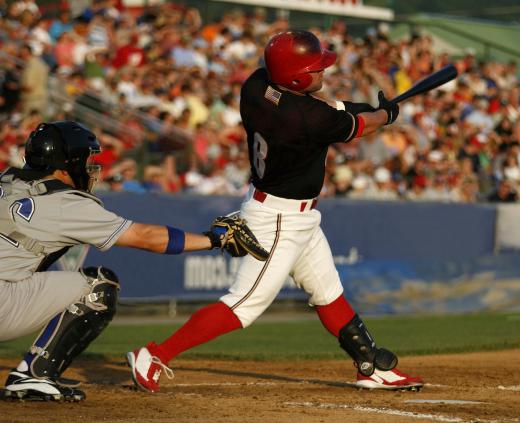
![Many baseball players have the power to hit the ball to the warning track, but few have the power to hit home runs.]() By: steven hendricksMany baseball players have the power to hit the ball to the warning track, but few have the power to hit home runs.
By: steven hendricksMany baseball players have the power to hit the ball to the warning track, but few have the power to hit home runs. -
![The surface of the warning track was originally intended for track-and-field events.]() By: Brenda CarsonThe surface of the warning track was originally intended for track-and-field events.
By: Brenda CarsonThe surface of the warning track was originally intended for track-and-field events.


Discussion Comments
I lways thought the warning track was a cool idea because it is kind of like the rough patch that runs along the shoulder of the highways and auses you car to vibrate loudly when you veer off the road. In general, ball players know that they have reached the warning track because they can feel the difference in the dirt beneath their feet.
They are too focused on the ball to look down and see the warning track so they need a way to pick up on the difference using a different part of their body. Its really a cool system, and the strip of dirt that runs the perimeter gives the field a nice look
@anon38836 - The width of the warning track varies depending on the stadium, like a lot of the features of a baseball diamond. In general they are designed to give a professional player three steps of room before they hit the wall. This typically translates to 10-15 feet of space.
what is the actual width of most warning tracks?
How wide is a warning track?
What year was the warning track installing at Yankee Stadium?
Post your comments