
At TheHealthBoard, we're committed to delivering accurate, trustworthy information. Our expert-authored content is rigorously fact-checked and sourced from credible authorities. Discover how we uphold the highest standards in providing you with reliable knowledge.
How Much Fat is in Whole Milk?
 Tricia Christensen
Tricia Christensen
Tricia Christensen
With the number of non-fat and low fat milk and milk products available on the market, certain questions are implied. Exactly how much lower in fat are these milks than standard milk? Is 1% or 2% milk really much lower in fat or calories than whole milk, and are there any people who should drink whole milk?
An 8 fluid ounce (about 0.236 liters or 247 grams) serving of whole milk has 146 calories, and approximately 0.279 ounces (7.93 grams) of fat. In contrast, 2% milk contains 122 calories and 0.169 ounces (4.81 grams) of fat. 1% milk has 102 calories and 0.083 ounces (2.37 grams) of fat, and non-fat or skim milk has about 0.015 ounces (0.44 grams) of fat and contains 86 calories per serving.

In percentage factors, this type of milk could be called 3.25% milk. It must have at least 3.25% milk fats in order to be classed as "whole." The above figures show, however, that whole milk has almost twice the fat content as does 2% milk, and about 16 times the fat content of nonfat milk.
This doesn't necessarily mean that regular milk is always bad. In fact, from a calorie standpoint, the difference between standard milk and 2% milk is fairly minimal. A person would be consuming about 30 more calories when drinking whole milk. Calorie differences are most significant when comparing whole fat milk to non-fat milk. A glass of non-fat milk saves 64 calories, which may be an asset if the drinker is trying to lower his or her calorie consumption.

There are groups of people who should not drink lower fat milk, and there is some evidence that using low fat milks can be detrimental. This is especially the case with children. For children who drink milk, more fat content is actually better, especially for kids under two. Pediatricians represent several schools of thought here. Some suggest that children under the age of five should keep drinking regular milk, while others argue that low fat milk is fine for kids over the age of two. If a child seems to be getting plenty of calories and eats a well-balanced diet, whole fat milk may not be necessary.

For people with conditions that cause them to be undernourished, whole fat milk may also be a better choice than low fat varieties. If a person is trying to gain weight, more calories are usually better, and humans do need a certain amount of fat in their diet. Alternately, if a person likes the creamy taste of regular milk and eats an otherwise low fat diet, a single glass of milk a day will only constitute 23% of his or her daily allowance for saturated fat. On the other hand, if someone is trying to lose weight, lower fat milk may be the better choice.
Tricia Christensen
Tricia has a Literature degree from Sonoma State University and has been a frequent TheHealthBoard contributor for many years. She is especially passionate about reading and writing, although her other interests include medicine, art, film, history, politics, ethics, and religion. Tricia lives in Northern California and is currently working on her first novel.
Learn more...
Tricia Christensen
Tricia has a Literature degree from Sonoma State University and has been a frequent TheHealthBoard contributor for many years. She is especially passionate about reading and writing, although her other interests include medicine, art, film, history, politics, ethics, and religion. Tricia lives in Northern California and is currently working on her first novel.
Learn more...AS FEATURED ON:
AS FEATURED ON:


-
![Low fat milk may be a better option for people who are trying to lose weight.]() By: jedi-masterLow fat milk may be a better option for people who are trying to lose weight.
By: jedi-masterLow fat milk may be a better option for people who are trying to lose weight. -
![Whole milk.]() By: Elena SchweitzerWhole milk.
By: Elena SchweitzerWhole milk. -
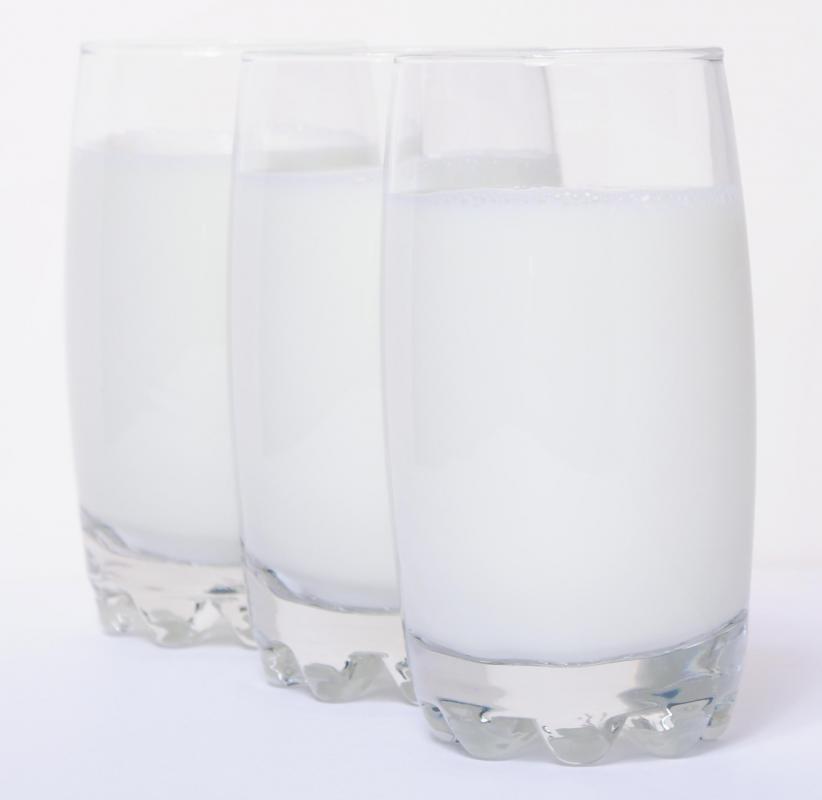
![Glasses of skim milk.]() By: chris32mGlasses of skim milk.
By: chris32mGlasses of skim milk. -
![Whole milk can be bought in grocery stores.]() By: vlorzorWhole milk can be bought in grocery stores.
By: vlorzorWhole milk can be bought in grocery stores. -
![More fat content is good for children who drink milk.]() By: altanakaMore fat content is good for children who drink milk.
By: altanakaMore fat content is good for children who drink milk.



Discussion Comments
Wow. I don't like whole milk. The only thing that contains cows milk is chocolate milk.
@bananas: People drank plenty of milk "back then". One cow could produce up to seven gallons of milk a day, and not everybody relied on selling the dairy products to support their families. I think the people you are referring to are people living in larger cities.
The difference is that "back then," people didn't eat all the junk food that is consumed nowadays. Food was wholesome and natural.
I don't know where in the heck you get the idea that people didn't drink milk. If they had a cow, they had plenty of milk.
If people didn't drink milk it was because they were so poor they could barely afford to eat bread. The second choice of food would be meat for a protein source, so milk would be a "luxury" for the poorest of the poor, but not for the farm families.
i am interested in this information (milk and yogurt). Please, can you tell me what does it mean when 10 percent is written on the yogurt label container?
@anon92676 -- All milk has Vitamin D.
I have not eaten any hydrogenated fats for ten years while I regularly take whole milk and butter.
I got lean and strong, rarely get sick and many people tell me that I look younger as well.
It's also because I exercise daily. I think nobody should worry about natural fats.
Worry about the unnatural ones, because they are the primary cause of obesity, but nobody will tell you because this won't suit the (trash) food industry.
I tried to change to low fat and I hated it so much I just avoided milk altogether. I now drink it without guilt, it has vitamin D (which many people have a shortage of now) and it is not as fatty as many "low fat" foods.
Oh but whole milk is so much better tasting. After all there used to be a time when there was only whole milk. The difference tho was that people did not have an abundance of it. Even if they had plenty of milk, they had to either sell it or make butter or cheese so they could buy other necessities for their household.
As a result, people were drinking whole milk, but it was consumed in smaller portions.
Post your comments