
At WiseGEEK, we're committed to delivering accurate, trustworthy information. Our expert-authored content is rigorously fact-checked and sourced from credible authorities. Discover how we uphold the highest standards in providing you with reliable knowledge.
How is Sweat Produced?
 Niki Foster
Niki Foster
Niki Foster
Sweat helps keep people cool in hot weather or when exerting themselves and is therefore an important part of thermoregulation, the maintenance of a uniform body temperature. By moistening the skin, the liquid cools the body as it evaporates. It also aids in excretion, or the removal of waste products from the body, and helps protect the skin from such environmental hazards as bacteria and chemicals. Sweat is produced by glands in the skin as a response to temperature or other stimuli.
The content of sweat is mainly water, but about 0.2 to 1% of the solute is made up of minerals, lactate, and urea. In addition to being triggered by a rise in temperature, it can also be caused by nausea and stress. Cooling the body typically reduces sweating.

Sweat glands in the skin are controlled by the hypothalamus in the brain, part of the autonomic nervous system. Temperature receptors in the skin affect the body's hypothalamic, or core, temperature, which in turn sends signals to the hypothalamus. Heated skin lowers the hypothalamic set point or threshold at which sweating begins. When this set point is reached, the hypothalamus sends signals to activate the glands.

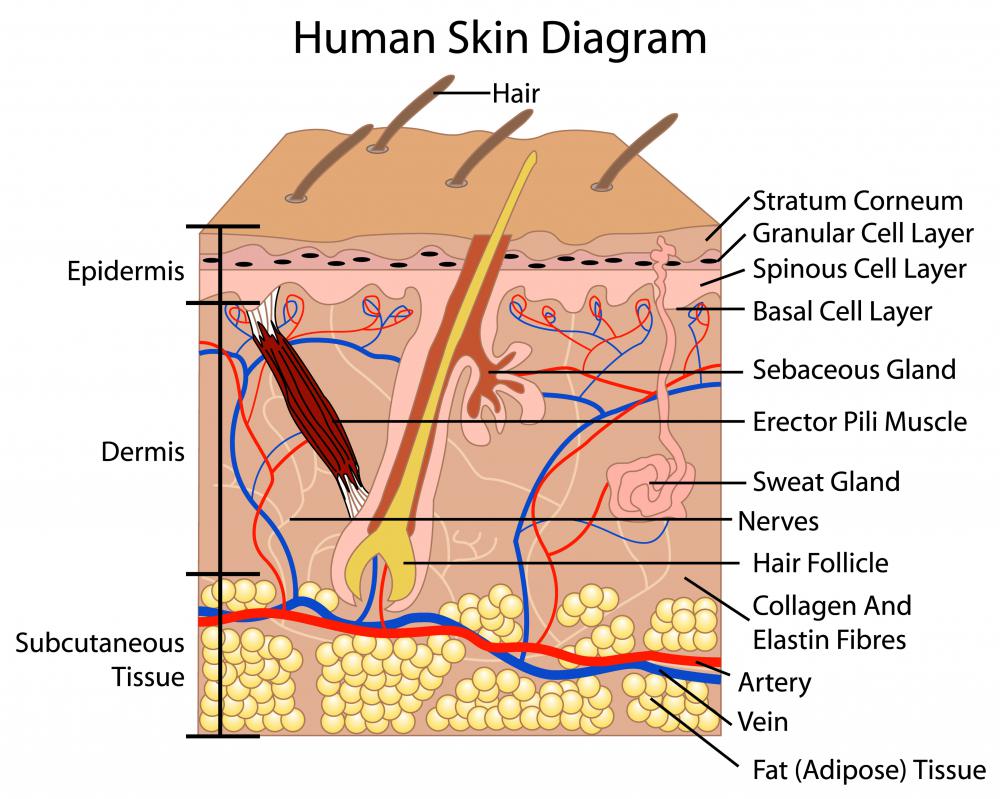
These glands are coiled, tubular structures in the epidermis, or skin. Each contains a special type of cell called myoepithelial cells that contract when activated. This motion squeezes the glands, excreting sweat directly onto the surface of the skin.
Human skin contains two types of sweat glands: merocrine and apocrine. Merocrine glands are more numerous and widespread, and shallower than apocrine glands. They are located all over the body, with the highest concentrations on the palms and soles of the feet. These glands are responsible for most of what people think of as perspiration.

Apocrine glands are located in the armpits, groin, and around the nipples. They secrete a more viscous, cloudy product and become active at puberty. The presence of bacteria in these glands sometimes causes a noticeable scent, which is part of why some people give off an obvious smell when they sweat. It has been hypothesized that these glands secrete pheromones, which can potentially communicate signals to others by affecting their hormonal levels.
Niki Foster
In addition to her role as a WiseGEEK editor, Niki enjoys educating herself about interesting and unusual topics in order to get ideas for her own articles. She is a graduate of UCLA, where she majored in Linguistics and Anthropology.
Learn more...
Niki Foster
In addition to her role as a WiseGEEK editor, Niki enjoys educating herself about interesting and unusual topics in order to get ideas for her own articles. She is a graduate of UCLA, where she majored in Linguistics and Anthropology.
Learn more...AS FEATURED ON:
AS FEATURED ON:









-
![Sweating is a natural function of the body.]() By: alexandre zveigerSweating is a natural function of the body.
By: alexandre zveigerSweating is a natural function of the body. -
![Glands produce sweat to cool off the human body when it gets too hot.]() By: roboriginalGlands produce sweat to cool off the human body when it gets too hot.
By: roboriginalGlands produce sweat to cool off the human body when it gets too hot. -
![People tend to sweat more in hot weather.]() By: umberto leporiniPeople tend to sweat more in hot weather.
By: umberto leporiniPeople tend to sweat more in hot weather. -
![An antiperspirant can help reduce sweating.]() By: karam miriAn antiperspirant can help reduce sweating.
By: karam miriAn antiperspirant can help reduce sweating. -
![A diagram of the human skin, including sweat glands.]() By: Anita PotterA diagram of the human skin, including sweat glands.
By: Anita PotterA diagram of the human skin, including sweat glands. -
![Sweat glands are located all over the body.]() By: camrockerSweat glands are located all over the body.
By: camrockerSweat glands are located all over the body.



Discussion Comments
@literally45-- You might want to get your hormones checked out because I had a friend who had the same issue and she was suffering from hyperthyroid.
I'm not sure how this is connected to the hypothalamus but I know that when the thyroid produces too much hormone, one of the symptoms is excessive sweating and also feeling really hot.
There might be a few other medical conditions that cause more sweat production than normal. You should see your doctor about this.
I also have an excess sweating problem but mine is all the time. I'm so tired of constantly changing my clothes because they're always soaked and it's very embarrassing. It doesn't seem to have anything to do with me being in stress or having anxiety.
Could there be something wrong with the functioning of my hypothalamus? Or maybe with my temperature receptors?
Why is my body producing so much sweat?
@anon109998-- I heard that the odor associated with armpit sweat forms when our sweat comes in contact with air. I suppose that's when the bacteria forms and that's why we use hygiene products under our arms. These products are supposed to prevent bacteria from growing there and that's how it prevents odor.
My friend has always said that dogs are lucky, because they don't have to deal with sweat problems like we do. I tell her that I would rather deal with water on my skin than have to walk around with my tongue hanging out all the time.
True, dogs don't get wet with sweat, but they do have to work pretty hard to regulate their temperatures. I've seen dogs pant so rapidly that they seemed on the verge of hyperventilation.
@feasting – The only way to stop sweating is to treat the source of the problem. I had the same issue that you had, but mine happened at work, and I was in my early twenties.
I had social anxiety disorder, and until I treated this, the sweating could not be stopped. I started taking an antidepressant, and this helped ease my stress over talking to people.
Once my issues with this went away, so did the excessive sweating. Now, I only sweat after exercise or when it's really hot outside.
As a teenager, I had problems with sweating in stressful situations. If I got nervous when talking to a new person or someone I had a crush on, then I would break out in a sweat.
I would get wet spots on my shirt under my arms within minutes. This really added to the self-consciousness and embarrassment that I already felt.
I grew out of this, but I have heard that some people have a chronic connection between nervousness and sweating. How do they deal with it? Is there some form of treatment?
@anon109998 – That answers I question I had. I wondered about pheromones, because they are supposed to be what attracts someone to someone else. I had wondered how this would be possible, since in order to produce pheromones, we would have to sweat, and sweat generally smells bad.
sweat doesn't smell until bacteria appear. the bacteria's favorite place to live is under the arms and pubic area because the liquid-like substances produced are milkier (and that's what's their favorite), so that's why it smells. sweat itself doesn't really smell.
I agree about Klima! I have to tell you that Klima Deodorant might be my favorite product on the market. It keeps my husband's armpits dry and smelling nice. It used to be a problem because he would sweat like a pig. Now, intimacy is easy.
Anyone who sweats too much in their underarms needs to try Klima Deodorant’s antiperspirant. It will dry you up like the desert! For real, it works great and lasts between three and five days. I swear by this stuff. Give it a try!
Why does sweat smell smelly?
Post your comments