
At DelightedCooking, we're committed to delivering accurate, trustworthy information. Our expert-authored content is rigorously fact-checked and sourced from credible authorities. Discover how we uphold the highest standards in providing you with reliable knowledge.
How is Kelp Used As Food?
 Mary McMahon
Mary McMahon
Mary McMahon
Kelp is a type of algae which has a number of uses in food, especially in Asian cuisine. It can also be processed to extract useful substances like alginate, which is used as a thickener in various commercially produced foods. Kelp can be purchased in a wide variety of forms, from fresh to dried, and it is also a component ingredient in an assortment of foods. In some cases, the focus of a dish may be on the algae, while in other instances, it is a supplemental ingredient, and consumers might not even notice it.
The term is generic for brown algae in the Laminaria genus. Kelp grows in large forests underwater that provide food and shelter to an assortment of marine organisms, and it has also traditionally been harvested by humans as a food vegetable. This algae has other uses as well; it can be burned to produce an ash used in come manufacturing industries, and it also can be used in fertilizer blends. Since kelp is rich in iodine, it is also a useful addition to the human diet.

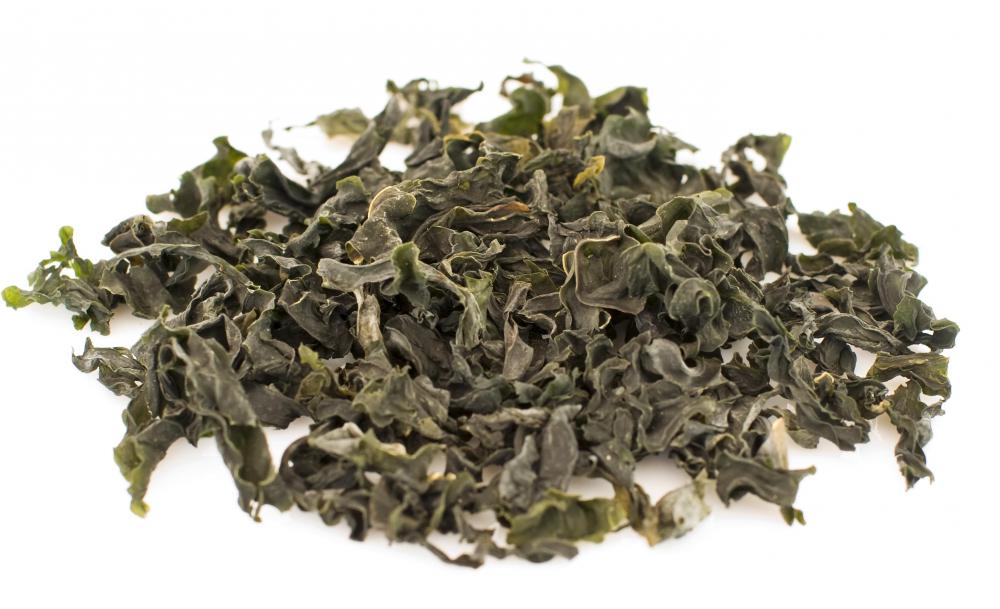
Most commonly, kelp is harvested and dried so that it can be packaged, shipped, and stored easily. When dried, it can be used like a garnish, rehydrated and added to foods like soup and stews, or ground up with doughs for crackers and other snack foods. The popular Japanese food called nori is also made from seaweed, but the seaweed is in a different genus, so nori is not considered a kelp product. Dried kelp is also used to create soup stocks.

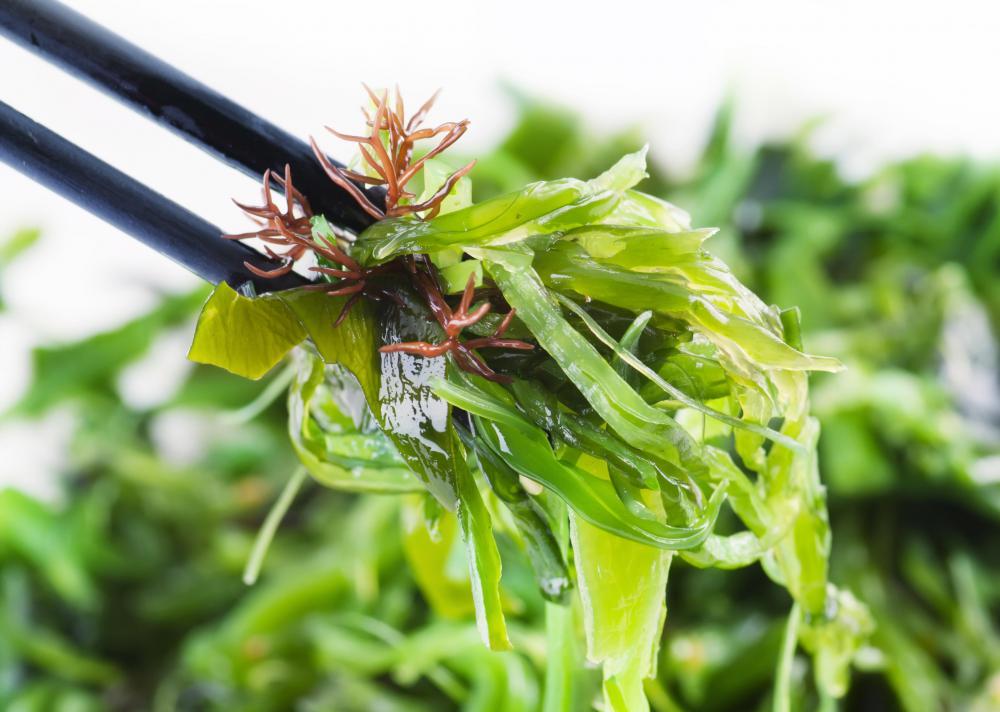
Fresh kelp has historically been used as a vegetable. It can be marinated to make salads, or included in mixed vegetable dishes. Various parts have different textures, from crunchy, dense stems to chewy leaves, allowing cooks to experiment with a range of mouthfeels when they use it in their food.
Dried kelp is often available in Asian markets or in health food stores, since some people like to use it as a dietary supplement. Some small regional producers make sun dried varieties that are handled without preservatives, for people who are concerned about additional ingredients in dried foods. A number of dried forms are available, from powders intended for soup stocks and spice mixtures to whole dried leaves that can be rehydrated. Dried versions should be stored in a cool, dry place, while fresh should be refrigerated and used quickly.
Mary McMahon
Ever since she began contributing to the site several years ago, Mary has embraced the exciting challenge of being a DelightedCooking researcher and writer. Mary has a liberal arts degree from Goddard College and spends her free time reading, cooking, and exploring the great outdoors.
Learn more...
Mary McMahon
Ever since she began contributing to the site several years ago, Mary has embraced the exciting challenge of being a DelightedCooking researcher and writer. Mary has a liberal arts degree from Goddard College and spends her free time reading, cooking, and exploring the great outdoors.
Learn more...AS FEATURED ON:
AS FEATURED ON:


-
![Sushi made with kelp.]() By: Radu RazvanSushi made with kelp.
By: Radu RazvanSushi made with kelp. -
![Dried kelp.]() By: sahua dDried kelp.
By: sahua dDried kelp. -
![Kelp is normally consumed in soups and shredded in salads, but can also be used as a dietary supplement.]() By: HLPhotoKelp is normally consumed in soups and shredded in salads, but can also be used as a dietary supplement.
By: HLPhotoKelp is normally consumed in soups and shredded in salads, but can also be used as a dietary supplement. -
![Kelp has a high iodine content, an essential nutrient.]() By: ksena32Kelp has a high iodine content, an essential nutrient.
By: ksena32Kelp has a high iodine content, an essential nutrient. -
![A nutrient-rich microorganism typically found in oceans and seas, seaweed has long served as a food for some populations.]() By: Picture PartnersA nutrient-rich microorganism typically found in oceans and seas, seaweed has long served as a food for some populations.
By: Picture PartnersA nutrient-rich microorganism typically found in oceans and seas, seaweed has long served as a food for some populations.


Discussion Comments
Beware. Kelp contains MSG. Enough said, you play with fire if you eat it on a regular basis.
I want to know if kombu can be substituted for nori although it's of a different genus. I'm making a tea that calls for sushi nori but I only have kombu and wasabi. I can't afford to keep buying all these different products to use 1/4 tsp, 1/3 cup.
@ PelesTears- Cooks usually use agar as a thickener in Japanese cuisine, but its water absorbing properties help with intestinal function.
Agar is made by boiling a certain type of kelp or seaweed, and drying the frothy jelly that forms on top. You can buy agar in its powder form in most Asian markets and health food stores.
To make a kid friendly laxative you will need three things; an ice cube tray, an ounce of agar, and two cups of no sugar added cherry or apple juice.
First, heat the juice just shy of boiling and take off the burner. Next, whisk in the agar. Once whisked in the agar will start to gel. Pour the gel into an ice cube tray and refrigerate until set.
The strong taste of the cherry or apple juice will mask the mild flavor of the agar, and the resulting cubes will be like firm jell-o.
I am not sure if Agar is a type of Kelp or Seaweed, but I heard you can use it as a gentle laxative for kids and adults. I want a gentle laxative for my child that is natural, but I do not know how to use agar. In fact, I am not even sure where to buy agar and what it is. Does anyone know how to use this product in this way, and where I can find some?
Post your comments