
At EasyTechJunkie, we're committed to delivering accurate, trustworthy information. Our expert-authored content is rigorously fact-checked and sourced from credible authorities. Discover how we uphold the highest standards in providing you with reliable knowledge.
How does Slow Motion Work?
 Mary McMahon
Mary McMahon
Mary McMahon
A slow motion effect is obtained by playing filmed material back at a rate slower than the rate which was used to film it, thereby staggering the frames and causing the action to appear slower, even though it actually occurred in real time. There are several ways to achieve this effect and it is a common film making technique seen everywhere from sports broadcasts to art films.
One way to create this look is to overcrank the camera being used to film, meaning that the camera films at a more rapid rate than it would normally. When the resulting film is projected with a projector using a regular rate, the overcranked film will be seen in slow motion. It is also possible to interpolate frames into film which has already been produced to slow down the action, creating slow motion. This technique is useful because it can be utilized in post-production, after the film has already been shot and someone decides that they want to see a slower version.

In films and television shows, a conscious decision is usually made to use slow motion ahead of time, and the camera will be overcranked at the appropriate time. In situations like sports shows, the slowed-down version is usually achieved by interpolating frames into film shot at normal speed. This type of slow motion is often used to highlight a moment of interest, or to replay fast action at a speed which people can actually see. At some sports games, one camera may overcrank continuously to make slowed-down instant replay available.
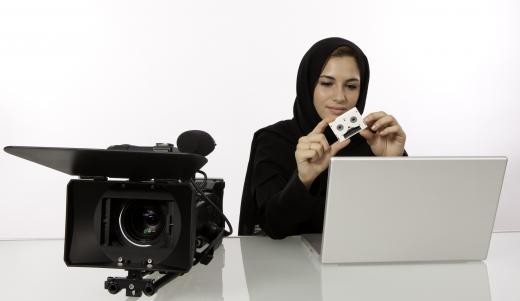
Frame interpolation can be tricky. Modern film makers have the advantage of computer programs which can be used to morph the two surrounding frames to create a new frame which will mesh seamlessly when the film is played back. Historically, the interpolated frames were sometimes made by copying one of the neighboring frames, which could create a choppy or strange look which often attracted the attention of critics. Blank frames were also sometimes inserted, which could cause the film to flutter in a rather distracting way when it was viewed.

The technique was developed by August Musger, an Austrian film maker who is unfortunately remembered for little other than this contribution to the art of filming. Musger worked in an era when filming and playback speeds were different than they are today, and he might be astounded to see the remarkably smooth and even look of modern slow motion.
Mary McMahon
Ever since she began contributing to the site several years ago, Mary has embraced the exciting challenge of being a EasyTechJunkie researcher and writer. Mary has a liberal arts degree from Goddard College and spends her free time reading, cooking, and exploring the great outdoors.
Learn more...
Mary McMahon
Ever since she began contributing to the site several years ago, Mary has embraced the exciting challenge of being a EasyTechJunkie researcher and writer. Mary has a liberal arts degree from Goddard College and spends her free time reading, cooking, and exploring the great outdoors.
Learn more...AS FEATURED ON:
AS FEATURED ON:









-
![Slow-motion technology is often used for showing replays during televised sports.]() By: Monkey BusinessSlow-motion technology is often used for showing replays during televised sports.
By: Monkey BusinessSlow-motion technology is often used for showing replays during televised sports. -
![Modern film makers use computer programs to create visual effects.]() By: Haider Y. AbdullaModern film makers use computer programs to create visual effects.
By: Haider Y. AbdullaModern film makers use computer programs to create visual effects. -
![A scene filmed a higher speed that normal can appear in slow motion when projected.]() By: drxA scene filmed a higher speed that normal can appear in slow motion when projected.
By: drxA scene filmed a higher speed that normal can appear in slow motion when projected.


Discussion Comments
@irontoenail - I don't agree. I think the magic of television and film comes from being able to create a scene or a story that resounds with people. Yes, many modern filmmakers don't care about that, but just as many do.
The film people think of when they think of slow motion special effects is The Matrix and it does make a lot of use of that technique in the fight scenes (something that's been copied by many people since then).
But I would argue that using that kind of slow motion frame rate in an innovative way wasn't what made the movie special. It was the story and the characters that made it like that. And that's been true since the dawn of film making and it's still true now.
Slow motion, like anything else, is just an effect and frankly I'm glad it's one that we take for granted now because I'd rather not be focusing on the effects when I watch a movie.
It must have been so interesting to be involved in the pioneering work of filmmakers back in the origins of film.
I mean, sure, their slow motion was choppy, but it was created by hand, frame by frame. The dedication and patience that that entails absolutely astounds me. And these days, you get trashy films where the director doesn't care how many explosions are happening as long as they fill up the screen. That kind of patience and dedication does still exist, but I think it is much more rare than it used to be.
When you can hit a button on your camera and you've got instant slow motion a little bit of magic is lost from the creation of that film.
You can also use slow motion on your TV.
Post your comments