
At AllThingsNature, we're committed to delivering accurate, trustworthy information. Our expert-authored content is rigorously fact-checked and sourced from credible authorities. Discover how we uphold the highest standards in providing you with reliable knowledge.
How do the Tides Work?
 Mary McMahon
Mary McMahon
Mary McMahon
Tides are caused by the gravitational pull of the Sun and the Moon on the Earth's surface. While most people associate them specifically with the ocean, the entire planet is subject to tidal forces, as is the atmosphere, and in fact all celestial bodies are influenced by these forces. The large volume of water on the Earth has made their actions particularly notable and interesting. Discussions of the movements of water can be found in the most ancient writings of the world, suggesting that people have long been intrigued by the once seemingly mysterious rise and fall of water along the shoreline.
As the Earth rotates, it is pulled on by the Moon and Sun. Because the Moon is much closer, its pull is approximately twice as strong as the pull of the Sun, which explains why the tides are so closely linked with the lunar day. As the Moon moves around the Earth, it creates a bulge of water on the Earth's surface which follows its movements. A corresponding bulge appears on the opposite side of the Earth, thanks to the centrifugal forces generated by the Earth's rotation.

There are a number of different types of tides. So-called “spring tides” occur when the Sun, Moon, and Earth are lined up all in a row, in a situation called “syzygy” by astronomers. During syzygy, the Moon and Sun are both pulling in the same direction, creating an especially large bulge and a correspondingly larger tide. In neap tides, the Sun and Moon are at right angles, exerting forces pulling in opposite directions and creating a lower tide. The difference between the high and low points is called the tidal range, and things that are alternately exposed and covered by the water are said to be in the intertidal zone.

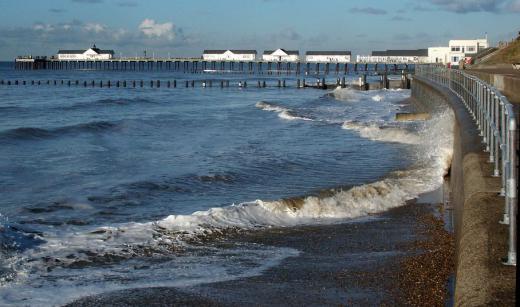
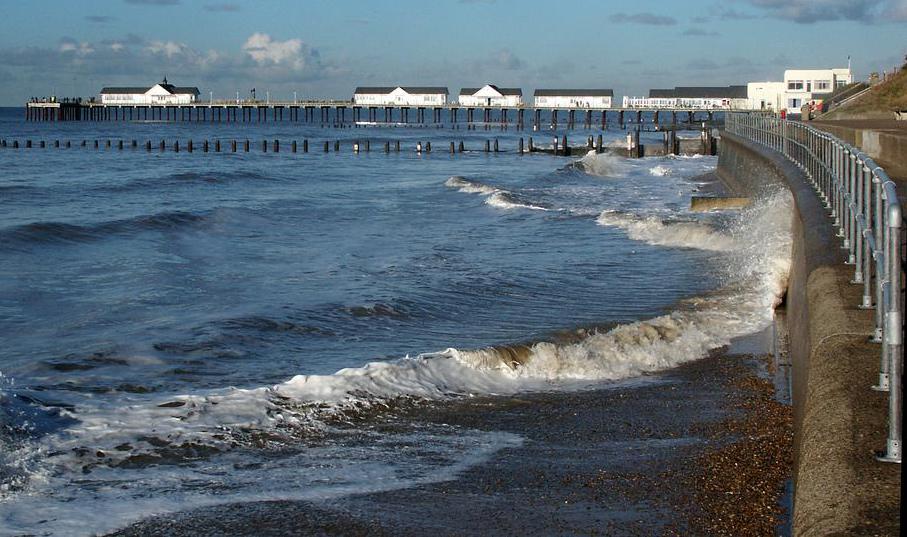
Tides vary radically around the world, depending on location and geographical features. As a general rule, they are less noticeable in the open ocean, and more pronounced along the shoreline, with places like the Caribbean and the Mediterranean having generally smaller tidal ranges, while the Canadian Bay of Fundy has an extremely large tidal range which can be as much as 50 feet (15 meters).

They also vary in frequency. In some locations, tides are diurnal, meaning that there is one high and one low tide every day. In other areas, they are semidiurnal, with two high and two low points. By observing tidal patterns in an area and keeping track of the movements of the Earth, Moon, and Sun, it is possible to create tide charts, predictions which list the time and height of various ones. These charts are extremely important for navigation, especially in areas with extreme tidal ranges.
Frequently Asked Questions
What causes the tides to occur?

The tides are primarily caused by the gravitational pull of the moon and, to a lesser extent, the sun. As the Earth rotates, the moon's gravity pulls on the Earth's oceans, creating a bulge of water that we experience as high tide. On the opposite side of the Earth, inertia creates another bulge, leading to a second high tide.
How often do tides happen?
Most coastal areas experience two high tides and two low tides every lunar day, which is 24 hours and 50 minutes long. This cycle is known as a semidiurnal tide pattern. However, some regions may experience only one high and one low tide each day, known as a diurnal tide pattern.
Why are there two high tides each day?
There are two high tides each day because the Earth has two tidal bulges at any given time. One is created by the gravitational pull of the moon on the side of Earth nearest to it, and the other is created on the opposite side due to the centrifugal force of the Earth-moon system's rotation. These bulges move around the Earth as it rotates, causing two high tides.
What is the difference between spring tides and neap tides?

Spring tides occur when the sun, moon, and Earth are aligned during the new and full moons, resulting in the highest high tides and the lowest low tides due to the combined gravitational forces. Neap tides happen during the first and third quarters of the moon when the sun and moon are at right angles, causing less extreme tides.
How do the positions of the sun and moon affect the tides?
The positions of the sun and moon relative to the Earth significantly affect the magnitude of the tides. When they are aligned (during full or new moons), their combined gravitational forces produce higher high tides and lower low tides, known as spring tides. When the sun and moon are perpendicular to each other, the gravitational forces counteract, resulting in milder neap tides.
Can weather affect tidal patterns?
Yes, weather can influence tidal patterns. Atmospheric pressure and strong onshore or offshore winds can modify the water level. A high-pressure system can push down on the sea surface, causing lower tides, while a low-pressure system can allow the sea to rise, resulting in higher tides. However, these effects are usually short-term and localized.
Mary McMahon
Ever since she began contributing to the site several years ago, Mary has embraced the exciting challenge of being a AllThingsNature researcher and writer. Mary has a liberal arts degree from Goddard College and spends her free time reading, cooking, and exploring the great outdoors.
Learn more...
Mary McMahon
Ever since she began contributing to the site several years ago, Mary has embraced the exciting challenge of being a AllThingsNature researcher and writer. Mary has a liberal arts degree from Goddard College and spends her free time reading, cooking, and exploring the great outdoors.
Learn more...AS FEATURED ON:
AS FEATURED ON:









-
![Tides can vary depending on the location.]() By: gdvcomTides can vary depending on the location.
By: gdvcomTides can vary depending on the location. -
![Tides generally are less noticeable in the open ocean than along the shoreline.]() By: Galyna AndrushkoTides generally are less noticeable in the open ocean than along the shoreline.
By: Galyna AndrushkoTides generally are less noticeable in the open ocean than along the shoreline. -
![The Moon's gravitational influence on the oceans of the Earth helps create the tides.]() By: Zhanna OcheretThe Moon's gravitational influence on the oceans of the Earth helps create the tides.
By: Zhanna OcheretThe Moon's gravitational influence on the oceans of the Earth helps create the tides. -
![Most people associate tides with the ocean.]() By: ikoMost people associate tides with the ocean.
By: ikoMost people associate tides with the ocean. -
![In neap tides, the sun and moon are at right angles, exerting forces pulling in opposite directions, creating a lower tide.]() By: pedrolIn neap tides, the sun and moon are at right angles, exerting forces pulling in opposite directions, creating a lower tide.
By: pedrolIn neap tides, the sun and moon are at right angles, exerting forces pulling in opposite directions, creating a lower tide. -
![The moon's pull is about twice as strong as the sun's pull.]() By: NajThe moon's pull is about twice as strong as the sun's pull.
By: NajThe moon's pull is about twice as strong as the sun's pull.


Discussion Comments
What is the reason for the tidal range being less in the Caribbean?
Can someone please explain to me how can two high tides and two low tides occur in one day?
Thanks for the explanation, however I'm not convinced it is a fully accurate explanation. I may be wrong, though. If tides are created by the Moon (leave the Sun apart) gravity, and if the Moon is above the Atlantic, then the center of the Atlantic should have a bulge (I'm OK), but the other side of the Earth, the Pacific, should experiment a level decrease, not a smaller bulge (the Moon's gravity is not "pushing", but "pulling"). To me, the rotation of the Earth makes all oceans bulging (centrifugal force) around the equator, but the Moon attraction adds to this bulge on one side (where there is the low tide), and subtract from this bulge on the other side (the bulge is smaller than the one created by the rotation).
I'm not either convinced by the difference in the Moon gravity field being so different between the opposite sides of the Earth (which in the article explain differences of bulges). Remember the Moon is at 384,000 km from the Earth, and the Earth diameter is only 13,000 km (3 percent). Anyone agreeing?
I was under the impression that it had more to do with how the horizontal gravity vector actually pushes the water horizontally to where the furtherest and closest points to the moon are? Thus the water bulges due to being pushed sideways along the Earth to where the both high tides are. Thank you for the valuable information.
@ Fiorite- The tidal forces of gravity that you wrote about are due to the properties of gravitational waves. The tidal effects of gravity are controlled by the properties of vertical and horizontal separation.
Gravitational waves pull to the center of an object. This causes objects vertically aligned to the axis of the force of gravity to pull away from each other. This is because the object closest to a gravitational force will accelerate towards its center slightly faster than the object farther away. The ocean closest to the moon accelerates to the moon faster than the ocean on the far side of the earth.
The horizontal separation property of the tidal effect causes two objects that are spaced horizontally to decrease their horizontal separation as they move towards the gravitational force. This is the phenomenon of tidal contraction. The water pulls horizontally across the earth's surface toward the center of the gravitational force. This causes the ebb and flow of the tides.
@ Anon77673- Most tides are semidiurnal because of the physics of gravity and the relationship between the earth and its oceans. When the moon is pulling on one side of the earth it pulls both the earth and everything on it, but the earth is somewhat elastic.
The tidal forces of gravity cause the side of the earth closest to the moon to accelerate faster than the side of the earth farthest from the moon. This is because gravity is not a uniform force, becoming weaker the farther the objects are from each other.
The far side of the earth moves slower in relation to the center side of the earth causing an opposite tidal bulge on an ocean centered on the far side. This will create a corresponding tide on the opposite side of the earth.
I'll give an example. The Atlantic Ocean is centered below the moon on one side of the earth. This creates a low tide because the center of the ocean is bulged causing the ocean to move away from the shore. The Pacific Ocean will bulge in the center on the opposite side of the earth, creating a corresponding tide. If the edge of an ocean is centered under the moons gravitational force then a high tide forms.
I don't get the two tides a day explanation. The Moon (and to a lesser extent the sun) pull a bulge of water creating a tide that follows them around. How does "centrifugal force" create a bulge 180 degrees out from the gravitational pull?
Surely this force pulls in proportion to the mass of the body of water and would exaggerate the gravitational pull and minimize any tendency to have an opposing bulge to the that caused by the moon's gravity?
Post your comments