
At TheHealthBoard, we're committed to delivering accurate, trustworthy information. Our expert-authored content is rigorously fact-checked and sourced from credible authorities. Discover how we uphold the highest standards in providing you with reliable knowledge.
How do Taste Buds Work?
 Niki Foster
Niki Foster
Niki Foster
The tongue, soft palate, and epiglottis are covered with structures known as taste buds, or lingual papillae, that allow humans to sense different tastes in the foods they eat. They are chemoreceptors, meaning that they transduce, or translate, chemical signals in food into electrical signals in the body. These electrical signals, called action potentials, travel to the brain via the nervous system, allowing us to experience the sensation of taste. Taste buds are known as direct chemoreceptors, meaning that they must make direct contact with the chemicals in food in order for us to taste. Distance chemoreceptors, on the other hand, such as those that sense smells, do not need to make direct contact with chemicals.
There are five distinct tastes that can be registered by the taste buds, but whether each one can sense one or many tastes is not known. The ability to sense each taste is present in all areas of the mouth. The five tastes are salty, sweet, bitter, sour, and umami or "savory" -- each linked to a specific chemical in foods. In general, humans have evolved to find salty, sweet, and umami foods pleasant, while sour and bitter foods are usually unpleasant. This is because sour and bitter tastes may indicate rotten food or poison, while nutritious, high-calorie foods usually taste salty, sweet, or savory.

Taste buds sense salty and sour tastes through ion channels triggered by electronically charged particles, or ions, in certain foods. Salty foods contain the chemical sodium chloride (NaCl), commonly called table salt, each molecule of which is composed of a positively charged sodium ion and a negatively charged chlorine ion. The sodium ions trigger ion channels in the taste buds, changing the electrical charge of the cells and beginning an action potential. Similarly, sour foods contain acids, which have positively charged hydrogen ions that create an action potential in taste buds.

Bitter, sweet, and umami foods are sensed by the taste buds through G-protein coupled receptors, a more sophisticated mechanism that is not as well understood as that of ion channels. The compounds in bitter and sweet foods trigger G-protein coupled receptors to release a messenger protein known as gustducin, which in turn triggers certain molecules that close potassium ion channels, creating an action potential. The mechanism through which umami is sensed is similar, though triggered by the amino acid L-glutamate.

Three cranial nerves are responsible for carrying the action potential initiated in taste buds to the brain, where taste is ultimately registered. The facial nerve carries signals from the front two-thirds of the tongue, the glossopharyngeal nerve from the back portion of the tongue, and the vagus nerve from the soft palate and epiglottis.
Niki Foster
In addition to her role as a TheHealthBoard editor, Niki enjoys educating herself about interesting and unusual topics in order to get ideas for her own articles. She is a graduate of UCLA, where she majored in Linguistics and Anthropology.
Learn more...
Niki Foster
In addition to her role as a TheHealthBoard editor, Niki enjoys educating herself about interesting and unusual topics in order to get ideas for her own articles. She is a graduate of UCLA, where she majored in Linguistics and Anthropology.
Learn more...AS FEATURED ON:
AS FEATURED ON:


-
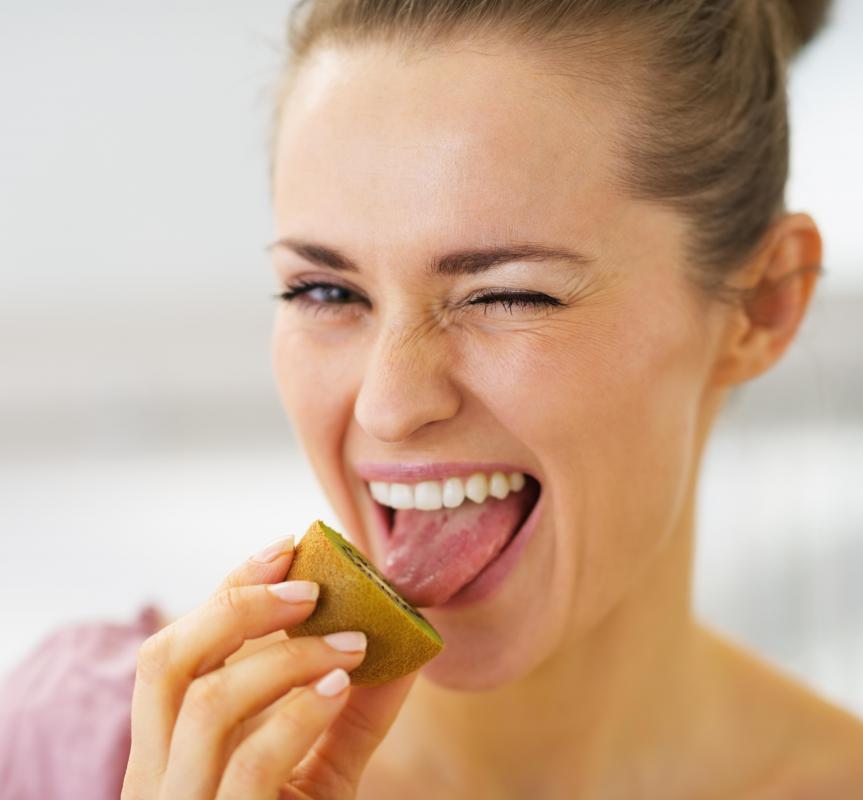
![Taste buds work as receptors and translate chemical signals into electrical signals for the brain.]() By: Ivan MonteroTaste buds work as receptors and translate chemical signals into electrical signals for the brain.
By: Ivan MonteroTaste buds work as receptors and translate chemical signals into electrical signals for the brain. -
![he sodium ions trigger ion channels in the taste buds, changing the electrical charge of the cells and beginning an action potential.]() By: extender_01he sodium ions trigger ion channels in the taste buds, changing the electrical charge of the cells and beginning an action potential.
By: extender_01he sodium ions trigger ion channels in the taste buds, changing the electrical charge of the cells and beginning an action potential. -
![The five distinct tastes are salty, sweet, bitter, sour, and savory, with each being linked to specific chemicals in food.]() By: AllianceThe five distinct tastes are salty, sweet, bitter, sour, and savory, with each being linked to specific chemicals in food.
By: AllianceThe five distinct tastes are salty, sweet, bitter, sour, and savory, with each being linked to specific chemicals in food. -
![The tongue is the major organ for taste, and circumvallate papillae serve as its taste buds.]() By: stockshoppeThe tongue is the major organ for taste, and circumvallate papillae serve as its taste buds.
By: stockshoppeThe tongue is the major organ for taste, and circumvallate papillae serve as its taste buds. -
![Young children typically find sweet substances palatable.]() By: famveldmanYoung children typically find sweet substances palatable.
By: famveldmanYoung children typically find sweet substances palatable.




Discussion Comments
So which taste registers first? I am a chef and I like to layer different ingredients into my dishes so the person eating the dish can experience different levels of taste as they eat.
I have a salad for instance, that has romaine lettuce, salsa and apples that I put a olive oil and sea salt dressing on. Simple, but as you eat it, you taste sweet and salty. I seem to experience the salty first then the apple hits me after a few seconds of chewing. As chefs, we want to create these taste levels for a enjoyable meal!
How do the taste buds affect your brain?
Does having diabetes affect my tastebuds? I'm sad.
@Whynhow: I am not exactly sure, but it could be a possibility that the temperature of the water might be affecting the chemical properties of the water, possibly causing carbohydrate bonds to break or mix with other molecules in the solution as the heat would cause an increase in the energy levels of the molecules, loosening the bonds. But this is just a guess. I'm not exactly qualified to answer this.
Number 1, you may have a rare case of cacoguesia, a permanent bad taste in the mouth. Now, normally, the taste is metallic or sour but this has led me to believe you do, in fact, have cacoguesia.
But it doesn't answer my question on why we have them!
what kind of acids does the savory taste buds have? how does this system work?
I read all these comments and I had answered to a lot of them so I thought I would answer them.
To number 4 yes, the heat of a substance does change how it tastes due to the fact that the taste buds will perceive the substance differently due to its level of thermal energy.
Number 5: No idea. awesome idea though.
Number 10: Yeah what your experiencing probably is not good your body if lacking or rejecting something will trick you into eating things or not eating other thing due to what your body needs or know it doesn't need. So that bad taste is either the food had gone bad, some sort of mold was on it or your body is telling you that you don't need it. number
I'm 81. i can still taste.
i hate smoking but i don't know why i still do it. i can't help it.
anon71905: As we age, eventually our tastebuds do not get replaced. An aged person can have as little as 5000 tastebuds, that is a reduction in half.
I am 53 and I have suddenly developed a bad taste when I eat some foods. The taste is the same but it does not occur with all foods. The smell of those food is bad too.
For examples bananas do not taste at all. Ranch dressing, some dishes, our dinner tonight all had the same bad taste and smell. I have good mouth care daily but this doesn't help.
The only changes that have occurred is that now I take Lexapro and two months ago I had a concussion. Could either of these things caused this reaction to food?
There aren't taste areas of the tongue as in the left side tastes sweet, etc.
Do we have the same taste sensation of sweet, bitter, sour etc.? when we taste "sweet", do we mean we taste the same taste sensation as each other? since we belong to same species, and have the same kind of tastebuds?
Do our tastebuds work the same way as each other? Do our tastebuds ensure we perceive "sweet" and "bitter" similarly?
Does a pizza taste the same to two different people? I do not mean the level of tastiness, but whether "sweet" is sweet, "sour" is sour?
How did our tastebuds affect what taste sensations we perceived? Is it the same?
I had this question when I saw a dog eat a biscuit. Does a biscuit taste like a biscuit to a dog? What if it is totally a different taste? What about between humans?
Why does chilled sugar solution taste sweeter than the same when warmed? Is it something to do with the chemo receptors in buds? Help, anyone?
It appears that our taste buds change as we go through life, so some foods that we did not like at one point in our life become quite pleasurable.
I have stopped eating salted foods, why do I have a salty taste in my mouth all the time?
Post your comments