
At WiseGEEK, we're committed to delivering accurate, trustworthy information. Our expert-authored content is rigorously fact-checked and sourced from credible authorities. Discover how we uphold the highest standards in providing you with reliable knowledge.
How do I Treat Impetigo?
 Tricia Christensen
Tricia Christensen
Tricia Christensen
Impetigo is an infection of the skin caused by Streptococcus or Staphylococcus aureus. It can be very contagious, especially among children, and it needs proper treatment right away. There are many incorrect suggestions for how to treat the condition, some of which even suggest leaving it alone or simply soaking the infection regularly in various substances. Due to its potential for complication, however, it is not recommended that people attempt methods that don’t involve some form of antibiotic treatment. Under some circumstances, especially in kids, a rare complication that can harm the kidneys may develop when people fail to treat the infection.
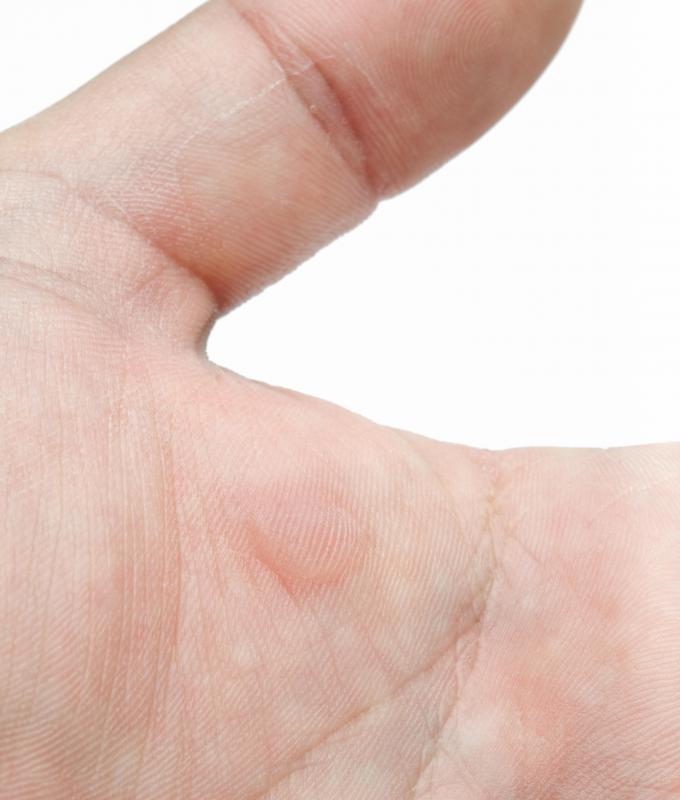
People who think they might have impetigo should see a medical professional to get a clear diagnosis. The main symptom of the disease is a rash that appears on the face or on the hands, where it can create blisters that eventually ooze and then crust over. The rash can show up elsewhere, but any blistery rash could indicate other illnesses too, like chicken pox. The scab or crust part will look different than chicken pox scabs, but in the blister stage, one might be mistaken for another. Patients should alert their healthcare provider when heading to the medical office to let them know about the blisters, as there may be different protocol if chicken pox are suspected.

Medical professionals usually take one of two approaches to treat this infection. They may recommend an oral antibiotic to kill the bacteria, or they could recommend a topical antibiotic, with instructions to return if it isn’t clearing up the problem. If the rash is on the hands, it’s usually advised people cover it with loose bandages — gauze and tape works well — to minimize the chances of passing the condition to others. It may be harder to cover rash on the face, and it’s strongly advised people don’t touch or scratch the exposed rash. People may need to keep their hands in their pockets, wear mittens, or tape gauze on the affected part of the face, but they should try to avoid touching the rash. It's especially important for patients to avoid scratching it, since this may make it worse or spread the rash elsewhere.

Since impetigo does itch, there are some helpful hints for reducing the irritation. Oatmeal baths or soaks may reduce some of the discomfort, as can using vinegar. Some anti-itch creams with diphenhydramine may be useful, and oral diphenhydramine can help too, though it will usually make the patient very sleepy.
Given the contagious nature of impetigo, patients need to be isolated from large groups of people, so they should not go to school or spend time in public areas where many other people gather. The infection usually clears up in a few days with proper treatment, but medical professionals usually advise that children not attend school while a case is still infectious. Even a covered rash may weep and spread to others. Schools and other groups may include people who are medically vulnerable or have impaired immune systems, and while the infection is only a transient and annoying illness for many, for the medically vulnerable, it may be very severe.
Tricia Christensen
Tricia has a Literature degree from Sonoma State University and has been a frequent WiseGEEK contributor for many years. She is especially passionate about reading and writing, although her other interests include medicine, art, film, history, politics, ethics, and religion. Tricia lives in Northern California and is currently working on her first novel.
Learn more...
Tricia Christensen
Tricia has a Literature degree from Sonoma State University and has been a frequent WiseGEEK contributor for many years. She is especially passionate about reading and writing, although her other interests include medicine, art, film, history, politics, ethics, and religion. Tricia lives in Northern California and is currently working on her first novel.
Learn more...AS FEATURED ON:
AS FEATURED ON:









-
![Antibiotics are sometimes prescribed to treat impetigo.]() By: WavebreakmediaMicroAntibiotics are sometimes prescribed to treat impetigo.
By: WavebreakmediaMicroAntibiotics are sometimes prescribed to treat impetigo. -
![Loose bandages help prevent the spread of the impetigo rash to others.]() By: Vivian SeefeldLoose bandages help prevent the spread of the impetigo rash to others.
By: Vivian SeefeldLoose bandages help prevent the spread of the impetigo rash to others. -
![Impetigo skin infections may present as blisters on the hands.]() By: leschnyhanImpetigo skin infections may present as blisters on the hands.
By: leschnyhanImpetigo skin infections may present as blisters on the hands. -
![Impetigo can resemble chicken pox.]() By: Gabriel BlajImpetigo can resemble chicken pox.
By: Gabriel BlajImpetigo can resemble chicken pox. -
![Oral diphenhydramine side effects may include fatigue.]() By: Andres RodriguezOral diphenhydramine side effects may include fatigue.
By: Andres RodriguezOral diphenhydramine side effects may include fatigue.




Discussion Comments
Vitamin deficiencies can cause impetigo. My impetigo was treated when I started taking vitamins.
@feruze-- I'm not a doctor but as far as I know, herpes blisters usually show up around the mouth, on the lips and sometimes inside the mouth. Genital herpes will also cause blisters in the genital area. Impetigo blisters can appear anywhere on the face, and on the rest of the body, not just at the mouth so that's one way to differentiate. I don't think impetigo causes blisters in the genital area but I'm not sure.
Also, impetigo is a bacterial infection and requires a treatment with antibacterials. Herpes is a viral infection and so antibacterial medications will not be effective for it. A blood test or a sample from the blister will give a definitive answer as to which type of infection it is.
That's why it's important to have a doctor diagnose this and prescribed medication rather than doing home remedies to treat it. Because it can easily be misdiagnosed as something else.
@dega2010-- Do you have a rash or blisters?
The article says these are the main symptoms and I do have blisters. The problem is, I don't know if the blisters are caused by impetigo or something else. From what I understand, blisters can be caused by many viral conditions. For example, they could be caused by the herpes simplex viruses as well. And herpes blisters and impetigo blisters sound very similar in characteristics.
How do we tell them apart? Does anyone know?
@dega2010: Impetigo usually starts as red sores on your face, nose or mouth. It often occurs when bacteria enter the skin through insect bites or cuts but it can also develop in healthy skin as well. Impetigo sores may rupture and ooze for several days. After that, it usually forms a honey-colored crust.
There is also what is called Bullous impetigo. It causes fluid-filled blisters, usually on the arms and legs of infants of children 2 and under. The skin will usually be itchy and red but not normally sore.
The most common form of impetigo is nonbullous, also known as impetigo contagiosa. Normally, you will not have a fever with this type but it is highly contagious.
What are the impetigo symptoms? How would I know if I had impetigo?
Post your comments