
At WiseGEEK, we're committed to delivering accurate, trustworthy information. Our expert-authored content is rigorously fact-checked and sourced from credible authorities. Discover how we uphold the highest standards in providing you with reliable knowledge.
How Do I Become an HIV Specialist?
The specifics for becoming a specialist in the human immunodeficiency virus (HIV) tend to vary a little bit from place to place, but in general the designation is available only to people who are already qualified as medical doctors and who have gained sufficient expertise in diagnosing and treating the virus to pass an exam or series of exams. There are usually a number of other prerequisites, including medical specialty, years spent in active practice, and overall experience working with HIV patients and lab scans. In most cases, you don’t need this credential in order to practice HIV-related medicine. Many doctors find that it enhances their credibility, though, and it might also make you more competitive for certain high profile or research-related positions. The credential might also enable you to more effectively conduct and share research with others.
Understanding the Job Generally

An HIV specialist is, generally speaking, a doctor who spends the majority of his or her time researching or actually treating the virus. The standard of care and best practices for treating infected patients has changed a lot in recent years, and continues to evolve as practitioners learn more about how the virus works. Most aspects of medical practice are “in flux” in this regard, but HIV often takes a special place near the top of most research priorities because of the demand for expertise worldwide. This virus is often considered a global health threat, and finding better treatments with an eye towards one day discovering a cure is often considered crucial work.

Specialists in this field usually earn their title through a combination of experience and additional study. You’ll want to research the specifics in your particular jurisdiction, but in general, you’ll need to first get involved in treating HIV-positive patients; then, you’ll want to complete HIV-related continuing medical education (CME), continuing education units (CEU), or continuing education (CU) courses; and, finally, you’ll need to pass an exam testing your knowledge of the virus and how to treat and diagnose it on an individual level.
Required Licenses and Credentials

The first thing you’ll normally need to do is earn a medical degree and pursue a license to practice to medicine in the jurisdiction where you want to be certified as a specialist. This is usually a complicated feat, and typically requires at least six years of post-secondary education and numerous competency and proficiency exams.
Depending on where you are, you might also be required to have treated a certain number of patients prior to applying. Doctors who have treated less than the prescribed volume of HIV patients may still apply to become an HIV specialist, but you’ll likely be admitted on a probationary basis and assigned to an experienced specialist for peer reviews and practice updates for a certain period of time. This is done to form a mentoring relationship between experienced doctors and doctors who have less HIV-specific experience.
Advanced Training and Education

Advanced training or education related to the treatment of HIV is something else you’ll probably be required to undertake. In some cases this can be satisfied if you’ve earned at least 30 credits in HIV-related Category 1 CME/CEU/CU courses within two years of applying to become an HIV specialist. You may also be able to satisfy this requirement with HIV fellowships, training, or attendance of HIV lectures. These substitutes must be summarized in detail and included with the application, and may not be available in all places. Talking with someone in your local board office or certification panel is usually the only way to know for sure.
Testing

Once you’ve submitted your application, the governing body awarding the credential will probably require you to sit for an exam that will test your applied knowledge of the virus, its treatments, and best practices for care and future research. Depending on where you are you may have the choice of taking the test online or by written exam. Regulatory bodies typically allow physicians taking the exam to use any reference book, classes, or websites to prepare for the exam, and there are many study materials to choose from; in most cases, you’ll want to schedule your test far enough off in the future that you have time to research and avail yourself of these sorts of study options.
Potential Career Benefits

There are many reasons you might find it advantageous to carry the credential of HIV specialist. Patients often take comfort in the knowledge that their primary care provider has taken extra steps in her understanding of HIV treatment, for instance. Doctors who achieve this designation are also usually granted access to a network of information and support not always available to general practitioners.
AS FEATURED ON:
AS FEATURED ON:









-
![HIV specialist candidates must pass a multiple-choice exam.]() By: uwimagesHIV specialist candidates must pass a multiple-choice exam.
By: uwimagesHIV specialist candidates must pass a multiple-choice exam. -
![HIV specialists must understand how multiple antiretroviral drugs work together to control HIV infections.]() By: danilkorolevHIV specialists must understand how multiple antiretroviral drugs work together to control HIV infections.
By: danilkorolevHIV specialists must understand how multiple antiretroviral drugs work together to control HIV infections. -
![HIV specialists are physicians with medical practices that include the treatment of HIV.]() By: Monkey BusinessHIV specialists are physicians with medical practices that include the treatment of HIV.
By: Monkey BusinessHIV specialists are physicians with medical practices that include the treatment of HIV. -
![Exposure to bodily fluids during the mouth-to-mouth rescue breathing and CPR process can expose individuals to HIV.]() By: Riccardo PiccininiExposure to bodily fluids during the mouth-to-mouth rescue breathing and CPR process can expose individuals to HIV.
By: Riccardo PiccininiExposure to bodily fluids during the mouth-to-mouth rescue breathing and CPR process can expose individuals to HIV. -
![Receiving a blood transfusion may increase an individual's risk of contracting HIV.]() By: Max TacticReceiving a blood transfusion may increase an individual's risk of contracting HIV.
By: Max TacticReceiving a blood transfusion may increase an individual's risk of contracting HIV. -
![An HIV specialist must have an in depth understanding of how the human immunodeficiency virus operates within the body.]() By: designuaAn HIV specialist must have an in depth understanding of how the human immunodeficiency virus operates within the body.
By: designuaAn HIV specialist must have an in depth understanding of how the human immunodeficiency virus operates within the body. -
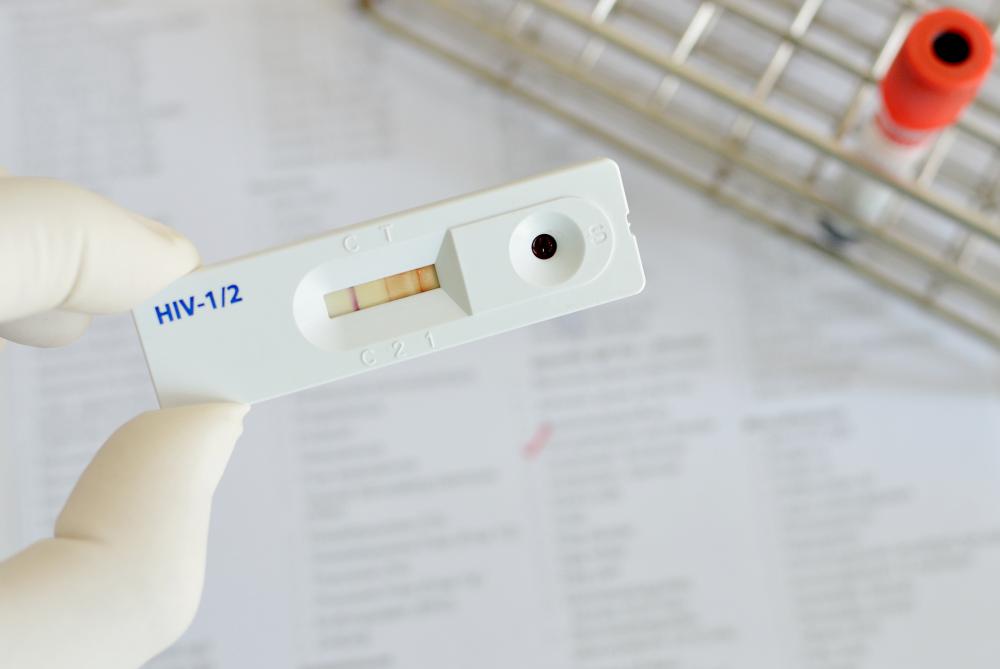
![An HIV specialist will be well-versed in the different types of testing, and how to confirm results.]() By: jarun011An HIV specialist will be well-versed in the different types of testing, and how to confirm results.
By: jarun011An HIV specialist will be well-versed in the different types of testing, and how to confirm results.


Discuss this Article
Post your comments