
At PracticalAdultInsights, we're committed to delivering accurate, trustworthy information. Our expert-authored content is rigorously fact-checked and sourced from credible authorities. Discover how we uphold the highest standards in providing you with reliable knowledge.
How do I Become a Political Campaign Manager?
In many aspects, politics is a game defined by the people one knows. Therefore, to become a political campaign manager, the best path may be the one that leads to the center of the action and offers access to necessary contacts. Aspiring campaign managers can find ways to offer services along campaign trails, most likely by beginning as a volunteer and climbing the ranks. To gain more of an edge, managers also may benefit from a college degree in political science, government, or a similar field.
The most direct way to become a political campaign manager may be by starting as a campaign volunteer or intern. Political campaigns of every creed and color are generally eager for volunteers. Often, all it takes is the effort to walk into a campaign office and express interest.

Before volunteering, hopeful campaign managers may think carefully over what party and ideals with which to affiliate. Parties naturally tend to hire staff with a history of supporting their causes. For instance, to work as a political campaign manager for a Republican candidate, it may not be wise to begin volunteering for Democratic causes. Volunteering during relatively calm political waters may be helpful as well. Campaigns may use volunteer services in the midst of caucus mania, but they're less likely to remember and observe individual merit during all the hype.

After securing a volunteer position, clarifying ambitions to the campaign staff may be the next step; explaining intentions to go beyond basic volunteer duties, such as handing out political swag, may help an ambitious volunteer stand out. Candidates can ask campaign leaders if they need volunteer coordinators as well. Though not often paid, volunteer coordinators generally get the advantage of taking on many of the same responsibilities of a paid staffer. These responsibilities can include actively recruiting and managing a team of volunteers as well as taking a lead position in the coordinating of special events, such as fundraisers.

Once a volunteer has gained experience and excelled in the position, he or she may find it easier to get hired on as paid staff, with a greater range of responsibilities. Staff members often find themselves in more direct contact with the leaders of a campaign and possibly the political candidates themselves. These types of connections can be very helpful for those wanting to become a political campaign manager in future election cycles.

Campaign managers tend to have as much pressure and responsibility as the actual candidates. In fact, many political candidates often have little contact with their paid and volunteer staffs, leaving those duties to the campaign manager. As a result, a manager should be prepared to work around the clock, helping the candidate fine-tune his or her next campaign speech, making sure the right message is conveyed through political ads, and overseeing all hiring and managing of campaign staff.

There generally are no specific education requirements to find work as a political campaign manager. A high school diploma or its equivalent may be expected, and a degree in political science may give an aspiring manager a competitive edge. Successful managers typically have strong communication skills, are comfortable addressing the media, and have strong writing, computer and Internet skills. There really is no rule as to what level of campaign to start working with, but it's generally easier to begin with a smaller, local campaign. An aspiring candidate may become a political campaign manager by helping a candidate run for city council. Successfully managing campaigns on city and regional levels can serve as a stepping stone toward managing campaigns on broader platforms.
AS FEATURED ON:
AS FEATURED ON:


-
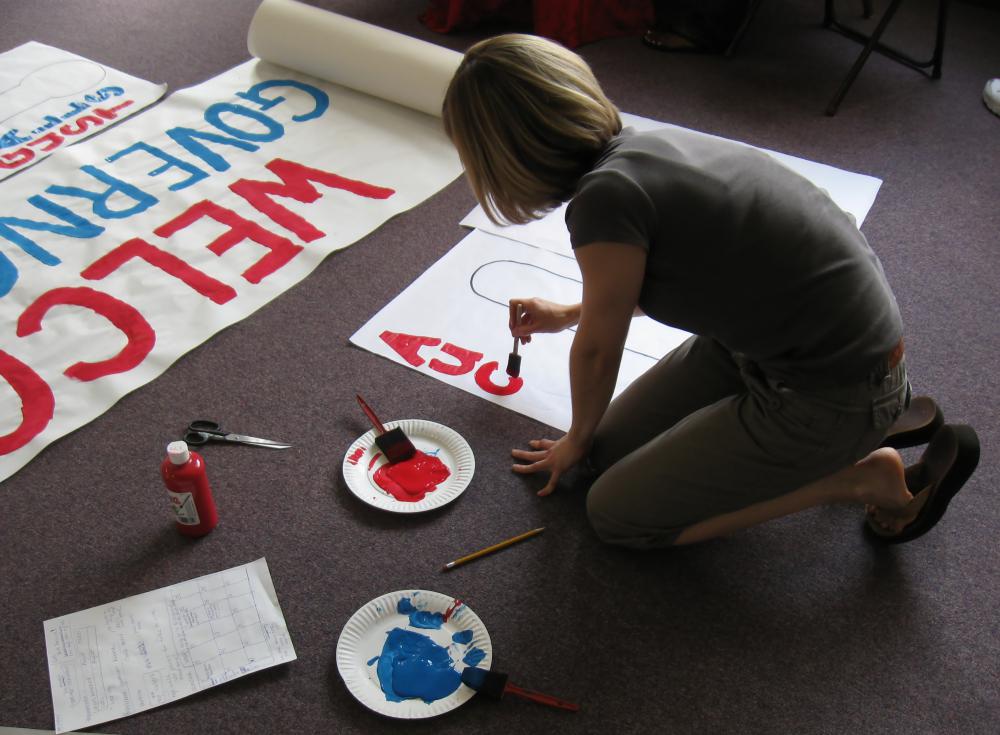
![Hands-on experience with a campaign may be useful to those who want to become campaign managers.]() By: Christopher MartinHands-on experience with a campaign may be useful to those who want to become campaign managers.
By: Christopher MartinHands-on experience with a campaign may be useful to those who want to become campaign managers. -
![Political campaign managers usually have experience talking with voters.]() By: razihusinPolitical campaign managers usually have experience talking with voters.
By: razihusinPolitical campaign managers usually have experience talking with voters. -
![Political campaign managers might give speeches to get donations on behalf of their candidate.]() By: Photographee.euPolitical campaign managers might give speeches to get donations on behalf of their candidate.
By: Photographee.euPolitical campaign managers might give speeches to get donations on behalf of their candidate. -
![Campaign managers tend to have as much pressure and responsibility as the actual candidates.]() By: Photo_MaCampaign managers tend to have as much pressure and responsibility as the actual candidates.
By: Photo_MaCampaign managers tend to have as much pressure and responsibility as the actual candidates. -
![Campaign managers must take charge of both paid and volunteer staff.]() By: Andres RodriguezCampaign managers must take charge of both paid and volunteer staff.
By: Andres RodriguezCampaign managers must take charge of both paid and volunteer staff.




Discussion Comments
Sunny27-Although everyone says that they hate negative ads, they are very effective. For example, many feel that the political consultants that John McCain hired failed him because they did not resort to negative ads.
They were almost afraid of pointing out Obama’s flaws and as a result he got a pass and instead John McCain’s negatives added up.
Obama’s associations were relevant to his character and if Mc Cain would have had a bolder campaign maybe he would have won. He went so far as to fire a campaign staffer that referred to Obama by his middle name of Hussein. What was wrong with that? After all wasn’t that Obama’s name?
I really wish Giuliani had won the Republican nomination. There is no question his campaign would have been hard fought and he would have challenged Obama instead of giving him a pass. Perhaps our political news would have been different and we would have had a different President today.
Cupcake15-Many candidates use political campaign management software to keep track of statistical data and polling numbers.
Often robo calls are performed in order to get the candidate’s message out in certain key geographic area. Robocalls are automated campaign messages that are offered to likely voters of the candidates’ political party.
The robocall is an efficient measure to relate information to the party’s base and use other volunteers for other tasks.
Political campaign management requires you to be one step ahead of an opponent and some politicians resort to hiring a private investigator in order to uncover unsavory details of their opponent.
When this information is revealed the element of surprise as a political strategy requires the opponent to be placed on the defensive and this is where most political campaigns take off.
This is what is happening in Florida in the Governor’s race. Alex Sink is on the defensive because of her reported failures managing pension funds as well as her cheating on governor's debate in which a text message was sent to her during a break which violated the debate rules.
Since then all of her commercials and speeches are defensive which is not a good place to be if you want to win.
Political campaign management is critical to in order to have the best chances of success. First a candidate must hire a treasurer.
A treasurer will be in charge of your campaign finance and this is the most important first step. Next, you will have to decide if you would like to hire a political consultant that will advise you on your campaign, or hire a campaign manager to run the campaign for you.
You will also have to determine if you have sufficient funds to hire a professional pollster so that you can gauge what your target market is thinking and feeling.
In addition, you will have to make public speeches that will entice volunteers that are willing to work for your cause. Volunteers are critical because campaigns have limited funds. You must brush up your public speaking skills right away.
Post your comments