
At WiseGEEK, we're committed to delivering accurate, trustworthy information. Our expert-authored content is rigorously fact-checked and sourced from credible authorities. Discover how we uphold the highest standards in providing you with reliable knowledge.
How Do I Become a Cytogenetic Technologist?
Becoming a cytogenetic technologist usually requires a combination of university education and experience in the field, and certification and a commitment to regular training throughout your career might also be needed. The job usually requires a lot of precision and an attention to detail, but in most cases it is possible to get hired right out of school. You may need to spend some time networking and looking for openings the same as you would for most jobs. Your university will probably have a career services or placement office that can help you make the right connections, though, which can speed the process in most cases. People with cytogenetic expertise are in high demand in most parts of the world, and it’s often the case that getting into an educational program and getting the right training is harder than actually finding a position. A lot of this depends on the individual, though, and there are a number of skills and personal attributes that can make a person more likely to succeed; among other things, these include a close attention to detail, an ability to work quickly and efficiently with minimal direction, and a high-level and current knowledge of medical diagnoses and technology.
Understanding the Job Generally

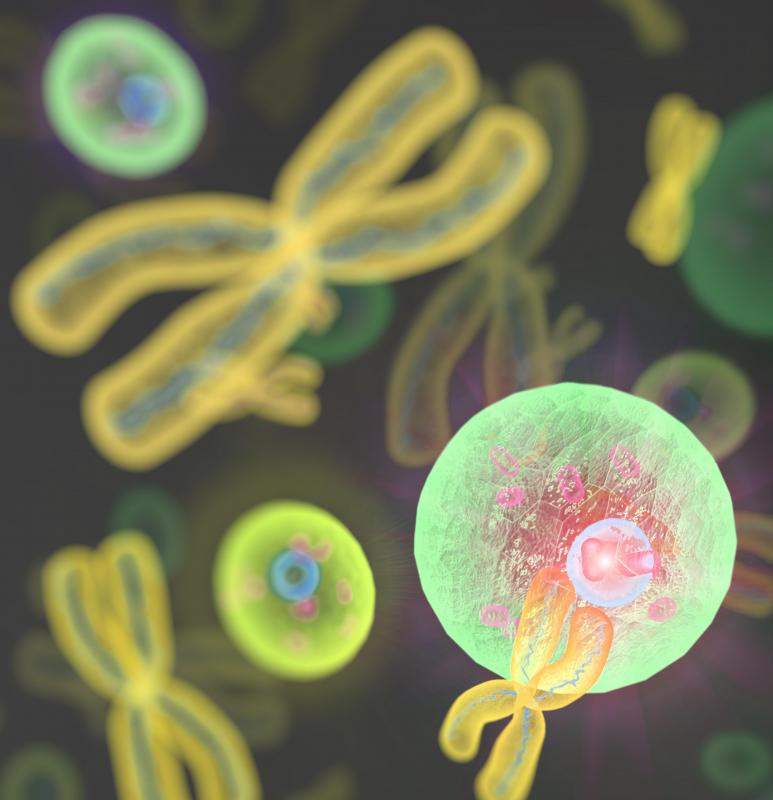
Cytogenetic technologists mostly work as laboratory specialists who focus most of their energy on preparing, examining, and analyzing the chromosomes present in biological specimens. Most of the time the work they do is used to diagnose and treat genetic diseases and other problems, including things like congenital birth defects and infertility. It can be a demanding career, requiring a deep sense of responsibility and meticulous work. In this respect, proper training is essential, since errors or oversights can have serious ramifications, both in terms of diagnosis and treatment.
Importance of a Focused Education

This career almost always requires graduate-level training. What this means more practically is that you’ll need to earn a bachelor’s degree, usually in a science or research field, before enrolling in a cytogenetic master’s degree or certification program. Schools will often consider undergraduate degrees in a range of fields, but you can better your chances by majoring, or at least taking significant credits, in biology, biochemistry, or genetics. Some amount of independent research during the academic year or volunteer experience in local hospital laboratories may help establish your experience and viability as a candidate.
Choosing a Strong Program
There aren’t always a lot of cytogenetic programs to choose from since the field is so narrow. Just the same, researching schools, faculty, and graduate hire rates can help you find the program that’s likely to be the best fit for you.

When applying to a cytotechnologist program, candidates typically check the program accreditation and available references. An accredited curriculum usually covers cytochemistry and cytophysiology. In addition, a student training to become a cytogenetic technologist often has to study chemistry, biology, mathematics, scientific method, processing techniques, preparation of specimens, and microscopy; in most cases the curriculum is rather rigorous, and usually takes between one and two years to complete.
Certification Exams

In some countries, including the United States, simply holding a cytogenetics degree isn’t always enough to work in the field. It can be enough to get hired certainly, but in part because of how sensitive the work is, many governments require employees to get and maintain certification throughout their careers.
Someone who wants to become a cytogenetic technologist with on-the-job-training in the field is usually required to work in a laboratory for one year before he or she can sit for the certification exam. New advancements and significant growth in volumes of diagnostic laboratory tests make cytotechnology a dynamic field. Many positions are generally available for certified technologists in laboratories all over the United States, Canada, and Europe.
Other Useful Skills

In addition to requisite academic qualifications, laboratory experience, and professional certification, there are a couple of other attributes you might find helpful. A student who aspires to become a cytogenetic technologist usually needs a focused interest in the diagnostic process, for instance, and must work relatively independently with minimal supervision. Other qualities usually required in this health care career include proficiency in biological sciences, patience to concentrate for long hours, precision in work, manual dexterity, and a high level of dependability.

Cytotechnology mostly involves careful reading of a patient’s medical record, examination of the patient’s cells under a microscope, interpretation, and analysis for correct diagnosis of the medical problem. Therefore, one who wants to become a cytogenetic technologist must generally have good vision, the ability to distinguish fine shades of color, and enjoy challenging laboratory detective work. Most successful cytogenetic technologists pay meticulous attention to detail, have effective communication skills, and can coordinate well with a variety of other healthcare professionals.
AS FEATURED ON:
AS FEATURED ON:









-
![Cytogenetic techologists will exmaine cells under a microscope.]() By: WavebreakMediaMicroCytogenetic techologists will exmaine cells under a microscope.
By: WavebreakMediaMicroCytogenetic techologists will exmaine cells under a microscope. -
![Cytogenetic technologists may analyze the chromosomes in biological specimens to diagnose and treat genetic diseases.]() By: Giovanni CancemiCytogenetic technologists may analyze the chromosomes in biological specimens to diagnose and treat genetic diseases.
By: Giovanni CancemiCytogenetic technologists may analyze the chromosomes in biological specimens to diagnose and treat genetic diseases. -
![Cytogenetic technologists must be able to keep accurate and detailed records of laboratory experiments.]() By: Monkey BusinessCytogenetic technologists must be able to keep accurate and detailed records of laboratory experiments.
By: Monkey BusinessCytogenetic technologists must be able to keep accurate and detailed records of laboratory experiments. -
![A cytogenetic technologist will likely take courses in genetics.]() By: spotmatikphotoA cytogenetic technologist will likely take courses in genetics.
By: spotmatikphotoA cytogenetic technologist will likely take courses in genetics. -
![A cytogenetic technologist can be a demanding career that requires meticulous work.]() By: Tyler OlsonA cytogenetic technologist can be a demanding career that requires meticulous work.
By: Tyler OlsonA cytogenetic technologist can be a demanding career that requires meticulous work. -
![An aspiring cytogenetic technologist should have sufficient laboratory experience.]() By: spflaumAn aspiring cytogenetic technologist should have sufficient laboratory experience.
By: spflaumAn aspiring cytogenetic technologist should have sufficient laboratory experience.



Discuss this Article
Post your comments