
At WiseGEEK, we're committed to delivering accurate, trustworthy information. Our expert-authored content is rigorously fact-checked and sourced from credible authorities. Discover how we uphold the highest standards in providing you with reliable knowledge.
How do Birth Control Pills Work?
 Mary McMahon
Mary McMahon
Mary McMahon
The hormonal birth control pill was first marketed in the United States in the 1960s, and it had a profound impact on the world. It allowed women to engage in sexual activity at any time during their menstrual cycle without fear of pregnancy, and essentially work by tricking the body into thinking that it is already pregnant with timed doses of estrogen. In addition to estrogen, the pills contain progesterone, another female hormone that has an influence on the reproductive system. When taken as directed, most pills are over 90% effective.
The origins of the pill can be found in experiments on rabbits in the 1930s, when researchers discovered that high doses of progesterone prevented ovulation, meaning that no eggs would be released to be fertilized by sperm. In the 1940s, scientists successfully synthesized both estrogen and progesterone, opening the way to the birth control pill, which was developed and tested in the 1950s. In 1960, the Food and Drug Administration approved the use of the pill for American women, and human sexuality and family planning have not been the same since.

The hormones used are combined to prevent the body from releasing an egg. Should an egg be released, the progesterone makes it difficult for it to travel down the fallopian tube, and also alters the uterine lining to prevent implantation in the unlikely event of fertilization. In addition, progesterone thickens cervical mucus, so that sperm have difficulty making their way into the uterus. The combination of estrogen and progesterone make pregnancy a challenge, although it can happen.

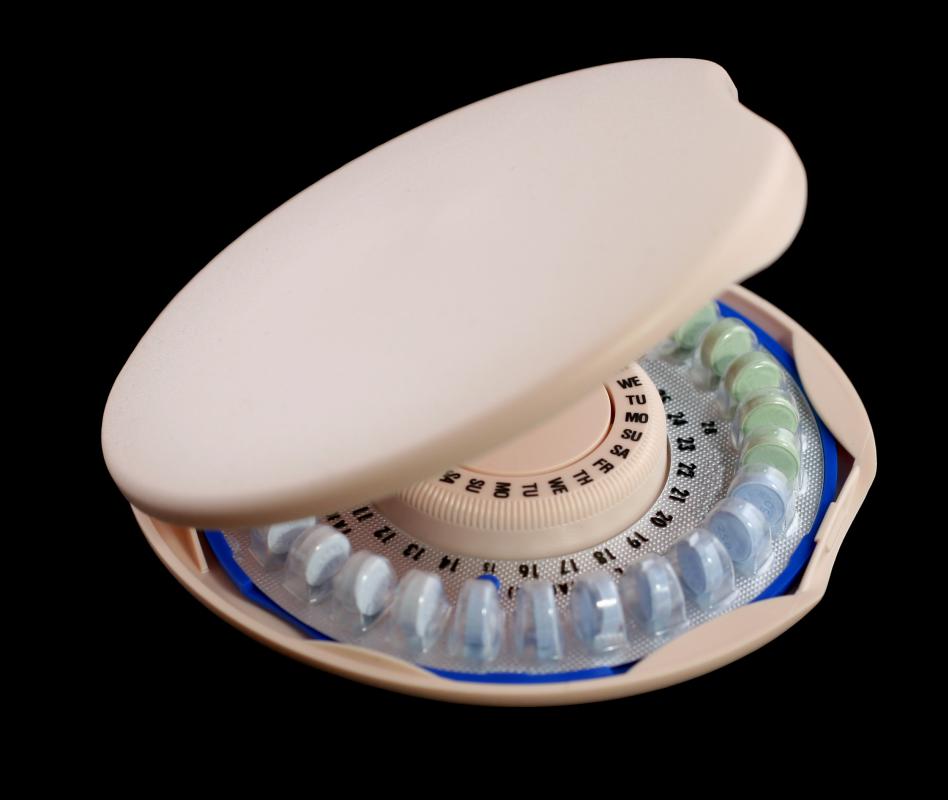
Most users have noticed that their pills are different colors and must be taken in a specific order. This is because the dosages vary from week to week, with one week actually containing placebo pills with no hormones to allow the body to slough the thickened uterine lining in a menstrual period. It is very important that birth control pills be taken at the same time every day, and in the proper order; women should never borrow a friend's pills, as they may not be the same dosage, and they will throw the woman's cycle off, putting her at risk of pregnancy.

While birth control pills are excellent at preventing pregnancy, they do not prevent any sexually transmitted diseases (STDs). To provide STD protection and extra insurance against pregnancy, condoms should always be used during sexual activity. Proper combined use of a condom and the pill will greatly reduce the risk of pregnancy and prevent infection with a potentially incurable STD.
Mary McMahon
Ever since she began contributing to the site several years ago, Mary has embraced the exciting challenge of being a WiseGEEK researcher and writer. Mary has a liberal arts degree from Goddard College and spends her free time reading, cooking, and exploring the great outdoors.
Learn more...
Mary McMahon
Ever since she began contributing to the site several years ago, Mary has embraced the exciting challenge of being a WiseGEEK researcher and writer. Mary has a liberal arts degree from Goddard College and spends her free time reading, cooking, and exploring the great outdoors.
Learn more...AS FEATURED ON:
AS FEATURED ON:









-
![Progesterone testing on rabbits helped produce the first birth control pills.]() By: rusugrigProgesterone testing on rabbits helped produce the first birth control pills.
By: rusugrigProgesterone testing on rabbits helped produce the first birth control pills. -
![Birth control pills must be taken in a specific order, as the dosage varies from week to week.]() By: Jacob KearnsBirth control pills must be taken in a specific order, as the dosage varies from week to week.
By: Jacob KearnsBirth control pills must be taken in a specific order, as the dosage varies from week to week. -
![Hormonal birth control medication taken as a pill is available in two forms: 21-day packs and 28-day packs, the latter of which supplement sugar pills for the menstruation week.]() By: cristi180884Hormonal birth control medication taken as a pill is available in two forms: 21-day packs and 28-day packs, the latter of which supplement sugar pills for the menstruation week.
By: cristi180884Hormonal birth control medication taken as a pill is available in two forms: 21-day packs and 28-day packs, the latter of which supplement sugar pills for the menstruation week. -
![When taken properly, birth control pills are over 90% effective.]() By: Kimberly ReinickWhen taken properly, birth control pills are over 90% effective.
By: Kimberly ReinickWhen taken properly, birth control pills are over 90% effective. -
![Unlike condoms, birth control pills are ineffective when it comes to preventing sexually transmitted diseases (STDs).]() By: Syda ProductionsUnlike condoms, birth control pills are ineffective when it comes to preventing sexually transmitted diseases (STDs).
By: Syda ProductionsUnlike condoms, birth control pills are ineffective when it comes to preventing sexually transmitted diseases (STDs). -
![Proper use of a condom along with birth control pills will greatly reduce the risk of pregnancy and STD transmission.]() By: DeklofenakProper use of a condom along with birth control pills will greatly reduce the risk of pregnancy and STD transmission.
By: DeklofenakProper use of a condom along with birth control pills will greatly reduce the risk of pregnancy and STD transmission.




Discussion Comments
@anon163083: If you have taken an ECP (emergency contraceptive pill), one of the side effects is that it disrupts your period in one of three ways: 1) the time it arrives 2) how light or heavy the flow may be 3) how long it may last! Some women see their periods sooner than the expected date, however there are women who don't see it, even up to the expected date, such as yourself.
If your period has been more than a week late, it is recommended that you take a pregnancy test, and continue every week you are without. There may be no need to panic because some women just have their periods come really late because of the ECP. But if two weeks have passed, you might need to see your gynecologist, just to be sure!
You also said this happened two weeks ago. How long after did you take the ECP? It is most effective immediately after intercourse, but you do have three days in which to take it. Please note that it is less likely to work the longer you wait after having intercourse, especially two weeks.
If it was two weeks, you need to do a pregnancy test now, because there's a 90 percent chance you are pregnant!
i had sex two weeks ago and i took an emergency contraceptive pill. but the problem is that i am not having my periods though it's time. Please, if anyone knows about it then inform what to do (birth control). Thank you.
Yes, Well i was talking to my doctor, and she said the *last* week of the birth control pills are just sugar pills. Just to regulate your period. The three previous weeks are regular birth control pills and if you were taking them on time every day then those three weeks of taking birth control pills cover the week of the sugar pills (the last week).If you miss one on the last week its okay because they are just sugar pills. They aren't there to prevent pregnancy. So if you have sex during the time where you are taking the *suagar* pills (the last week) you should be okay. That's *if* you were taking the birth control pills on time every day!
I was just wondering if there is any possible chance you can get pregnant while your cycle is on if you take birth control pills but never take the last week. I never take the last week of pills. I read in the pamphlet that if you miss 1 throw out that pack and wait to begin the new pack but it doesn't say anything about pregnancy and the last week of pills! somebody must know! Thanks
Post your comments