
At TheHealthBoard, we're committed to delivering accurate, trustworthy information. Our expert-authored content is rigorously fact-checked and sourced from credible authorities. Discover how we uphold the highest standards in providing you with reliable knowledge.
How do Antidepressants Work?
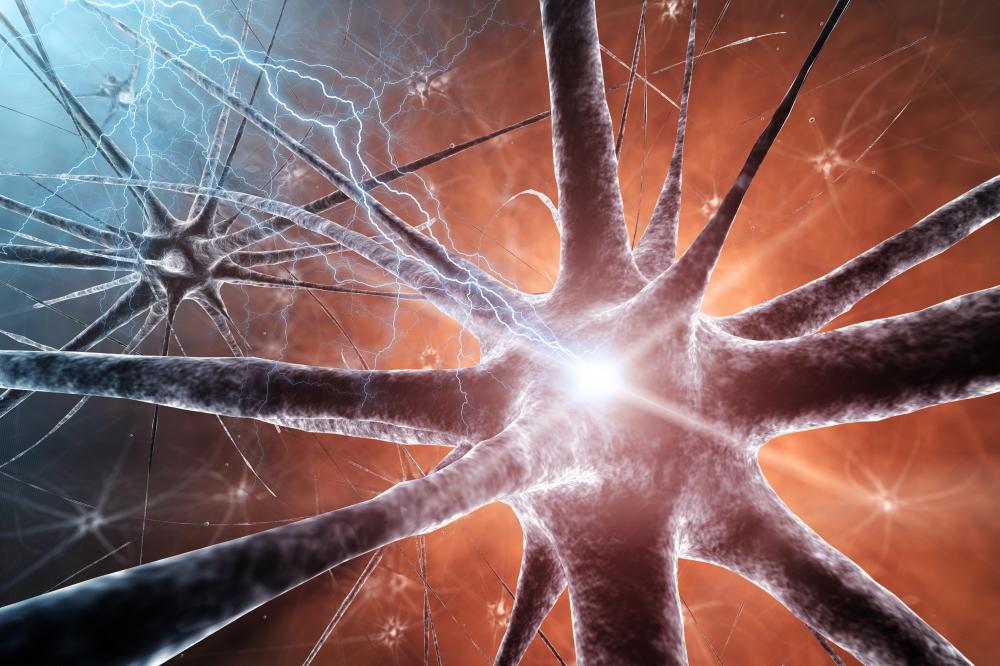
There are several different types of antidepressants, each of which works in different ways. All of these medications are designed to affect certain chemicals or neurotransmitters in the brain that are responsible for mood, but different types affect one or more of these neurotransmitters differently. In general, antidepressants work by increasing the amount of neurotransmitters in the brain, usually by preventing them from being broken down or "recycled" in the body. How exactly this is accomplished, and how the changes in levels of neurotransmitters affect other aspects of brain chemistry, is still being investigated.
This type of medication is often prescribed to people suffering from depressive illness. The causes of depressive illness are not completely understood, but many researchers believe that neurotransmitters, including serotonin, norepinephrine, and dopamine, play a significant role. These chemicals, which are released from nerve cells in the brain, only have a short time to relay their message to another cell before enzymes destroy them or they are taken back up by the cell. This process is referred to as reuptake. Once reuptake occurs, the neurotransmitter stops having any effect on the brain.

Medications known as selective serotonin reuptake inhibitors (SSRIs) delay the reuptake of one of these neurotransmitters, serotonin, raising its levels in the brain. Higher levels of serotonin seem to help the brain send and receive messages more easily, which, in turn, improves mood. SSRIs are very popular because they seem to have the fewest side effects among such drugs. Additionally, those side effects tend to be mild to moderate and are transitory, usually disappearing after one to three weeks.

Tricyclic antidepressants (TCAs), work in the same manner as SSRIs, but affect the uptake of all three neurotransmitters associated with mood: serotonin, norepinephrine and dopamine. They do have more side effects, however, and can be dangerous if taken in high amounts. TCAs are not recommended to patients with heart trouble.
Monoamine oxidase inhibitors (MAOIs), an older class of antidepressants, increase levels of all three neurotransmitters by inhibiting an enzyme responsible for inactivating them. MAOIs also affect tyramine, a molecule linked to blood pressure; as a result, anyone taking MAOIs must stick to a very strict diet that forbids a variety of common foods like cheeses, yogurt, certain meats, bananas, and many more foods. Failure to do so can lead to a hypertensive crisis and may result in death. MAOIs also interact with many medications and are no longer widely prescribed.

Although these drugs are not addictive and can be taken in an ongoing regimen, they are normally prescribed for a four to six month period, with most people experiencing some benefit after two to four weeks of use, and full benefits at about four months. Patients are encouraged to seek other means of relief from their depression during this period, including exercise, a healthy diet, and "talk" therapy to work through any external cause for the depression.

Specific side effects vary among the different groups of antidepressants and should be discussed with a healthcare professional. Medications should not be mixed unless under the guidance of a medical professional. In some cases, depression can increase when patients first start taking the drugs, before they have a chance to work, and this has been linked to a higher risk of suicide in rare cases. For the majority of patients, however, these medications have played an important role in relieving depressive illness. They might also be prescribed to relieve anxiety, obsessive behavior, panic attacks and post-traumatic stress syndrome.
AS FEATURED ON:
AS FEATURED ON:


-
![Antidepressants affect neurotransmitters in the brain.]() By: nobeastsofierceAntidepressants affect neurotransmitters in the brain.
By: nobeastsofierceAntidepressants affect neurotransmitters in the brain. -
![An antidepressant.]() By: Andrew S.An antidepressant.
By: Andrew S.An antidepressant. -
![Bananas should be avoided when taking MAOI antidepressants.]() By: bergamontBananas should be avoided when taking MAOI antidepressants.
By: bergamontBananas should be avoided when taking MAOI antidepressants. -
![Antidepressants are precribed to people suffering from depessive illnesses.]() By: 18percentgreyAntidepressants are precribed to people suffering from depessive illnesses.
By: 18percentgreyAntidepressants are precribed to people suffering from depessive illnesses. -
![Higher levels of serotonin seem to help the brain send and receive messages more easily.]() By: snyggg.deHigher levels of serotonin seem to help the brain send and receive messages more easily.
By: snyggg.deHigher levels of serotonin seem to help the brain send and receive messages more easily.



Discussion Comments
Where can I find the chemical formula and a picture of an insulin neurotransmitter?
Eat healthy! Eat and take your B1, B2, B3, B4, B6, B12 and iron supplements. Your hormone imbalance changes your mood. Your low red cells in the blood means low oxygen to your brain, which means depression.
Change your lifestyle, friends, city, family. Change your life!
The drug manufacturers don't even know how these work.
Prozac: "Presumed to be linked to the inhibition of nuronal uptake of serotonin." If you read the actual papers on anti-depressants, they admit they have no clue how it works. Words like "presumed" may sound serious, but every prisoner incarcerated today was once "presumed" innocent until proven guilty.
Another word is "linked" -- not caused by or because. "Believed" meaning no proof; "Related to" means not "cause proven by." There has never been any scientific study that proves anyone had a chemical imbalance and needed medicine to resolve that. Never.
Let's look at just three of the admissions of the drug manufactures. Paxil: "Presumed to be linked to to the reuptake of serotonin." Cymbalta: "Believed to be related to." Welbutrin: "it's not known." Are you seeing a pattern? Some 10 million Americans are taking drugs and the drug companies don't even know what the hell they're making. Paxel, Zoloft, Prozac, Lexapro, Effexor, and Celexa all have lawsuits pending for birth defects "linked" to them.
O.K., so if "linked to" is good enough to sell the drug to you as proof, then isn't "linked to" good enough to prove the drug is the cause of birth defects?
Look at the number of drugs that have been recalled because the manufacturer had no clue how dangerous they were. Then ask yourself if you're really willing to take medicine based on a "We presume" approval with the FDA.
Here is my advice: Always felt more or less like crap with bad confidence?
You have nothing to lose by trying medication and talk therapy. A combination may be best. Antidepressants are still a subject of controversy, and I think I know why.
Becoming better at anything or in any regard is often perceived as a threat by peers.
Nobody likes a winner, you know. Remission is winning.
Here is the best way, if you want to know the reality.
Science is not always correct. There are evil spirits behind depression. Otherwise stress will not become depression.
Look up depression, evil spirits and blind science.
I have had several mental issues for about 10 years now, which I have seen a psychologist (twice) about and have been to the doctors for sleep pills, etc. But never anti-depressants. I have had terrible insomnia, depression, anxiety, paranoia and aggression issues for the last 10 years, on and off.
I have been in a worse state than I am in now, to not wanting to socialize at all and where the only friend I had was my computer and c&c online and not having any job or future prospects. I am now, however, in a much better state. I have had a girlfriend for two years and three quarters of the way to getting my degree at university. This transformation involved no drugs at all just adjustments to my life. I have always been curious about anti-depressants though, and it seem there is much mixed views on them.
Regardless of my curiosity about them, I am still a firm believer that depression and related syndromes can be combated and improved with basic lifestyle adjustments like exercising, reduction of harmful substances, learning and diet. Before I had success with women and before I stopped smoking pot I was very unhappy. Now I still might get unhappy at times, but not to the extent I did before. Good luck on life's journeys,
Interesting discussion here. I've been on all the major SSRIs for a few years now and have seen no improvements at all. I believe my depression has resulted from years of severe social anxiety.
The first psychologist I saw in 2007 said I had the most severe case of social anxiety he'd seen -- not a title I really wanted. Since then, I've made significant inroads into conquering social anxiety and you definitely can improve. Anxiety is the devil driver behind depression, so if you learn how to treat the cause and 'not relieve the symptoms' you'll be in front. Searching for the 'right' medication is a falsehood; you only get stressed and let down when nothing helps.
Do things you can control: yoga, relaxation, proper diet, plenty of water, relaxation, hypnotherapy, psychology, sports, social outings. These are the best options at the moment. Anyway, I've said enough. Good luck with your treatments and I hope all goes well. There is definitely a long way go in this area as far I'm concerned.
@anon162506: You sound a little like me. I always started having anxiety and if that didn't go away it would turn ink depression, which sounds like what is happening to you. After dealing with this cycle for seven years, I decided to try something different and started taking antidepressants a month ago and apart from the start up side effects, I feel great.
If your antidepressant is not working for you, go back to your doctor; you may need to try another one. Good luck.
I use to suffer from anxiety a lot. It has been going on since January 2010, and then exactly a year later (January 2011) after suffering these anxieties, it turned into negative thoughts about everything, changing my mood and opinions about life and I hate it.
Is that still a form of anxiety? Having these disturbing and awful thoughts constantly every second of the day? I'm taking Zoloft and it worked for a week, but I still have these ridiculous and awful thoughts. Please help!
I have a severe anxiety disorder, which makes me depressed. I have had bouts of it since I was 15 years old but nothing for the past four years as I was on prozac but came off them for a whole year and then a few weeks ago I had an anxiety attack.
now I am off work, probably going to lose my job, sat at the laptop searching for reassurance that I will get better, started prozac a few days ago and the anxiety has increased and now taking propranolol and diazepam which aren't working. I feel like ut will never go away. The docs say it takes time for the anti's to work but I just don't believe anything can help me anymore, my thoughts won't let me get better. anyone else feel like this?
My doc, whom I saw this afternoon, prescribed me with 30 days worth of SSRI antidepressants. He did so because he thought I should get on weaker medicine first. I hope it will alleviate my depression.
All these posts have only confused me more on if medication will help me or not.
When it comes to the 'chemical imbalance theory', it is as another poster suggested, a theory.
Theoretically speaking, yes they seem to work, for some people at least. I have tried three this year, prescribed by my GP. First one - took one tab of smallest dose and could not get off the bed for two days. How any member of the human race could possibly function at all on that stuff is a mystery to me. It was not a 'sedating' effect, that allowed me some sleep, which I was sorely lacking and which I was assured would happen - sleeping, but like the worst brain haze possible. Like my appetite for eating and drinking was completely switched off and I had to literally force myself to take any nourishment. Needless to say the rest of the tabs went in the bin.
Then my GP said, "OK we'll try Ciprolax." So on 10 mgs of that. Side effects straight away, so I dropped to a half dose and thought to give it a week at least. By end of that week I think I lost at least 1/2 stone weight and looked like something out of Belsen Concentration Camp. Treatment worse than original 'disease'. So I had to stop those.
Next the doc looks at the book, BNF here in UK, and says, "I think we'll try this one. The minimum dose is 30 mgs, but if you need, begin with half of that - i.e. 15 mgs." The tabs only came in capsule form, so how I was supposed to 'halve' the dose was a mystery to me.
I was having bizarre thoughts lately and thinking to take blades and open the arteries in my wrists. Slink into a warm bath, watch the blood flow out, the water turn gently red, warm, and slip into oblivion and peace. Scary. I was angry, irritable and wishing my elderly parents at times were dead.
I thought it was the depression, and I should keep trying with the meds. The thinking persisted at times. I went out one night, drank, though I know not what, got drunk and ended up in a police cell, told I was 'acting suspiciously' at someone's car. I have no memory of that night at all. But it made me stop and think. I took myself off these meds. Over a week now and that 'thinking' has ceased.
I feel low still, to a degree, especially I notice in the AM - but not as bad. I have gastrointestinal things going on still - diarrhea, flatulence, (pardon me) to a degree. Made me wonder that, supposedly 90 percent of serotonin lies in the gut. Some link?
I am determined to find other ways to beat this - CBT worked well before. I saw a clinical psychologist to help me work through past sexual abuse and other matters. I am going back to the gym even though I could not be bothered.
I know how hard it is not to want to do anything. Why at times I would have downed a bottle of bleach if I thought it would help and why I tried the meds. When you read the literature on these meds, it says things like, "We think... such and such..." "We believe... such and such..." Language used to explain theories, as they are theories, not factual.
I will never put one of those things in my mouth again.
I am not suggesting that those for whom they work should not keep using them. If it works for you, great. But the side effects, adverse effects can be very dangerous and you should be aware of what they are. I believe in the US now, anti depressants have 'black box warnings' about the risk suicidal ideation, suicidality on them. They need to do that here. I am delighted the police arrested me that night. I could have been dead otherwise and family would have said, "Oh he was very depressed etc etc," when it was the flippin' meds making me far worse.
just wanted to say, antidepressants have totally changed my life. it took a few tries to find one that worked, finally an SNRI did. Over the last year, I have become a happy, confident, and optimistic person. My only regret is wasting so much time (12 years) believing that my recurring depression was some kind of personality fault that I should fix on my own.
I'd like to say a few things about the use of antidepressants.
There is some research (a little controversial though it is) which suggests that antidepressant meds are good for preventing overwhelming feelings from breaching conscious awareness. They act like painkillers.
Used in conjunction with a good, feelings-based psychotherapy, there can be a much less frightening and traumatic process of uncovering the deeper and more repressed feelings which are causing the depression or anxiety.
I am considering using medication after years of suffering and not being able to face the pain which I know to be the cause of my depression and anxiety, and I am thinking about this because I believe it may help to alleviate the intensity of the overwhelming feelings.
When one suffers from chronic and persistent anxiety or depression, it causes the brain and body to fail in their task of providing effective blockage to this pain, which is usually achieved naturally with the development of the neurotransmitters which can flood the body with the right kind of chemicals to help us to feel better.
Antidepressant meds can aid in the process of keeping the more overwhelming feelings at bay while we work through them in a more consciously controlled and less overwhelming way.
I cannot back this up with too much evidence, but there seems to be a case for the interaction of meds and therapy, especially if the therapy allows for feelings to be looked at and experienced.
16504 - don't talk about what you don't know. Anti depressants combined with counseling and willpower, have kept my anxiety/panic attacks and depression at bay for five years.
The side effects when you start taking them are not pleasant, but the benefit after a couple of weeks is worth it 100 percent. I believe some people just need anti depressants like some diabetics need insulin.
I have been on effexor for years and it helps, but i still have panic attacks just not every day! Will there ever be a cure for this in our lifetimes? I once believed it, but not anymore!
People, before taking any medication, please try to inform yourself about your condition, whether is anxiety, stress or panic attacks.
Read online and books; that will help you so much to understand you're not going crazy. It helps you to know that what you're feeling and thinking is totally normal.
Also try natural "medication" like SAM-e or St. John's Wort, change your diet, get vitamin B complex, and vitamin C which helps you when you're under too much stress. If you're religious pray a lot. Exercise is very important. It stimulates brain chemicals that leave you feeling happier and more relaxed, it boosts your confidence and improves your self-esteem, and it helps prevent depression too.
All this has helped me be free from anxiety and panic attacks. Good luck and remember: there is a way out!
I have anxiety for the past 8 months and I have tried medications such as paxil, zoloft, prozac, cymbalta, elavil, abilify, luvox, lexapro, remeron, effexor and so far, none of these cured my anxiety.
I take klonopin also, which i hate, but it does help ease the anxiety but in essence doesn't cure it at all. These medications gave me more side effects than helped me.
I started out with severe headaches and dizziness, depersonalization and derealization.
I do not have depression, just anxiety. I am still trying to find the right medicine and my headaches and dizziness has gone away. They do work but which one works with your body is the key element.
- anon16504, there is plenty of evidence for the case of anti-depressants and other drugs used to treat mental disorders.
It has not been proven to be a casual relationship, i.e., a person with low levels of serotonin will have depression, but it is much more likely. Likewise, someone with a high level of dopamine does not automatically have schizophrenia. But schizophrenics do tend to have higher levels of dopamine.
Therefore, doctors prescribe drugs that change the way your body produces and absorbs chemicals, or neurotransmitters if you want the technical term, and although they are not effective in 100 percent of cases (no method of treating disorders is) it does help significantly. Like anon21493 says, taking medication combined with psychotherapy (or cognitive behavioural therapy) is the most effective way of treating, and living with disorders such as depression.
Anybody who is on anti-depressants, or any other medication, please do not stop taking it. It will help. It'll be a long journey, but with perseverance and treatment, it will be worth it.
I have been taking Zoloft for about a year now and it was not because I have depression. It is because I have high stress levels and with a condition I have, I pass out without my Zoloft. anon45133 Yes I had the same thing with it when I started it. It does get better but I would talk to your doctor about your dose. I had to increase mine to make sure I still felt well.
Anon21493, are you a scientist? A doctor? Personally, I think if somebody is "diagnosed with clinical depression" it's crap. Guys, I'm depressed, I'm depressed as hell for many, many reasons. But I refuse to go on anti-depressants, or anything like that. We do not need drugs to get through our struggle. Is it really any different than doing hardcore drugs? Like heroin? Or other kinds of hardcore drugs? Is it really any different than just smoking pot? A drug is a drug, and just because a scientist or a doctor recommends you take these drugs, doesn't mean it's best for you. I think the only way to get over things like depression, (And I say 'things like depression' because I'm not referring to issues when you are sick), is to do it with will power. Change your life and make it better yourself, and don't rely on drugs.
Hi there. I have recently started on Zoloft and quite worried because it is actually making me feel worse instead of better. Has this happened to anyone else? Is this normal? If so how long does it stay around for.
The doubtful anon sounds shockingly close to the official line of Scientology.
hey. i took xanax, paxil, abilify, lamictal, and seroquel.. abilify was horrible. lamictal i was allergic to. paxil didn't work. xanax was just fun. and seroquel was the best for me. i eventually didn't need them because i found my own happiness. i combined it with psychotherapy and i'm happy as can be. they do work, but i promise you you won't need them for the rest of your life. it's kind of like a crutch when you can't handle the depression.
I have no idea when this article was posted, but based I feel compelled to make a comment based on the comments, just in case someone who has been recently diagnosed with depression (or has had depression for a long time) reads the post of anon16504 and is frightened into not taking their medication.
First of all, hundreds of studies have clearly demonstrated that SSRIs are extremely beneficial for the treatment of depression. This has been clinically proven time and time again. Psychotherapy is also helpful, and in fact, the most effective way to treat depression is to COMBINE psychotherapy with antidepressants.
While it is true that the monoamine hypothesis of explaining depression (i.e. the depression is a result of low levels of norepinephrine and serotonin) is just that, a hypothesis, that does not mean that it is fabricated, and it does not mean that there is "no medical evidence that these chemical imbalances even exist." In fact, multiple studies have found that serotonin and norepinephrine are lower in patients with depression. And most importantly, these medications work!!! The brain is an extremely complex thing and to be completely sure of why and how depression (or any psychiatric disorder) occurs is a huge feat, one that scientists are diligently working on, but there is still much work to be done.
There are cases when depression is REACTIVE (meaning in response to something bad happening; i.e. "my grandmother and my dog died and I failed out of college") this depression may not be a result of a chemical imbalance, but depression that affects daily life for an extended period of time may be a result of this chemical imbalance.
In conclusion, these medications (namely SSRIs) are effective with minimal side effects and are prescribed based on scientific and medical evidence. It is certainly much more dangerous to NOT take medication if you are diagnosed with clinical depression. Please do not listen to Anon16504 if you have been diagnosed with depression. Instead, talk to your doctor, or a psychiatrist, or a scientist, or even a Biology teacher. Depression isn't a weakness or a character flaw, it is a chemical imbalance in the brain and it is very treatable. Thank you, and good luck
Is what anon16504 posted true? Is there really no medical evidence for the chemical imbalance theory? Do psychiatrists know this? Shouldn't it be illegal?
Why do you tell people that antidepressants help correct chemical imbalances in the brain when there is no medical evidence that chemical imbalances even exist? No one knows what one would look like and research shows that an increase in the brain chemicals needed have little or no effect on depression. It is also true that some people with depression have high levels of seratonin and some people experiencing no symptoms of depression have incredibly low levels of seratonin. Is it true that psychiatrists and physicians do not actually know how or why the medication works?
hi i am taking anti depression for 3 years
can i become pregnant now?
please could you tell me as soon as possible
Hi there www, I have taken paxil for major depression for 13 years straight....I have never had another bout of depression again...is there anyone with similar results with ssri use?
Post your comments