
At TheHealthBoard, we're committed to delivering accurate, trustworthy information. Our expert-authored content is rigorously fact-checked and sourced from credible authorities. Discover how we uphold the highest standards in providing you with reliable knowledge.
How Dangerous are Rattlesnakes?
Rattlesnakes (genus Crotalus) have a venomous bite that can inflict serious harm but these unaggressive snakes only strike when threatened, so it is easy in most cases to avoid danger. Most of the 8,000 or so people bit by poisonous snakes annually in the United States, receive bites when attempting to handle, catch or corner a snake. Rattlesnakes will look for any chance to escape confrontation. The telltale rattle gives warning the snake feels threatened.
There are 32 species of rattlesnakes in the United States and many subspecies, with the highest concentrations in the southwest. Smaller populations of perhaps a single species can be found elsewhere in the country. Native to California, several regional species include the Pacific Rattler, Diamondback and Sidewinder.

Rattlesnakes are pit vipers, possessing an indentation (or organ pit) below each eye, which help the animal detect slight changes in air temperature. This allows them to locate warm-blooded prey even in pitch darkness, providing the night air is not so warm as to mask the heat signature. Unique morphology of the rattlesnake includes fangs that lay along the roof of the mouth only folding down to strike. The teeth act like hypodermic needles, pumping poison into the victim. The snake will not hold on to the prey after striking. The stricken animal might even run a short distance before succumbing to the venom. The snake follows and eats the prey whole, unlocking its jaws to swallow the entire body. During this sometimes slow process (depending on the size of the meal) the rattler is completely defenseless. After feeding it will usually be inactive for several days while it digests its meal. A rattler's main diet consists of lizards and rodents.

Rattlers vary in color from brownish gray to greenish and can grow to a length of 6 feet (2 meters). They have distinct, broad triangular heads with narrow necks and yellow eyes. Their pupils are elliptical. The snakes blend in so well with their surroundings that if you disturb a rattler while hiking, for example, you might not know it until you hear the warning sound of its rattle. Do not make sudden or threatening movements towards the snake. Simply move away. Rattlers can span a distance of a few feet very quickly in a strike as they extend their bodies outward. This needn't be from a coiled position.
If bitten by a rattlesnake DO NOT do any of the following:
- Do not make incisions over the bite wound.
- Do not restrict blood flow by applying a tourniquet.
- Do not ice the wound.
- Do not bathe the wound in water.
- Do not suck the poison out with your mouth.
These methods can very well cause additional harm and most amputations or other serious results of a rattlesnake bite are a result of icing or applying a tourniquet.
There are only three things you should do:
- Stay calm.
- Call 911.
- Get to a hospital or poison treatment center immediately.

Most modern over-the-counter snakebite kits consist of a suction device for drawing out venom from the bite wound. This can be helpful in the interim of getting to a hospital or poison center if a kit is handy. Using your mouth is not advisable as the poison can enter the bloodstream through cuts or sores and might be swallowed.
Rattlesnake serum (antivenin) is made from antibodies extracted from horse blood. The serum has its own side effects as the body will have an allergic reaction. However, it's the most effective treatment available. Rattlesnake bites are rarely fatal with less than 1 in 600 resulting in death, and approximately 33% not containing injection of venom at all. However you should assume for your own sake that venom has been introduced and always seek treatment.
To avoid rattlesnake bites some safety precautions will help:
- Wear appropriate hiking boots and thick socks.
- Look at your feet to watch where you step and don't put your foot in or near a crevice that you cannot see into.
- If a fallen tree or large rock is in your path, step up on to it instead of over it, as there might be a snake on the other side.
- Do not turn over rocks or logs.
- If you must move a rock or log, use gloves and roll it toward you, giving anything beneath it the opportunity to escape in the opposite direction.
- Avoid approaching any snake you cannot positively identify as a safe species.
- If you hear the warning rattle, move away from the area and do not make sudden or threatening movements in the direction of the snake.
Depending on weather rattlesnakes may roam at any time of the day or night. If walking at night, be sure to use a flashlight.

Female rattlers carry up to 25 eggs internally until hatched, giving birth to live wriggling snakes. The baby rattlers have a pre button on the tip of the tail which upon molting will start to develop rattles. Each time the snake molts or sheds its skin, a rattle is added. After the first shedding at about 1 week, the single rattle can vibrate against the button to create a small noise. At this point the young leave the mother to search for food. Snakes continue to molt every few months, adding a rattle each time. Many young rattlers become food themselves to birds and other animals and many do not survive their first year. Since rattles can break off, the size of a rattle is not necessarily an accurate indication of age.
There is one species of rattler without a rattle at all. It is the Santa Catalina Island Rattler whose tail simply ends in a stub.
AS FEATURED ON:
AS FEATURED ON:


-
![A Northern Pacific rattlesnake.]() By: fivespotsA Northern Pacific rattlesnake.
By: fivespotsA Northern Pacific rattlesnake. -
![Wearing hiking boots and thick socks in a rattlesnake infested area may help prevent bites.]() By: Robert NeumannWearing hiking boots and thick socks in a rattlesnake infested area may help prevent bites.
By: Robert NeumannWearing hiking boots and thick socks in a rattlesnake infested area may help prevent bites. -
![The highest concentration of rattlesnakes is found in the American Southwest.]() By: jovannigThe highest concentration of rattlesnakes is found in the American Southwest.
By: jovannigThe highest concentration of rattlesnakes is found in the American Southwest. -
![The Western Diamondback rattlesnake is considered to be one of the most dangerous snakes in North America.]()
The Western Diamondback rattlesnake is considered to be one of the most dangerous snakes in North America. -
![While painful, rattlesnake bites are rarely fatal.]() By: ronstikWhile painful, rattlesnake bites are rarely fatal.
By: ronstikWhile painful, rattlesnake bites are rarely fatal. -
![It is important not to restrict blood flow to a rattlesnake bite.]() By: Remus MoiseIt is important not to restrict blood flow to a rattlesnake bite.
By: Remus MoiseIt is important not to restrict blood flow to a rattlesnake bite. -
![Someone who has been bitten by a rattlesnake should call 911 to summon emergency medical help.]() By: smukiSomeone who has been bitten by a rattlesnake should call 911 to summon emergency medical help.
By: smukiSomeone who has been bitten by a rattlesnake should call 911 to summon emergency medical help. -
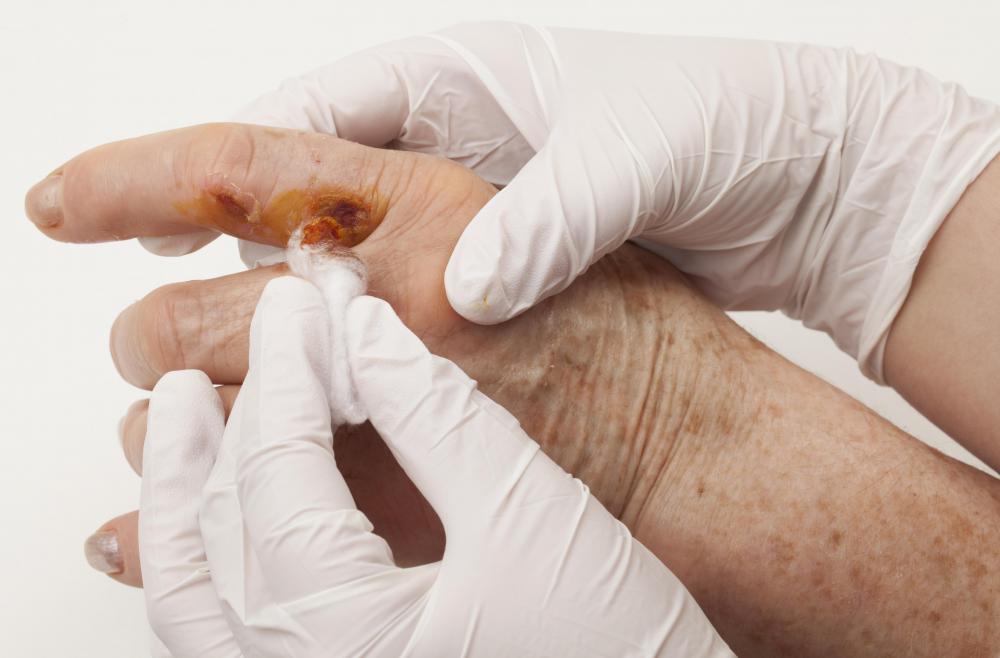
![A person who has been bitten by a rattlesnake may go into shock.]() By: Syda ProductionsA person who has been bitten by a rattlesnake may go into shock.
By: Syda ProductionsA person who has been bitten by a rattlesnake may go into shock.






Discussion Comments
To all those people who like to kill rattlesnakes: these statements are so incredibly stupid they are just painful to read. It is not only backward but morally and totally wrong to kill wildlife just to "wipe it out". This behavior is so dumb and disgusting. Just consider what you are talking about. Your cats and dogs are not supposed to be running in the woods. Every forester can shoot them anyway for transmitting diseases, preying on birds etc. So there is no reason at all to persecute the timber rattler. It is probably the most endangered rattler in the US, and I would be happy to have even the chance to see this magnificent animal around my home.
Whenever I saw a venomous snake I immediately "shot" it with my camera.
Of course, rattlers clean the ground from rats, but we should not even reduce wildlife only to its immediate pest control function. It is amazing creation that has evolved over millennia.
The timber rattler was also a proud symbol of the Union states during Civil War.
My advice is: deeply question yourself, and try to understand why wildlife is there. Enjoy it, and stop trying to kill it. Otherwise you are destroying the natural wonders that your children and grandchildren would enjoy if they have the chance to do so.
I live in California on a ranch an hour from town. We have Mojave Rattlers, one of, if not the most aggressive rattlesnake there is! This last weekend a rattler claimed the life of my dog. The only good snakes are the non poisonous kind! The only thing rattlesnakes are good for, are belts, wallets and hat bands. And good eating! Long live the king snake!
Interesting discussions. I am from the Southeast, where timber rattlers (and canebrakes and Eastern Diamondbacks) have their native homes.
I imagine one reason rattlers are not common in Maine is because they are not native to the area, and it is too cold for them to really thrive. This part of the country probably already has sufficient non-venomous reptiles to keep the rodent population under control. I'd be willing to bet the majority of those few that do exist in Maine are the descendants of "pets" that became too much for their owners and were released into the wild. As I said, I suspect it's far too cold for them to breed regularly.
Having said that, let me also add that, even though I live in an area where they are native to the environment, it is extremely rare to see one, especially in an urban area. People who live on farms might see one occasionally, but not often. They do help keep the rodent population under control, so, even though I hate snakes, I admit their place in the ecosystem.
There's no question they are dangerous animals. They are nervous and territorial. Any animal capable of injecting venom is dangerous. However, the timber rattlers are pussycats compared to the Diamondbacks. Those rascals are bigger, more aggressive and much more likely to bite when threatened. Fortunately, they are not as common as the timber rattler.
Every Southern child learns snake safety, much as people who live near bear populations learn bear safety. Rattlers actually aren't as prone to bite as copperheads. That's one nasty little snake. But because they are smaller, they can't inject as much venom.
A rattler generally *will* run if given the opportunity. You never know with a copperhead, though. People are bitten more *often* by copperheads. More *fatal* bites are delivered by rattlers because of their larger size. However, fully 90 percent of all pit viper bites are "dry" bites, and antivenin is generally readily available in any good ER.
The best policy is always to leave them strictly alone. If they are near a human dwelling and you can't get Billy the Exterminator out to get it, then you probably just need to kill it. They don't have any business around people. They have their place in nature, but not around people.
Fascinating. By telling us that it is ridiculous to kill the rattlers in sanford and windham, you are indirectly admitting something inland fisheries (due to the fact the state refuses to pass a law on killing one they want to protect then) and NERD have known for years.
Don't worry. By next september, timber rattlers will be officially extinct in the state of maine.
Sorry, i live too close, don't know how far they can travel, i have two st. bernards and six cats that would not know better than to tease one. The only good rattlesnake is a dead one. And don't give me the crap about rodent extermination. This is 2011 and we now have glue traps, snap traps, and poison. We don't need rattlesnakes for any reason.
just remember one thing, Kev, it's like you said before: Maine did not care then and they don't care now. There is no law on killing rattlesnakes in maine. these creatures can inflict severe damage on you and your family if allowed to live.
I can hardly believe the ignorance being expressed here about rattlesnakes. Exterminate them? What, you think they are aligned with the devil or something? Just stay out of their way. If they aren't in a populated area, leave em alone. A couple of the posters here talk as if they know about rattlesnakes, but clearly they don't. Throw a rock at one from a distance and hit it in the head? Step on its head? You've got to be kidding me.
yes, I would love to help to exterminate what is left of the rattlesnakes in Maine. I know about the ones at claman, also there is another den living in Raymond, which inland fisheries and wildlife is well aware of, but would never admit it. However, there is no law in the State of Maine against killing a rattlesnake. If you see one, step on his head as hard as you can; you may be saving someone's life one day.
Maybe you think that they're extinct, but every summer in Windham at the Claman Sanctuary my husband has thrown rocks at the head of Timber Rattlers to kill them. They are far from exterminated.
I agree with the other poster that New England Reptile Distributors will cover up any information about Rattlesnakes in Maine, something they've known about since the beginning of this century. They were thought to be extinct.
If you go just a little deeper into the woods past all of the blueberries, you will see a bunch of rocks and you have to look very closely, because they camouflage so very well, you will see a few. There is definitely a den living there.
As soon as I find the location near Sanford, I will post it so maybe we can exterminate what is known as the last of the timber rattlers in Maine. If you see one, which is very unlikely, throw a rock at his head as hard as you can and you will kill him instantly. Never get too close to them. These are very dangerous, highly poisonous snakes. There is a reason that Maine exterminated them many years ago.
there us a den of rattlesnakes within a few miles of sanford, maine. New England reptile distributors will lie through their teeth in order to protect these extremely dangerous snakes. Believe me, there are timber rattlers in maine. i have killed several right near here in sanford.
@ Fiorite- Believe it or not, your friend is right. New England does have timber rattlesnakes, although they are endangered in all New England states. They are also thought to be extinct in Maine.
I used to live in Vermont, and I have actually seen a timber rattlesnake when I was hiking. I was hiking in the southern part of the State and I came across a south facing rock ledge. I heard a rattle and looked ahead and to my left to see a small black rattlesnake sitting on a granite outcropping. The snake was coiled, but it couldn't have been more than two or three feet long. It was a beautiful silky black with faint copper bands and a copper tail. The snake had a very large wedge shaped head. With its coloring and markings, it looked very menacing for such a small snake.
Sightings are extremely rare, but I was able to get a picture, though it is hard to see the contrast on such a dark colored snake. Besides timber rattlers, I know that New England also is home to copperheads, which look very similar to the timber rattler.
@ Fiorite- There are not that many natural predators to rattlesnakes, but there are a few. King snakes are immune to the venom of pit vipers, and they are snake eaters. King snakes will eat various species of rattlesnake, cottonmouths and water moccasins, and copperheads among other snakes.
If you live in the Southwest, then roadrunners will eat rattlesnakes as well as hawks and eagles. In the southern United States, wild boars have also been known to eat rattlesnakes. Besides those animals, most people steer clear of rattle snakes. As far as rattlesnakes in New England, I am not sure, but they do have a very wide range across North America, and they can survive in colder and higher elevations.
Are there any natural predators to rattlesnakes? Also, are there any rattlesnakes west of the Mississippi? I live in Boston and someone told me that there are rattlesnakes in New England. I do not believe her, but I would like to know anyway.
Post your comments