
At DelightedCooking, we're committed to delivering accurate, trustworthy information. Our expert-authored content is rigorously fact-checked and sourced from credible authorities. Discover how we uphold the highest standards in providing you with reliable knowledge.
How can I Tell if a Cake is Done?
 Tricia Christensen
Tricia Christensen
Tricia Christensen
Most cake recipes provide some guidance when it comes to baking time, but it can still be challenging to know when, exactly, a cake is done. There is no single way to know when a cake has finished baking, but there are some tips and tricks bakers can follow in order to better their chances of success. First, you should follow any instructions about pan size and oven temperature as closely as possible. Keep a close eye on the cake as it bakes so that you can see if the edges are getting overcooked or burned. You can test the center with a toothpick or lightly tap the surface with a few fingers to see if more time is needed.
The Toothpick Test

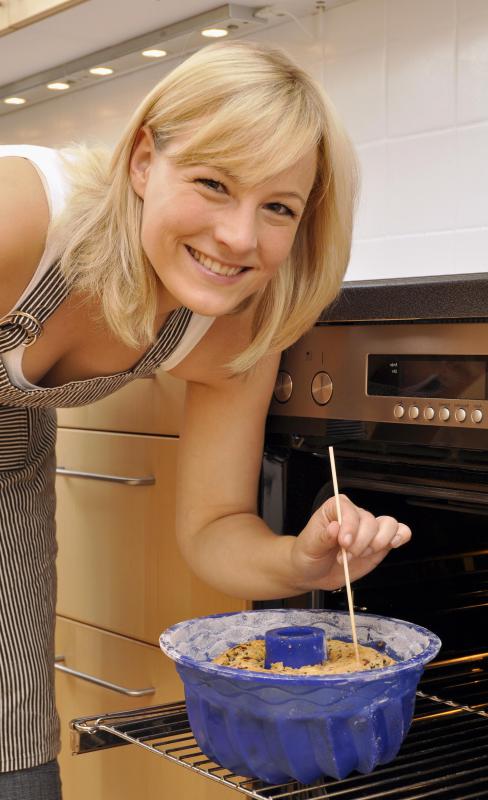
One of the most popular methods of testing a cake for doneness involves little more than a toothpick and a bit of patience. You can insert a clean toothpick into the center of the cake when the estimated baking time is nearly up. If the toothpick comes out clean or nearly so, the cake is usually done. Wet batter from an undercooked cake will stick to the toothpick, showing you that more cooking time is required.
Serious bakers often invest in dedicated "cake testers," small wire-like appliances used in place of a toothpick. There is no need to be so fancy, however, and a raw spaghetti noodle or a clean, unbent paperclip will work just as well.
It is important not to use a knife to test the cake, as this can create a big hole. If a lot of air escapes, the cake can collapse in on itself. This is all but impossible to fix, and should be avoided if possible.
The Touch Test

Some cooks swear by the "careful hand test," or "touch test," to assess when a cake is done. While the cake is still in the oven, a baker will carefully press the top surface with a few fingers. If it feels firm and does not give under the pressure, it is likely done. Any significant give or bounce indicates that the cake needs to stay in a bit longer. This method should be done carefully and quickly, since the cake will be quite hot. Press down very lightly, so as to not deflate or puncture the cake.
The Edge Test

Experienced bakers may find that a good look at a cake, particularly those that are yellow or white, can provide a lot of information about its doneness. Cakes tend to shrink from the sides as they get close to being done. If the top seems to be turning a darker golden or yellow, the cake is probably nearly ready. A cake that still seems very pale may benefit from a few more minutes in the oven. This isn't a foolproof system, however, because an oven that's turned up too high can cook the outside of the cake quickly while the inside is still liquid.
Follow the Recipe

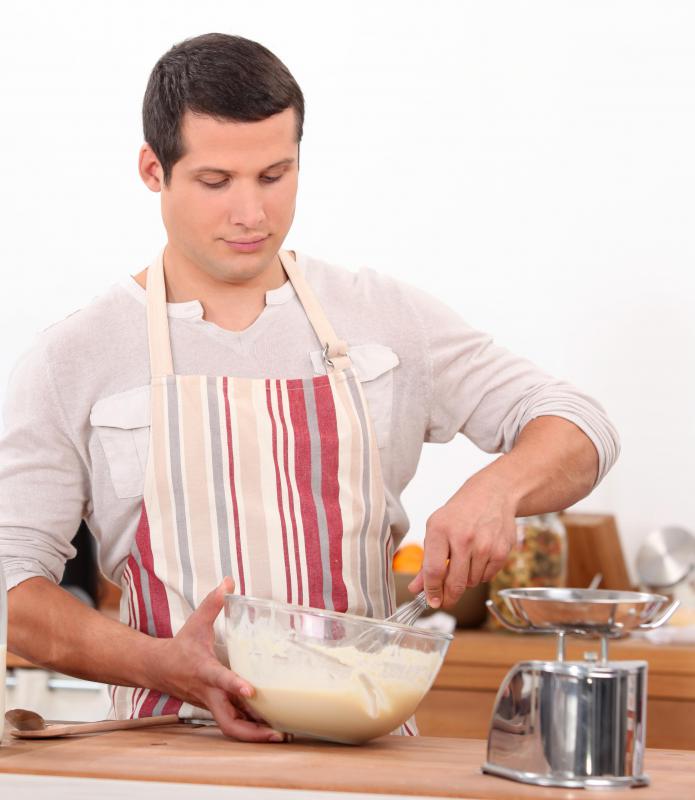
Usually, the best way to ensure that a cake is done is to closely follow the recipe. Most will tell you what size pan to use and material the pan should be made of, as well as oven temperature. If the instructions call for a metal pan, for instance, using one made of glass can change the required cook time; similarly, using a pan that is deeper or wider than what's called for can change things, as well.
Paying attention to the ingredients is also very important. Substitutions like honey for sugar, or additions of wet ingredients like blueberries or bananas, may result in a longer baking time. Doubling or tripling a recipe may also have an effect on how long the cake needs to bake. Even if each cake is in its own pan, most recipes are designed — and tested — on the assumption that a single cake is the only thing in the oven. It can take more time to distribute the heat when there are multiple cakes (or cake layers) in the oven.
Calibrate the Oven Temperature
Cooking time is largely dependent on how hot the oven is. If the temperature is hotter or cooler than what the recipe calls for, your cake may be done either before or after the estimated time. You may want to use an in-oven thermometer if you're concerned about how accurate your oven’s temperature gauge is.
Special Considerations
Cooks who are working at high altitudes or who are using convection ovens often need to adjust the overall baking time to compensate for these special circumstances. Most of the time, baking under either of these conditions is faster. An unprepared cook may find that a cake is done or overdone before ever getting a chance to test it.
Tricia Christensen
Tricia has a Literature degree from Sonoma State University and has been a frequent DelightedCooking contributor for many years. She is especially passionate about reading and writing, although her other interests include medicine, art, film, history, politics, ethics, and religion. Tricia lives in Northern California and is currently working on her first novel.
Learn more...
Tricia Christensen
Tricia has a Literature degree from Sonoma State University and has been a frequent DelightedCooking contributor for many years. She is especially passionate about reading and writing, although her other interests include medicine, art, film, history, politics, ethics, and religion. Tricia lives in Northern California and is currently working on her first novel.
Learn more...AS FEATURED ON:
AS FEATURED ON:


-
![The toothpick test is a popular method for checking if a cake is done.]() By: Dan RaceThe toothpick test is a popular method for checking if a cake is done.
By: Dan RaceThe toothpick test is a popular method for checking if a cake is done. -
![Yellow and white cakes should turn a golden brown on top when done.]() By: cobraphotoYellow and white cakes should turn a golden brown on top when done.
By: cobraphotoYellow and white cakes should turn a golden brown on top when done. -
![Closely following the recipe is a good way to make sure a cake will bake correctly.]() By: auremarClosely following the recipe is a good way to make sure a cake will bake correctly.
By: auremarClosely following the recipe is a good way to make sure a cake will bake correctly. -
![An unfolded paperclip may be used to test a cake.]() By: Chris TefmeAn unfolded paperclip may be used to test a cake.
By: Chris TefmeAn unfolded paperclip may be used to test a cake.


Discussion Comments
@anon318069: Are you *sure* the cakes are undercooked, or are they just moist because they aren't overcooked? Undercooked cakes will often have a streak of raw batter or really mushy crumbs. A cake that is uniformly done, but still moist is cooked properly, in my opinion.
To me, slightly underdone is far better than overcooked and dry. Some people think a cake has to be dry as dust to be "done." That's not the case.
I baked two 12" cakes today. The recipe said to cook at 160 for 1 1/2 hours. I baked it at 150 for two hours. The prong was clean -- a little wet from the hot cake but it was clean. When it had cooled down and I cut it open, the cake looked moist and undercooked and I cannot understand why? Any help would be great. I even put a flower nail in the middle of the cake.
Knowing how your oven bakes is one major key for making sure your cakes are done. Adhering to the recipe times works *if* your oven bakes at the same temperature the test kitchen did.
My rule of thumb is to check a cake at about three-fourths of the cooking time, but it's really about knowing your oven. For instance, I baked a cake recently where the cooking time was listed at 60 to 75 minutes. I checked it at 50 minutes, and ended up leaving it for 55 minutes.
If your cake pulls away from the sides of the pan, it's probably overcooked. Remember that the cake will continue to cook for a few minutes after you take it from the oven. So, it's really better to not cook it quite enough and allow it to finish outside the oven, than to wait until a toothpick is perfectly clean and it's pulling away from the sides.
In a lot of ways, it all boils down to how much experience you've got in baking cakes, the kind of cake you're baking and how well you know your oven. An experienced cake-baker can gauge a cake's doneness in other ways besides the toothpick test.
I bake cakes for special occasions, and when I am making a sponge or chiffon cake, I use the spring test. I tap the center of the cake gently with a finger, and if I can feel a little reverberation, I know the cake is done. I know it sounds like a little bit of a vague description, but basically I am looking for a little bounce or spring in the cake. Remember though, as the article stated, pressing too hard, or doing this too often can cause the cake to collapse.
@ Deborah17- Flourless chocolate cakes will not usually produce a clean toothpick. Flourless chocolate cakes are a type of custard cake, made with eggs, sugar, and butter. This is why these cakes are so dense.
If you follow the recipe, the cake will cook out completely. If you are still unsure about the cake, use a food thermometer to check the temperature. Anything over 165 degrees will be sufficient, but honestly most eggs can be eaten when cooked to only 135 degrees. You should also make sure that the cake does not jiggle when tapped or tilted (you don't have to worry about a flourless cake falling).
Hi, how do you tell if a flourless chocolate cake is fully baked? I followed the directions to a "T" and when I inserted a toothpick it came out looking sticky with chocolate- is this normal?
Post your comments