
At HomeQuestionsAnswered, we're committed to delivering accurate, trustworthy information. Our expert-authored content is rigorously fact-checked and sourced from credible authorities. Discover how we uphold the highest standards in providing you with reliable knowledge.
How can I Repair Cracks in Concrete?
Repairing cracks in concrete is not as difficult as it might seem to someone who has never done it before. It basically involves cleaning out the cracks, then using either a concrete patching compound or concrete caulk to fill the space. For larger cracks, a little sand can be added before the patching compound is used. After the cracks have been filled, they should be allowed to dry completely. For concrete that is heavily damaged, or if the cracks appear in the foundation of your home or another building, it probably is best to use a professional concrete repair service.
Repair Quickly

Home ownership comes with both benefits and responsibilities, and one of those responsibilities is to maintain the concrete or cement-paved areas around your home. It is best to perform the repairs as soon as you see any cracks in concrete on your property, for a variety of reasons. Cracks are easier to repair while they are still small. Safety is another reason to get started right away; homeowners are responsible for any injuries that occur on their property, and large cracks could cause someone to trip and fall. Cracked concrete can also be unattractive, and you likely will want to protect the looks and value of your home.
Causes of Cracks

Cracks in concrete can appear in driveways, patios, sidewalks and even around the foundation of your home. There are many things that can cause damage in these areas, including root growth and weather conditions. Perhaps the most common cause of cracked concrete is standing water; when water does not drain properly, it can work its way down between weakened sections and create a crack. Unless you solve the drainage problem, the cracking is likely to reoccur.
Repairing Small Cracks
For small cracks, such as those that are about 0.125 inch (about 3 mm) wide, start by using a screwdriver to chip away any flakes or loose concrete. Scour the cracks with a wire brush to remove any dirt and debris. Rinse the area using a hose or a bucket of water.
Next, mix up a small batch of concrete patching compound, which is available at most hardware stores. Using a latex additive will allow the compound to expand naturally through cold and hot weather. Trowel the compound into the cracks using a small putty knife. Smooth the surface right away, while the compound is still moist, because concrete compounds typically begin to set very quickly. Allow your repair work to dry thoroughly before you let anyone walk or drive on the surface.
Repairing Large Cracks

The beginning steps for repairing larger cracks in concrete are the same as for small cracks, but larger ones require the use of more advanced techniques: caulking or sand packing. Use a screwdriver to chip away any flakes or loose concrete. Scour the cracks with a wire brush, and rinse them out using a hose or a bucket of water.
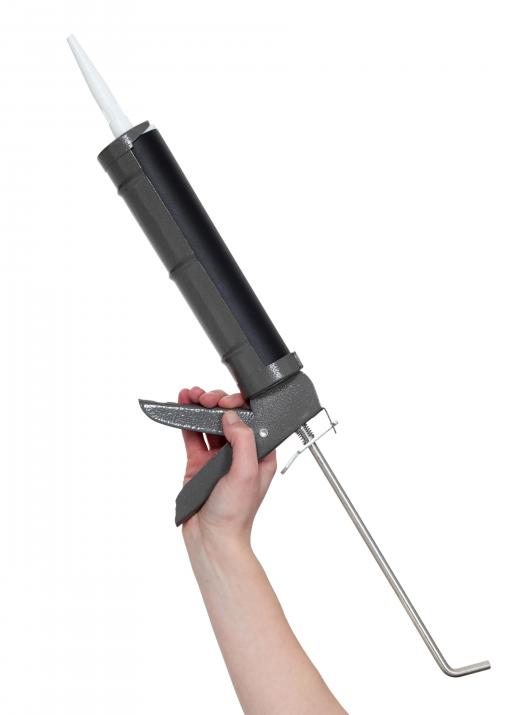
To employ the caulking method, get some siliconized latex concrete caulk, which is available at most hardware stores. Using a caulking gun, force the caulk deep into the cracks along their length and breadth. The caulk will expand to fill the crack, and the nature of the substance will allow for expansion and contraction during weather changes, cutting down on the frequency of future repairs. The caulking compound will self-level, so there is no need to smooth the surface, but for large cracks, multiple applications may be needed.

If you choose to use the sand-packing method, you will need to buy sand and concrete patching compound, preferably with a latex additive for flexibility. Pour in a layer of sand to help fill the cracks, then apply the patching compound on top of it with a trowel. Smooth the surface quickly, and feather the new surface into the existing edges for a finished look.
Excessive Damage
For serious or exceptionally large concrete crack repairs, you might need to call in a professional. This is especially true if the cracks appear in the foundation of your home. A professional can conduct a risk assessment survey to find out whether there is structural damage that needs to be addressed. He or she may also be able to determine the cause of the cracking, and how future damage might be avoided.
AS FEATURED ON:
AS FEATURED ON:


-
![Cracked concrete.]()
Cracked concrete. -
![A closeup of a crack in concrete.]() By: Taweesak NgamamornpiA closeup of a crack in concrete.
By: Taweesak NgamamornpiA closeup of a crack in concrete. -
![Caulking with silconized latex concrete caulk might be needed for large cracks.]() By: auremarCaulking with silconized latex concrete caulk might be needed for large cracks.
By: auremarCaulking with silconized latex concrete caulk might be needed for large cracks. -
![Cement powder is commonly made of limestone and clay and is a key ingredient of concrete.]() By: Yali ShiCement powder is commonly made of limestone and clay and is a key ingredient of concrete.
By: Yali ShiCement powder is commonly made of limestone and clay and is a key ingredient of concrete. -
![A trowel may be used to repair cracked concrete.]() By: yunava1A trowel may be used to repair cracked concrete.
By: yunava1A trowel may be used to repair cracked concrete.


Discussion Comments
OK, I'm a skater from the uk, and there are some skate spots here and there but cracks spoil them. Would I be able to patch them or would it be illegal? They are about 1" wide and 5 " long.
I have a second floor in India. The roof has a crack in one side and down to all the walls on the same side. Please suggest to me what I should do.
I second the product called rubaroc. I have used it myself and it's great for surfacing over damaged concrete. The installer was also able to level my shifted concrete with the rubaroc.
I have coloured stamp concrete walk way to my front door, and a crack has formed from one side to the other maybe 1/4" thick. would an epoxy work? it looks terrible!
Cracks should be cut out with a 5" grinding saw, then cleaned out with chlorine to kill any mold spores.
If the crack is no longer moving best option is epoxy mixed with sand after you trowel the epox into the crack pour sand over the top, this will help to stop the epoxy shrinking back, leave epoxy till completely dry -- usually 5 - 10 hours unless fast cure is used then grind flat with 9" cup wheel grinder. You may then want to think about coating the concrete with a stenciled concrete coating.
I have a crack in a cement porch- 3feet long 1/4" wide. I would like to patch it and not have the patch show. Could I patch it per your instructions, and then cover the entire porch with a very thin layer of the patching cement? If so, what product should I use?
"Are some cracks in concrete too big to patch? I have a crack the length of my garage from 1" to 2" wide. Can I patch?"
Yes you can patch it if it is not moving any further, with a product like Concresive 2200 epoxy or Emaco S88CT.
"After filling a crack that had a latex additive in the concrete, can you *stain* it, or will the concrete not absorb the stain (acid) stain??"
Doing my own research for this same question, I found the answer to be no.
You can stain the concrete, but the repair will stand out. The recommendation is to either work the flaw into your stain, or go with an epoxy coating to hide the flaw(s).
Are some cracks in concrete too big to patch? I have a crack the length of my garage from 1" to 2" wide. Can I patch?
I came across a great product called Rubaroc. The price was around the same price, maybe a bit cheaper, as other products like having interlocking bricks or pavers installed. The installers came and applied the product right on top of my concrete deck! The deck was really old and horribly cracked. It looked good as new! The product was rubber granules mixed with resin, and troweled out on the concrete. Apparently you can apply this on almost any surface.
After filling a crack that had a latex additive in the concrete, can you *stain* it, or will the concrete not absorb the stain (acid) stain??
pls tell me what are the different types of cracks in brick masonry wall and RCC wall. what are their reasons and remedies of those cracks. how can we repair those cracks. it's urgent.
"perhaps the most common cause of cracked concrete is standing water"
cracks in concrete can also be caused by unevenly dense subsurfaces below the slab. for example, if some areas below the concrete are soft and compressible and others are firm, the uneven settling could cause cracks over time.
ensuring an equally dense subsurface can help to prevent cracks in concrete even before they appear.
Post your comments