
At HomeQuestionsAnswered, we're committed to delivering accurate, trustworthy information. Our expert-authored content is rigorously fact-checked and sourced from credible authorities. Discover how we uphold the highest standards in providing you with reliable knowledge.
How can I Remove Mold from my House?
 Mary McMahon
Mary McMahon
Mary McMahon
An ounce of prevention is worth of a pound of cure when you need to control mold. By making it difficult for mold to thrive, you can greatly reduce how much is in your house, and you should remove the fungus as soon as it starts to show. Do not give mold a chance to gain a foothold, as it can spread spores all over the house, resulting in a moldy nightmare.
You should also check closely for signs of mold and mildew in a prospective new house, because they can be difficult to eradicate once established. It can be a challenge to remove mold from your house, but if you stick with it, you will ultimately be successful, unless previous tenants allowed it to set in.

Mold and mildew are actually different types of fungus, although they are often confused. The rules to reduce and remove mold fortunately apply to mildew as well. Primarily, the best way to prevent mold is to keep the house clean and dry. Mold and mildew thrive in damp, warm environments, so make sure that spills of liquids and foods are promptly cleaned up, so they have nothing to feed on, and take steps to reduce the humidity in your home. A dehumidifier can be used to dry the air. Proper ventilation is also important, and you may want to invest in fans to improve air circulation.

If mold and mildew do start to appear, your approach to remove it will vary, depending on the substance the mold is infesting. If possible, the fungus should be exposed to sunlight. A rug, for example, that begins to show mold can be taken outside and sunned to kill the spores. The same can be done with other textiles, and they can be treated with a mild bleach and water solution before being washed and hung outside to dry so that the sun will kill any remaining spores. Paper products should be discarded, as it can be impossible to remove mold from your house when it has established itself on books, magazines, and newspapers.

To remove mold when the area of infestation is not as movable, as is the case with moldy walls and bathroom fixtures, you will need to be a little bit more aggressive. Mix a bleach and water solution or use a commercial mold removing product to wash the area, and make sure to keep the work space well ventilated. When you remove mold from your house using this technique, make sure to spot test the surface for staining. You may need to try a few options before you find a cleaner that is safe for wood or paint. Never paint over mold, because it will continue to grow underneath, and it will be even more difficult to get rid of.

On carpeting, use a vacuum to pull up as much mold and mildew as possible, and make sure to wipe the vacuum down and expose it to sunlight afterwards. Use a cloth soaked in a bleach solution to blot the moldy area, first spot testing on a hidden area. Use a dry cloth to absorb as much moisture as possible from the area, and a fan to help it dry quickly. Other types of flooring such as wood, linoleum, stone, or tile can be thoroughly mopped to remove mold.

Garages are particularly notorious places for mold, as they often have no natural light through windows and damp, dirty floors. Try to keep the garage door open on sunny days, if possible, to help deter fungus growth, and build shelving to keep articles stored in the garage off the floor. If mold does appear, empty out the garage, wash it well with a strong bleach solution, and allow it to dry entirely. Check individual items in the garage for signs of mold and mildew, discarding paper products that have become moldy and cleaning everything else thoroughly.
Mary McMahon
Ever since she began contributing to the site several years ago, Mary has embraced the exciting challenge of being a HomeQuestionsAnswered researcher and writer. Mary has a liberal arts degree from Goddard College and spends her free time reading, cooking, and exploring the great outdoors.
Learn more...
Mary McMahon
Ever since she began contributing to the site several years ago, Mary has embraced the exciting challenge of being a HomeQuestionsAnswered researcher and writer. Mary has a liberal arts degree from Goddard College and spends her free time reading, cooking, and exploring the great outdoors.
Learn more...AS FEATURED ON:
AS FEATURED ON:


-
![Loaf of moldy bread.]() By: anetlandaLoaf of moldy bread.
By: anetlandaLoaf of moldy bread. -
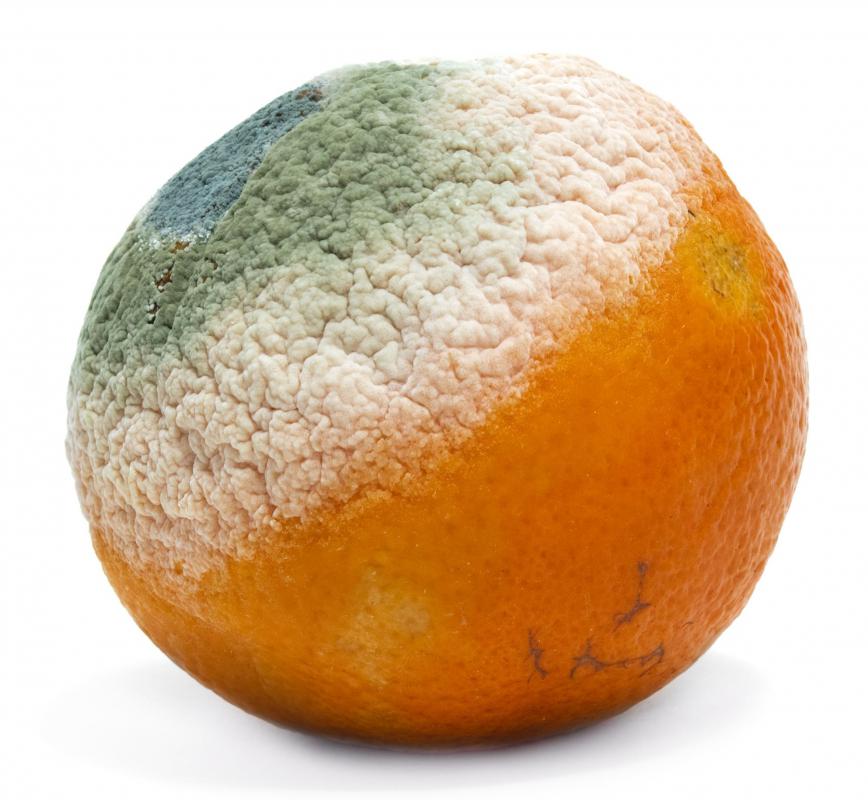
![An orange with mold on it.]() By: nitoAn orange with mold on it.
By: nitoAn orange with mold on it. -
![Old newspapers should be discarded if mold gets on them.]() By: by-studioOld newspapers should be discarded if mold gets on them.
By: by-studioOld newspapers should be discarded if mold gets on them. -
![A dehumidifier may help prevent mold from appearing in a home.]() By: KellisA dehumidifier may help prevent mold from appearing in a home.
By: KellisA dehumidifier may help prevent mold from appearing in a home. -
![A bleach and water solution will kill most mold spores.]() By: design56A bleach and water solution will kill most mold spores.
By: design56A bleach and water solution will kill most mold spores.



Discussion Comments
Molds are multi-cell (comprised of more than one cell) filamentous parasites, generally having a fluffy or cottony delicate presence when they develop in your home. They may be white, dull or any shade. They process spores normally agamically and in extensive numbers which implies they emerge and inherit from a solitary guardian. Agamic generation is the essential manifestation of propagation for single-celled living beings, for example, microorganisms and organisms. They are light, impervious to drying and can without much of a stretch spread through the air and pollute anywhere.
More often, a rotten odor could be the main sign that there is a concealed mold development far from your house. Never disregard mold smells on the off chance that you can't see any mold. You ought to completely investigate your home before any mold issues get worse.
Great article, but I would agree with @icecream17. You want to look into a mold remediation service. You don't want to make the situation worse. Talk to a professional! Better safe than sorry.
To clean out the garage, we used a professional group called Affordable Renovations. This group consists of two men. They charged us $800 to remove the mold. They used a vinegar and water solution, a 50/50 mix. Then they used a scrubber with Ajax.
So far, the floor looks pretty good. It is messy to clean up. They used a scrubber to get around the furnace and we are wondering if the water got under the furnace and if we are going to have a rust problem in the future. What do you think?
If you do the drying out, remove the source of the moisture and keep a dehumidifier going will that not just kill off the mold?
A question: the text states "A rug, for example, which begins to show mold can be taken outside and sunned to kill the spores."
How long -- or more appropriately, how *short* an exposure is required? In winter months, our access to direct sunlight is shortened by surrounding trees and houses and the lower altitude of the sun. The opportunities for direct sun in a spot might be only tens of minutes -- are hours of exposure the necessary minimum?
Mold can be pretty brutal and I suggest if you're having a problem to seek a professional.
Icecream17- You made a good point, but remember mold removal is expensive.
A typical crawl space can run from $500 to $4000, but fees as high as $10,000 to $30,000 is not uncommon for mold found in the walls.
You can also hire a professional contractor with experience in mold remediation, because if mold is not properly removed it can spread and cause all sorts of health problems and even make the home inhabitable.
The Environmental Protection Agency or the EPA suggests that homeowners use air conditioners, dehumidifiers and fans whenever possible.
Post your comments