
At TheHealthBoard, we're committed to delivering accurate, trustworthy information. Our expert-authored content is rigorously fact-checked and sourced from credible authorities. Discover how we uphold the highest standards in providing you with reliable knowledge.
How can I Make my Eye Stop Twitching?
 Tricia Christensen
Tricia Christensen
Tricia Christensen
If you’ve ever experienced blepharospasm, the involuntary twitch of the eye, you certainly want to know how to make your eye stop twitching. First off, don’t panic if you can help it, stress often leads to the condition, and greater anxiety may make it last for longer. Being able to relax, and ignore the twitching eye may help the eye stop twitching sooner.
Most often, the eye twitches because of three common reasons. These are stress, fatigue or intake of caffeine. The condition usually lasts for a couple of days and then is gone. It is helpful during this time to try to get a good amount of rest, try to minimize stress and avoid caffeinated beverages. This can all help make the eye stop twitching more quickly.

Sometimes the eye twitching can be more pronounced. Instead of just a slight tic, the whole eyelid closes during the twitch. The most common cause associated with this involuntary eye closure is usually caused by injury to the eye, for example a scratch on the cornea. If you scratch your cornea, there’s no chance you won’t notice because it does hurt. Different forms of pinkeye may also make the eye twitch.
If the whole eye is closing with the twitch, you should definitely see a doctor. They can easily diagnose conditions like pinkeye or corneal scratch. Treatment will make the eye stop twitching, usually within a few days.

Another reason to see the doctor for eye twitching is if the twitching lasts for more than two to three days. In fact, if the twitching keeps recurring, you may have chronic blepharospasm. The origin of this condition may not be diagnosed, but it can be treated.
Treatments to make the eye stop twitching include injections of Botox®, which paralyzes the eye muscles involved in the twitching movement. For some this is very successful, and only one injection is needed. Others may need to repeat the injections every three to four months.

Doctors may also prescribe different types of medications to make the eye stop twitching. These include benzodiazepines, what we commonly call muscle relaxants or tranquilizers, and some anti-convulsant medications like Tegratol. If the underlying cause is anxiety-based, they may make the eye stop twitching.
When Botox and medications don’t work, surgery to make the eye stop twitching, called myectomy, removes some of the muscles around the eye. This can be effective but is usually only used as a last resort. Physicians try Botox and medications first before recommending surgery.

Twitching that occurs with other involuntary contractions of facial muscles may suggest several other conditions. These include Tourette Syndrome, and other disorders of the facial muscles. If you notice pronounced involuntary muscle contractions of the face that don't resolve, do see a doctor for diagnosis.
In most cases, you will never need to see a physician. Usually a few days of rest and recovery make the eye stop twitching on its own. Since one of the main causes is stress, addressing the underlying causes of stress might also help a long-term twitch. People with panic disorder report a high rate of eye twitching, and sometimes before big events people report eye twitching occurring. Once the event is over or panic disorder is under control, the eye stops twitching.
Tricia Christensen
Tricia has a Literature degree from Sonoma State University and has been a frequent TheHealthBoard contributor for many years. She is especially passionate about reading and writing, although her other interests include medicine, art, film, history, politics, ethics, and religion. Tricia lives in Northern California and is currently working on her first novel.
Learn more...
Tricia Christensen
Tricia has a Literature degree from Sonoma State University and has been a frequent TheHealthBoard contributor for many years. She is especially passionate about reading and writing, although her other interests include medicine, art, film, history, politics, ethics, and religion. Tricia lives in Northern California and is currently working on her first novel.
Learn more...AS FEATURED ON:
AS FEATURED ON:


-
![Avoid caffeinated beverages, such as coffee, to reduce eye twitching.]() By: picsfiveAvoid caffeinated beverages, such as coffee, to reduce eye twitching.
By: picsfiveAvoid caffeinated beverages, such as coffee, to reduce eye twitching. -
![In severe cases of eye twitching, a doctor may use Botox to control the twitch.]() By: VictorDIn severe cases of eye twitching, a doctor may use Botox to control the twitch.
By: VictorDIn severe cases of eye twitching, a doctor may use Botox to control the twitch. -
![An eyelid twitch causes involuntary blinking.]() By: DelphimagesAn eyelid twitch causes involuntary blinking.
By: DelphimagesAn eyelid twitch causes involuntary blinking. -
![Stress can cause eye twitching.]() By: blueringmediaStress can cause eye twitching.
By: blueringmediaStress can cause eye twitching. -
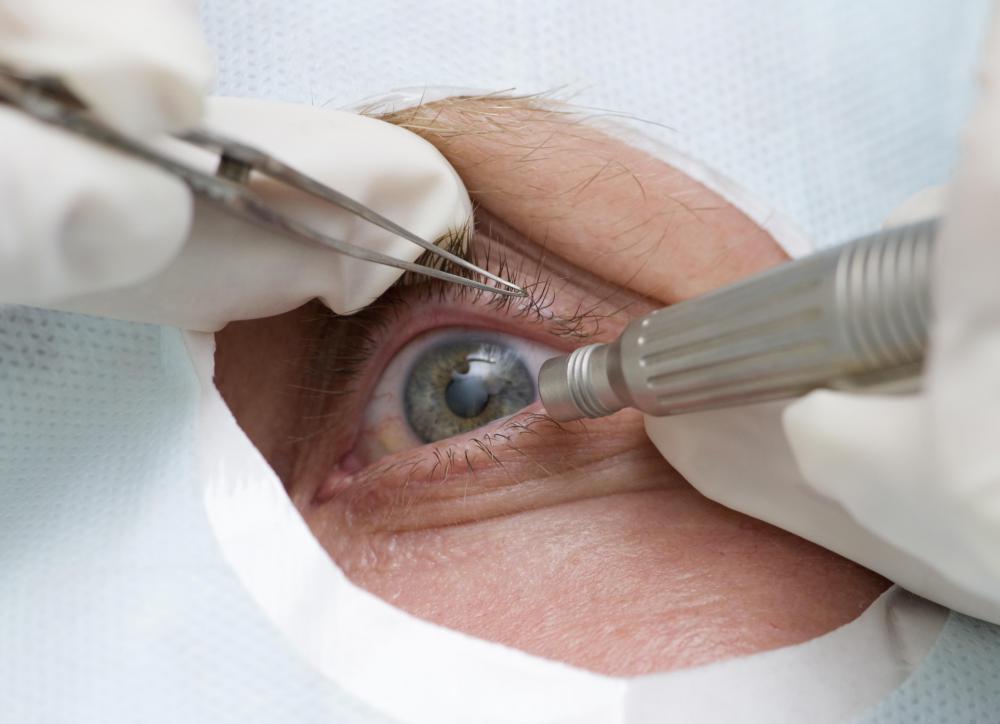
![If other methods don't work, surgery to remove muscles around the eye can be an option to address eye twitching.]() By: Max TacticIf other methods don't work, surgery to remove muscles around the eye can be an option to address eye twitching.
By: Max TacticIf other methods don't work, surgery to remove muscles around the eye can be an option to address eye twitching. -
![Stress and anxiety can cause an eye twitch to become worse.]() By: Africa StudioStress and anxiety can cause an eye twitch to become worse.
By: Africa StudioStress and anxiety can cause an eye twitch to become worse.





Discussion Comments
Twitching muscles around the eye are a B vitamin difeciency symptom. Take a B complex supplement plus a B6 supplement daily.
This explains a lot. I just recently started drinking coffee and bam! My left eye twitches.
This is helpful info. My eye is twitching uncontrollably right now, but that's because I just saw two people smooch on TV. For me, I get this reaction whenever something disturbs me. It usually stops within a minute or two.
Obviously the causes are going to be different for everyone. For some folks, it is as simple as blood or trace mineral deficiency. Chiropractic treatments helped my twitching.
Muscle twitching is a result of low magnesium or too much calcium. Simple as that.
People shouldn't write nonsense here. What abuse of medicine? Eye twitching is due to injury. Don't write nonsense.
Love it! To the point, articulate, and interesting.
There is help for eye twitching.
An old TCM solution to the immediate problem (as this can be quite annoying at times):
Slightly moisten a tiny piece of paper and stick it on the eyelid that is twitching.
I had this eyelid twitching 16 years ago constantly for over 10 months. as soon as I woke up until I went to sleep at night there it was every five seconds. I was really worried about it and was thinking I had all sorts of neurological diseases.
then one day I happened to see an article in a magazine about a girl who had had it for six months and had been cured by simply taking a magnesium supplement. I then researched the connection between muscle jumps and a deficiency in magnesium which both myself and I have to say my GP had never heard of. Within two weeks it had totally gone and I have never had it since.
Occasionally when I run out of my magnesium tablets within a few weeks I can feel little muscle jumps start to appear in my legs or other parts of my body. Two weeks of my magnesium and they calm down. I cannot speak highly enough for this supplement because I have tried and tested it and it always works for me.
meditate. everything is done through breathing. if you don't know how to breathe you will always have physical and mental problems.
I popped my back and straightened my spine with stretching and it stopped immediately.
I have been having twitching in my right eye for over two or three months now. It started as barely twitching but then increased a lot in regularity of occurring, then I had a lean period of it not twitching and its again started to twitch a lot.
I have had twitching under my right eye for almost 2 years. I have been to my regular doctor with no luck. I have been to my eye doctor with no luck (both wanted to send me to an eye surgeon for Botox). And most recently went to a chiropractor for a different reason. Learned through x rays that I have a vertebrae out of place in my neck that is pushing on the nerve that controls the eye muscles. Had no pain in my neck to make me think that would be the problem.
Been getting treatments and it got better but is not gone completely.
I think there is a big difference between "eye twitching" and "blepharospasm". As I have suffered with blepharospasm and dry eye now for seven months with very limited relief, I must say Western medicine has nothing to offer.
I have tried acupuncture in a physician's office but am now moving on to my own He-Gu treatment regularly, as I have nothing else to lose. I have recently started Vitamin A, Vitamin B12, Vitamin B6, Magnesium and GLA to see what might be going on. Do I really care which one solves the problem? Not at this point. I just want my life back. It is very limiting and distracting - often it hurts.
Anyone who has what I term "clenching" of my eyelids knows exactly what I am talking about - it's not just a "twitch" by any means.
Well, I took vitamin pills and tried other mainstream treatments before as well, and they didn't work out anything. About the acupressure method, well, perhaps the related posts below will be helpful and useful to you.
I had eye and facial twitching for about five years now and I took a vitamin B supplement called nuribine forte and it went away for four year but it is back again. I have gone through some stress in my job but I am trying anything I read about and nothing so far is helping I even tried accupunture and I just don't know what to do now.
anon101160: Congratulations then. I hope that the particular acupressure technique would work for the others too.
I've been twitching for five days and just tried the acupressure technique on myself, and it stopped! thank you!
I have gotten minor random eye twitches that have always gone away very quickly. My eye started twitching a week ago and has not stopped. It's a very minor twitch like the one you would get after staring at a computer for too long. It is only twitching below my eye. What should I do?
I get this every few years. I take magnesium and smash a motrin and stick it up in there and within a few days it goes. sometimes when I get very stressed, it comes back but I try my best also eating large amounts of salmon. It's good.
Thanks, I relaxed a bit, and my eye stopped twitching so much.
I've had eye spasms for two months now. Top and bottom right eye and now getting cheek and lips and tongue, legs, hands, stomach, temple, back, basically all over spasms but the worst is in my eye.
These spasms come all day every day and don't hurt, but annoy the heck out of me. The eye twitch goes non stop all day while the body twitch last for a few seconds and jumps from body part to body part throughout the entire day.
I've already had an MRI and EEG and both were good. Next is the EMG. I'm not stressed and don't drink much coffee or take any meds.
The doctor has had me try magnesium and calcium and the spasms have not ceased. The eye spasms are making me crazy and I can't concentrate. I want to get Botox to help these spasms but I want to of course know what's causing them first.
Might I also add that, in the past two months, I also experienced a tingling sensation in my left arm as well as a warm sensation on the top of my left foot and bad chest pains that hurt most when I lay on my back.
I've woke up crying because of the pain. Doc said my heart is fine and gave me anti-inflammatories. Has anyone ever heard of this happening to anyone else? Help!
I have a more simple solution. Take a magnesium supplement. I would also add a potassium, calcium and good daily vitamin. It cured me. regards
It's actually called Blepharospasm which is a symptom of involuntary and uncontrollable movements in the muscles around a person's eyes which in turn make them appear like 'blinking non-stop' to other people.
In certain cases, this may be caused by myasthenia (muscular weakness) in the eyes organ as a result of stresses, overstraining of the eyes, lacks of sleep, the serious lacks of certain nutrients / minerals to support the normal functionings / movements of your eyelid muscles etc.
Next, in the case whereby no stress, any kinds of infections, overstraining of the eyes etc are involved while the eyelids and the entire organs just look superficially normal and OK, and at the same time, the eyelid-twitching / eye-blinking just get 'unexplainedly' from bad to worse
from time to time, such medical scenarios could actually be caused by other neuromuscular disorders which are much more complicated.
And in terms of such neuromuscular disorders, they may arise as a neurological / Tardive Dyskinesia side effect of certain medications, especially the powerful mind-altering tranquilizers of antipsychotics / neuroleptics, particularly when such medications are
over-relied on to the point of sheer abuse.
How does one know that one is applying pressure exactly at the right "He Gu" Acupuncture Point ? - Additional Details About The Suggested Self-Administered Acupuncture Cure For Blepharospasm / Chronic Non-stop Rapid Eyelid-twitching / Eye-blinking (Please Refer To The Prior Post Below)
The information as follows is added accordingly in response to further additional feedbacks and enquiries made ever-increasingly by the ones troubled with chronic non-stop rapid eyelid-twitching / eye-blinking problems (especially the medication-induced ones) seeking helps from me through the emails.
About the question of how would one know that he / she is applying the blunt-pointed instrument-aided pressure at the right point (the "He Gu" acupuncture point), well, the nerves of our bodies especially the ones closely adjacent to each other, would tend to interwind, overlap and interconnect among one another. While the 1.5 cm and its location on the wrist as portrayed in the diagram - available over the internet) for the 'He Gu' acupuncture point is actually a standard measure for the size of the hands of the average grown adults.
Next, applying blunt-pointed instrument-aided pressings upon it (or any points around that 'He Gu' acupuncture point area) will actually generate direct stimulations to the other nerves surrounding that pressed point around the wrist area as well, and subsequently, produce a reflexology stimulus / 'qi' that will flow / travel right up to the 'final destinations'(please refer to the medical references weblink through an internet search), which are the peripheral nerves attached to the muscles of the entire face, especially the eyelids to generate the desired healing effects to the intended areas by gradually restoring their bodily chemical balances. In my case and the others, that acupuncture technique actually serves to gradually and eventually drive out the risperdal toxins / other related contaminating substances that disrupt the normal functioning of the dopamine neurotransmitters chemicals of the neurons / nerve cells around our eyelid muscles and cause all those rapid unwanted eyelid-twitching / eye-blinking, totally out of our bodies and enable us to get totally cured once and for all in the end.
For related references regarding the diagram and medical references for the "He Gu" acupuncture point, please make a search by the keywords 'non-stop eyelid-twitching' through Yahoo Search Engine
and look for the related posts containing such information.
Lastly, I hope that the information given above will be useful to the intended readers. Thank you.
Well, regarding the 'He Gu' acupuncture point I have mentioned in my prior articles for the suggested cure for non-stop eyelid-twitching, its exact location is at the back of the palm of one's right hand, which is 1.5 cm (applicable to the average grown adults only) measured vertically from the point of intersection (that would appear visibly when the fingers are closed loosely together) between the thumb and the forefinger. (Kindly take note that this point is located at a much 'fleshy' instead of a much 'boney' area - perhaps you would need to briefly explore that part of your right hand at the same time to locate that point, and I hope you will understand that the hand structures of each person differ from one another).
When the acupuncture point is identified and marked accordingly, you can then re-open your hand, and then what you all can do is to sit down, and at the same time press that onto the surface of that acupuncture point (using just mild force) with any long blunt-pointed object such as toothpick, a normal writing pen (which is out of ink of course) etc against your chin (suggested for convenience purpose) for a continuous 2 hours (during any time in a day), and it's preferably to do that when you are about to go to sleep at night (so that you have more free time to do it). However, if you are eager to find out the very exact location of that particular acupuncture point to further verify the information given above, I would suggest you to seek consultancy from a licensed acupuncturist.
In this regard, based on the acupuncturist, the blunt-pointed objects such as normal writing pen (which is out-of-ink of course) etc instructed to me for such self-administred therapy is actually intended as a substitute for the acupuncture needle to deal effectively with the particular acupuncture point.
Unlike the other traditional method of acupressure which involves the use of fingers to press and massage the acupuncture points, the use of blunt-pointed object in such a case for the treatment of chronic eyelid-twtiching is actually meant as a 'leverage' to provide an adequately focused and hence a 'reflexology stimulus' that is strong enough to deal more precisely and effectively with that acupuncture point.
Whereas, if that acupuncture point is to be treated with fingers, the stimulus effect generated would be very much smaller due to the fact that such pressings and massagings would reasonably not last long enough to provide any reliefs for the chronic eyelid-twitching. Besides, given the larger suface area of the fingers as well as their rounded physical shape (compared to the blunt-pointed objects), a large part of the forces produced from such pressings and massagings would then be reasonably applied onto the related muscles rather than directly onto the intended nerves through the related acupuncture point to deal effectively with such sickness.
Please be reminded that a good sleep at night throughout the therapy period is essential for the healing to be effectively done. And a person shouldn't associate oneself again with the underlying causes such as over-straining of the eyes, excessive cafeine intake, allergy/overdosage of certain medication (with muscle spasms side effects) that causes this non-stop eyelid-twitching to the particular person in the first place to avoid a relapse of that sickness, especially after getting cured from it.
Please take note that one should continually apply that method in the case where it proves to be effective in dealing with the eyelid twitching problem (after trying it for about 3 days' time).
For your reference, I get my eyelid twitching stopped the next day after the acupuncture treatment. But when I stop the treatment for the next few days, the twitchings just come back again. Based on the acupuncturist, the explanation for the relapse is such that if one were to apply just one-off / short-term treatment, it would then only serve to disperse the dopamine-disturbing toxin / other 'contaminating agents' around one's eye nerves enabling the twitching to stop just temporarily (without totally purging such toxins / 'contaminating agents' out of the human body). So, it works just like doing a physiotherapy whereby one should complete the whole course of treatment (in this case, applying that self-administered technique persistently for weeks / a few months) to get the eyelid-twitching sickness totally cured effectively once and for all in the end.
Next, the suggested duration of two-hour period/day (continuous non-stop healing process) for that self-administered treatment is just what I have recommended so far to other persons having the similar symptoms based on my very own healing experience from this eyelid-twitching sickness and the others who suffer from it (who eventually get it totally cured). All in all, it would actually depend on one's healing progress for the eyelid twitching sickness upon applying that suggested self-administered acupuncture method.
In the case of prolonged neuromuscular eyelid twitching, since it is the dopamine-disturbing substances / other 'contaminating agents' that disturb the eyes nerves and cause all the unwanted twitching, spasms, tics etc, getting rid of them from the eyes nerves /related nerves around the particular organ having the twitching would then naturally, reasonably, logically and obviously be the most clear-cut, direct and straightforward way of curing such a neurological / neuromuscular sickness.
Unfortunately, in terms of the formal mainstream western medical Science (in contrast to such alternative therapies as acupuncture etc), the particular technology of administering direct and effective treatments onto the peripheral nerves around a particular area of muscles having certain neurological movements / neuromuscular disorders (in order to cure them effectively) simply has not yet been found/invented/developed/discovered by the modern medical science of the formal western medication.
Next, even such sophisticated medication as Botox injections could only deal with such neuromuscular disorders merely through indirect means of 'interception' by 'half-paralysing' the areas of muscles having the twitchings (even in the case where the muscles themselves do not have any problems / simply are not the root cause of such twitching) without being able to deal with the problematic nerves causing all those unwanted twitching to those muscles. And that's the reason why the recipients of Botox injections would need to get such treatments over and over again when the muscle-paralysing effects of such medications lapse totally (after 3-6 months).
Therefore, such an argument actually suggests the main reason why a person troubled with chronic prolonged eye twitching problems would hardly get their problems effectively solved by using such formal therapies as eye drops, vitamin / mineral pills, anti-muscle-spasms injections, medications etc as they simply do not or rather cannot deal directly and effectively with the underlying problematic nerves around the twitching eyes /other muscles & organs that cause all those unwanted twitching. This is due to the underlying fact that the 'right technology' for the treatment of such neuromuscular disorders simply doesn't exist in the present day western medical science (which covers the those treatments mentioned above). I may appear to sound a little arrogant to you by making that remark, nevertheless, that's simply the truth.
In this regard, I was caught in such a predicament / difficult situation too during the initial period when I firstly sought repeated but futile treatments from such formal medical personnel and specialists of the western medication to deal with my Tardive Dyskinesia-induced non-stop eyelid twitching before I finally got it totally cured once and for all through the acupuncture treatment which serve to deal with the root cause of the non-stop eyelid-twitching problem by purging / driving out the dopamine-disturbing substances / other contaminating agents that cause all the non-stop twitching gradually and eventually out of my body enabling me to get healed in the end.
Blepharospasm may also be a symptom of magnesium deficiency. Magnesium supplementation relieves most types of muscle spasm. --LC, Clinical herbalist in CO
Certain medications, especially the ones that involve the changing of the normal functioning of dopamine receptors, such as blocking them etc (in carrying out their medical mechanisms to cure certain sicknesses and unfortunately is also one of the unavoidable side effects of such medications) would definitely present a possibility of causing interruptions to the "message sending, conveying and relaying" neuron operations between the human brain and any parts of the human body resulting in various neuromuscular disorders, including abnormally eye blinking and other muscle spasms.
In my case, I get such a sickness totally cured through acupuncture treatment administered onto the "He Gu" acupuncture point located on my right wrist.
In the case of severe eyelid twitching which lasts for months and even years, it may very likely be one of the symptoms of Tardive Dyskinesia which falls under the EPS (extrapyramidal symptoms) syndrome.
Such EPS syndrome (mainly physical movement disorders, including Hemifacial Spasms triggered by bodily chemical imbalances) in turn is caused by disturbances to the dopamine receptors of the nervous system that is induced normally by most of the AAP's (atypical antipsychotics).
I get an abnormally rapid eyelid twitching sickness some years ago and it is diagnosed as one of the symptoms of Tardive Dyskinesia (neuroleptic medication-induced repetitive, involuntary, purposeless facial muscle movements). And I actually got it finally and totally cured through both acupuncture and alternative instrument-aided self-administered acupressure treatment applied onto the "He Gu" acupuncture point located on the wrist at the back of the palm of my right hand.
I have a very simple solution for this problem. I put very gentle pressure on the eye muscle and hold it for a while until the muscle calms down. I do not get eye twitching often, but the few times that it happened the simple gentle pressure seemed to help.
Post your comments