
At WiseGEEK, we're committed to delivering accurate, trustworthy information. Our expert-authored content is rigorously fact-checked and sourced from credible authorities. Discover how we uphold the highest standards in providing you with reliable knowledge.
How can I Improve my Chances of Pregnancy?
Starting a family is an important decision in your life. The journey through pregnancy and raising a child is indeed an exciting time for you and your partner. Keep in mind, though, that getting pregnant is not as easy as it may seem. In fact, 25% of couples have problems conceiving. If you fall into this group, there are a number of things you can do to improve your chances, including making sure that you're trying at the right time, that you're having sex regularly, and that you're eating right and getting enough exercise.
Check Your Timing

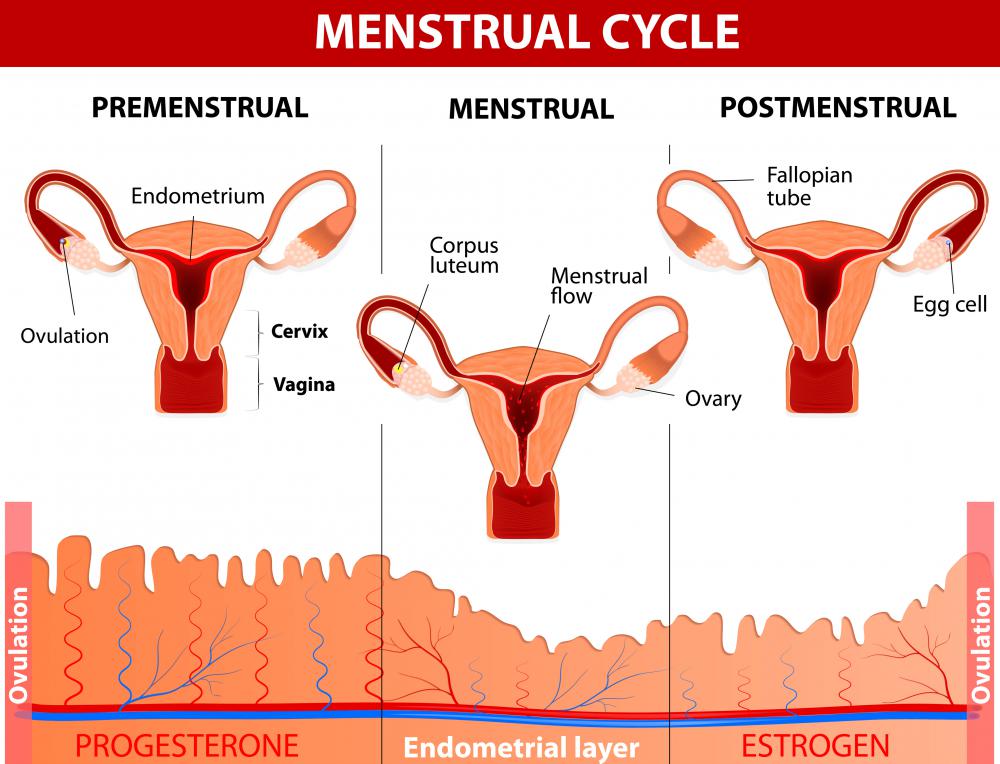
Pregnancy is dependent upon a couple's fertility, and a woman is most fertile during ovulation, when her ovaries release a viable egg. Although chances of conception are highest during ovulation, the fertile period actually begins four to five days before and continues up to two days after it. It is possible that you and your partner are having sexual intercourse outside your fertile period.

To avoid improper timing, start monitoring your menstruation cycle closely. If you have an average 28-day menstruation cycle, your ovulation will probably occur on day 14. Therefore, your fertile period lasts from day 11 to day 16, and days 13, 14 and 15 bring you the highest likelihood of getting pregnant. Since sperm can live in the body for four to five days, have sexual intercourse just before your ovulation in order to maximize your chances.
Have Sex Regularly, the Right Way

Regular sexual intercourse is important when attempting conception. This is because long periods of abstinence increase old sperm count in the semen, decreasing its ability to fertilize the egg. Having sex every two or three days refreshes semen, resulting in better sperm quality. Nevertheless, simply having sex regularly may not be enough. Also consider your positions during intercourse.

Pregnancy is most likely when sperm is deposited as close as possible to the cervix, and certain positions are more favorable to help this happen. The missionary position and entry from behind are best, because they allow for deeper penetration, encouraging ejaculation closer to the cervix. Avoid positions that cause sperm to leak out of your body. These include female superior, standing, or sitting positions.

After intercourse, lie flat on your back with your hips elevated at a 30° angle for about 20 minutes. This prevents the sperm from leaking out. It also relaxes your vaginal and cervical muscles, easing your cervical mucus flow and consequently assisting the sperm in making its way to the egg.
Change Your Diet
Being overweight or underweight affects your ability to become pregnant. In addition, the type of food and drink you consume has an effect on your reproductive system. Therefore, maintain a balanced diet by eating moderately, including food and/or drinks with nutrients like vitamins C and D, antioxidants, calcium, zinc and folic acid.
Cut down or eliminate the alcohol and caffeine in your diet. Research shows that consuming any amount of alcohol reduces your chance of pregnancy by 50%. Drinking even one cup of coffee each day has the same effect on your fertility.

Xenoestrogens in your food should be minimized as well. These are female hormones that are used in pesticides and other environmental chemicals. When ingested, xenoestrogens can cause a hormonal imbalance in your body, and may make it more difficult to get pregnant.
Get Enough Exercise
Low impact exercises such as aerobics, cycling, walking, and swimming help you maintain a healthy body weight while improving fertility. An ideal body weight keeps your hormones in balance, encouraging pregnancy. Over exercising can be just as detrimental as not exercising at all, however, and exercising too hard and for too long every day drains your body of the energy it needs.
The stress of trying to conceive also has an impact on your chances of getting pregnant. Do not worry unnecessarily if you have not become pregnant after one or two attempts. It usually takes at least six months to a year for most couples. If you have been trying for more than a year without any success, consult your doctor or a fertility specialist to discuss possible fertility issues in either you, your partner, or both.
AS FEATURED ON:
AS FEATURED ON:









-
![Using a basal body thermometer will help a woman to better understand her ovulation cycle.]() By: svetlana larinaUsing a basal body thermometer will help a woman to better understand her ovulation cycle.
By: svetlana larinaUsing a basal body thermometer will help a woman to better understand her ovulation cycle. -
![The chances of becoming pregnant are greater if a woman is not obese. Being obese may cause hormonal fluctuations that might prevent pregnancy.]() By: MartinanThe chances of becoming pregnant are greater if a woman is not obese. Being obese may cause hormonal fluctuations that might prevent pregnancy.
By: MartinanThe chances of becoming pregnant are greater if a woman is not obese. Being obese may cause hormonal fluctuations that might prevent pregnancy. -
![Healthy sperm is vital to increasing the chances of becoming pregnant.]() By: Santiago CornejoHealthy sperm is vital to increasing the chances of becoming pregnant.
By: Santiago CornejoHealthy sperm is vital to increasing the chances of becoming pregnant. -
![After intercourse, lie flat on your back with your hips elevated at a 30 degree angle for about 20 minutes to improve your chances of pregnancy.]() By: detailblick.After intercourse, lie flat on your back with your hips elevated at a 30 degree angle for about 20 minutes to improve your chances of pregnancy.
By: detailblick.After intercourse, lie flat on your back with your hips elevated at a 30 degree angle for about 20 minutes to improve your chances of pregnancy. -
![Understanding how menstruation works can help women track their menstrual cycle.]() By: designuaUnderstanding how menstruation works can help women track their menstrual cycle.
By: designuaUnderstanding how menstruation works can help women track their menstrual cycle. -
![Pregnancy is most likely when sperm is deposited as close as possible to the cervix, and certain positions are more favorable to help this happen.]() By: marinasvetlovaPregnancy is most likely when sperm is deposited as close as possible to the cervix, and certain positions are more favorable to help this happen.
By: marinasvetlovaPregnancy is most likely when sperm is deposited as close as possible to the cervix, and certain positions are more favorable to help this happen.



Discussion Comments
@anon20796: Well, both are not true. In a recent magazine from Harvard they researched that the sperm is actually fast enough that they can reach the cervix within miliseconds. But they also said it would raise the chances of pregnancy if you did lie on your back for five to 15 minutes and not pee right after.
Things that will help you get pregnant:
1. Take your basal temperature to see if you have a normal cycle or if you have any hormone problems. Look up take control of your fertility.
2. Know when you ovulate! Have sex before and after the day of ovulation. If you take your basal temperature, you can predict when you will ovulate easily.
3. Get medical advice about taking a mini aspirin, coq10, omega 3., etc.
4. Relax and have fun!
5. Do not put a laptop computer on your lap. The computer increases temp in males and affects sperm production. A big no-no.
6. Cut down on coffee.
7. Make sure you take folic acid multivitamin with at least 400 mg and try a multivitamin that you take in the morning and evening.
Good luck and have fun!
I'm glad this didn't include the tip for the woman to ensure she climaxes. I can't have orgasms ever, so it's annoying and insulting when I'm instructed to do so.
I have been trying to conceive for the last seven months. I have actually gotten pregnant twice, but lost both pregnancies only two or three days after finding out I was actually pregnant. Is there anything I can do to make sure this doesn't happen again?
You know it takes two to tango! I always wonder why when a woman isn't getting pregnant that she assumes she's doing something wrong. And applying fault to not getting pregnant is not constructive.
The woman may be PAIS (Partial Androgen Insensitivity Syndrome) and may not have female reproductive organs? The man may be XXY (Klinefelter's syndrome)and not have sperms?
And it is possible, much more so for the man, that they don't know they don't have the wherewithal to have a family?
That's why there are such places as fertility clinics where people ought to go when they're wanting to start a family and it just isn't happening.
So it's been 16 months now of trying to get pregnant and still nothing! I've tried everything: regular sex, healthy diet etc and nothing seems to be helping. is there anything that i should be taking to help me and my partner maximize chances of conceiving or is it just a waiting game?
If you have an average 28-day menstruation cycle, your ovulation will probably occur on day 14. Therefore, your fertile period lasts from day 11 to day 16, and days 13, 14 and 15 bring you the highest likelihood of pregnancy! If this is the case, when is day 14? Is it from the start or end of your menstrual cycle?
Nice post, Wisegeek. You’re right, diet can make a world of difference.
Sometimes ovulation issues can complicate things. The right diet goes a long way toward normalizing ovulation. Eat at least 10 servings of fruits and veggies a day and cut out the junk food. Good advice to anyone wanting to be healthy.
Also, the overall health benefits of omega-3 fatty acids cannot be underestimated. The best sources are oily fish (i.e. salmon, mackerel, herring and tuna) and omega-3 supplements. Research shows that Omega-3s promote healthy menstrual cycles, support normal ovulation and improve ovarian health.
Joseph C., medical researcher and creator of Plan of Pregnancy
Try just enjoying the hell out of having sex without using protection! I can't tell you how many people I know who tried for years and then gave up, and instantly got pregnant. I also recently spoke to a friend of mine who is a doctor, and she said that almost all men are zinc deficient, and that decreases fertility. Also, to increase the chances, the man should have sex every two to three days to ensure his sperm are new and fresh and vital, not old swimmers! Good luck to all!
I've been trying to get pregnant for the past seven months. now i've tried lying with a pillow under my hips and i've taken folic acid, as well. nothing seems to be working. i've visited a doctor and he says that i'm perfectly fine any suggestions on anything else i can do to increase my chances of getting pregnant?
Hi, i read that a female urinating soon after the intercourse is not harmful in the sense the sperm does not get leaked. But also i read that a female have to raise her hips and be in that position for 15-20 mins for better penetration of the sperm. These 2 statements are contradictory. Which is right? If we do not raise hips after intercourse and do urinate immediately after intercourse, are the chances of conceiving less. If so y?
i have a friend who has been trying to get pregnant for a little while now. she is now on a diet, having just gained a significant amount of weight in a relatively short amount of time. she and her doctors seem to think that her cycle and hormones have been thrown out of wack due to the rapid weight gain. so, if you're overweight, and trying to get pregnant, try to drop some weight. you not only might get pregnant, but won't have to worry so much about losing all that pregnancy weight!
Post your comments