
At WiseGEEK, we're committed to delivering accurate, trustworthy information. Our expert-authored content is rigorously fact-checked and sourced from credible authorities. Discover how we uphold the highest standards in providing you with reliable knowledge.
How are Dill Pickles Made?
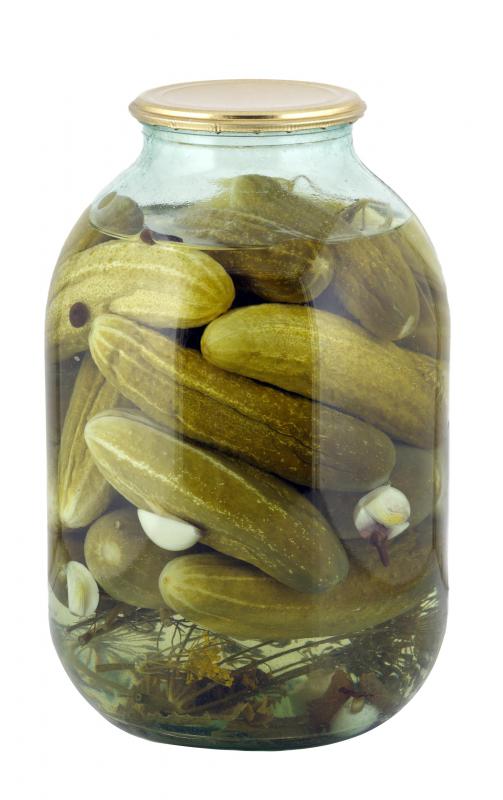
Dill pickles, also known simply as pickles, are fairly easy to make and a staple food in many cuisines around the world. To make them, a vegetable — often but not always cucumbers — are fermented in salt water or vinegar, along with a variety of spices, including dill. They were historically popular in areas where cold winters prevented the residents from obtaining fresh vegetables after summer. Cucumbers are the most popular type of vegetable used to make pickles, but others are used depending on local availability.
People eat pickles as a snack, on sandwiches and hamburgers, or as an add-on to salads or hot meals. Different cultures pickle different vegetables. In East Asia, people pickle turnips and radish, while mushrooms and eggplant are popular in Russia. Pickled onions are popular in England, and bell peppers are a typical pickled dish in Romania.

Dill pickles are basically made by fermenting the vegetable in a mix of water and salt, or, alternatively, in vinegar. Both mixes produce a slightly different product that will stay edible for a long period of time. Because the mix has a pH of 4.6 or less, bacteria cannot survive, helping the vegetable last longer. Different add-ons produce different results, including changes in color and consistency; adding grape leaves to the containers, for example, can preserve crunchiness.

Mixes to prepare pickles are now available for sale in most supermarkets, and they are designed to make the process easier. Simmering the mix in water and then adding the pickles once the mix is back to room temperature is all that a home cooks needs to do. Pickle mixes are available in a variety of flavors, including sweet, hot, extra sour, and Kosher dill. Dill pickle recipes require need some type of dill to add to the mix, and fresh dill, dry herbs, or dill seed can be used. Not matter what type of mix used, once the pickles have been canned in the liquid, the whole jar should be boiled in water for 5 to 10 minutes. At that point, the pickles are ready to store.
AS FEATURED ON:
AS FEATURED ON:









-
![Dill weed is often used to flavor pickles.]() By: ViktorDill weed is often used to flavor pickles.
By: ViktorDill weed is often used to flavor pickles. -
![Dill seed.]() By: Andrey StarostinDill seed.
By: Andrey StarostinDill seed. -
![Dill pickles.]() By: Yury TeploukhovDill pickles.
By: Yury TeploukhovDill pickles. -
![Pickling cucumbers.]() By: ElenathewisePickling cucumbers.
By: ElenathewisePickling cucumbers. -
![Dill pickle spears are often served with deli sandwiches.]() By: sumnersgraphicsincDill pickle spears are often served with deli sandwiches.
By: sumnersgraphicsincDill pickle spears are often served with deli sandwiches. -
![Dill pickles may be sliced for hamburgers.]() By: Louella FolsomDill pickles may be sliced for hamburgers.
By: Louella FolsomDill pickles may be sliced for hamburgers. -
![The coarse kosher salt that is used to brine kosher dill pickles contains no iodine or other additives.]() By: natashamam35The coarse kosher salt that is used to brine kosher dill pickles contains no iodine or other additives.
By: natashamam35The coarse kosher salt that is used to brine kosher dill pickles contains no iodine or other additives. -
![Cucumbers are the most popular pickling vegetable.]() By: food pictures studioCucumbers are the most popular pickling vegetable.
By: food pictures studioCucumbers are the most popular pickling vegetable.




Discussion Comments
My grandmother, my mother and I always make brine pickles. We use water with salt, garlic, horseradish and dill. We never boiled them in the jar. We store them in the basement for the winter, but mostly we eat them before winter.
If you get just one or two decent gherkin vines, you will have all the pickles you need for the whole year.
A pickle cucumber vine will produce dozens of pickles for you over the growing season and you just have to decide when to pick them. The smaller ones are good as sweet pickles and the larger ones for the more salty and sour pickles.
This is especially good for people who want to grow as many of their own vegetables as possible, as pickles can be a godsend in the winter months when there isn't much greenery around. It's easy to learn how to make your own dill pickles.
And the vines produce quite quickly after they have been planted as well. It's just generally a really nice plant to have around.
If you are planning to make pickles and your dill pickle recipe suggests using a grape leaf in order to preserve crunch, there are other ways of doing it.
The pickle has some enzymes on it which can soften it in the jar. If you add a leaf, it contains a substance that stops this from happening.
But, if you remove the blossom end of the cucumber it will also get rid of the source of the enzyme so you don't have to worry about the leaf.
Of course, pickled grape leaves can also be used in some delicious dishes, so you might want to consider keeping it in there!
The boiling is to seal the jar lid.
Why are you supposed to boil the whole jar after you've canned the pickles? I thought it was to kill bacteria but the article says that the pickling mix has a pH that bacteria can't live in, so what does the boiling actually do?
Post your comments