
At WiseGEEK, we're committed to delivering accurate, trustworthy information. Our expert-authored content is rigorously fact-checked and sourced from credible authorities. Discover how we uphold the highest standards in providing you with reliable knowledge.
Do Cubicles Make Workers More Productive?
 Michael Pollick
Michael Pollick
Michael Pollick
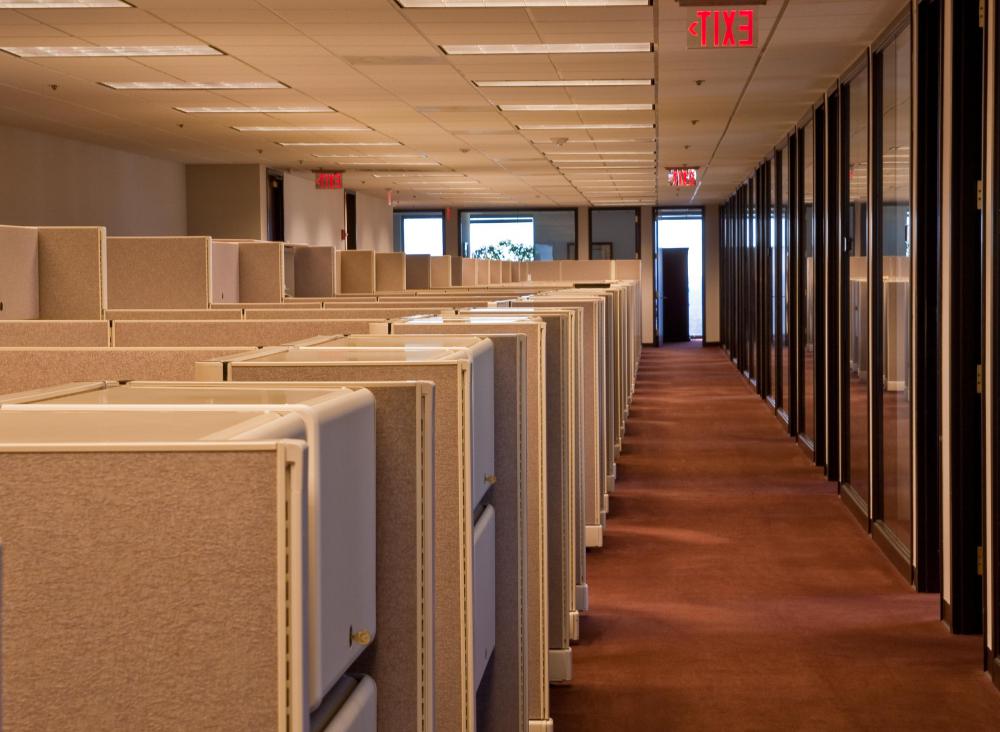
Office cubicles appear to improve worker productivity during the performance of "head down" tasks, such as word processing or filing, but could cause productivity problems whenever workers need to communicate freely with each other. In an effort to address this problem, a number of companies are now creating pods of desks designed to accommodate each department's specific needs. Those workers who need interactivity and open communication may work in cubes with low walls, while those who need more privacy could have desks surrounded by high walls and even a door.
When the concept of individual cubicles for office workers was first introduced in 1968, it was part of a larger vision called the "Action Office." Historically, many companies used an "open bullpen" approach, in which rows of desks were placed in a centralized and often impersonal arrangement. The inventor of the office cubicle, a man named Robert Propst, envisioned improving workers' productivity by providing a customized workspace that minimized distractions. Workers could then spread out their assigned workload in a way that was most efficient, instead of relying on cramped "incoming" and "outgoing" filing systems.

Under the original "action office" concept, cubicles were meant to be grouped together according to the workers' needs for interaction. Some would be open and accessible while others would be soundproofed or shielded for what would be considered "head down" work. Under the original configurations, they would improve worker productivity by providing some privacy and customization, but the ability to communicate with others would still be a consideration.

Over time, however, the idea of using cubicles to unite workers with common needs gave way to economic concerns. Cubicles now represent the most efficient way to use available floor space, which can be a major consideration in high-rent business districts. They may delineate individual work spaces, but they can also lead to morale problems as workers begin to feel confined in semi-private "nests" with little contact with the outside world. When worker morale is low, productivity also tends to suffer.

Determining if the use of office cubicles alone could have an impact on worker productivity can be difficult. There are a number of other factors, such as job satisfaction and experience, that could affect the productivity levels of individual employees. Some have speculated that the increased privacy and clearly defined workspace may have been an improvement over the open bullpen office configurations of old, but the cubicle has not been proven to increase worker productivity enough to call it completely successful.
Michael Pollick
A regular WiseGEEK contributor, Michael enjoys doing research in order to satisfy his wide-ranging curiosity about a variety of arcane topics. Before becoming a professional writer, Michael worked as an English tutor, poet, voice-over artist, and DJ.
Learn more...
Michael Pollick
A regular WiseGEEK contributor, Michael enjoys doing research in order to satisfy his wide-ranging curiosity about a variety of arcane topics. Before becoming a professional writer, Michael worked as an English tutor, poet, voice-over artist, and DJ.
Learn more...AS FEATURED ON:
AS FEATURED ON:









-
![Office cubicles.]() By: Jesse KunerthOffice cubicles.
By: Jesse KunerthOffice cubicles. -
![Cubicles in an office building.]() By: dbviragoCubicles in an office building.
By: dbviragoCubicles in an office building. -
![Some workers in cubicles are more productive than others.]() By: Monkey BusinessSome workers in cubicles are more productive than others.
By: Monkey BusinessSome workers in cubicles are more productive than others.


Discussion Comments
There is no credible research supporting "open plan/low cubes as collaboration improvers", just a lot of gurus spouting opinions like they were facts, and a lot of companies buying it (like 90 percent of silicon valley).
There is research showing that people in open plan (low or no cubes) do *worse* on head down tasks like programming. See "Peopleware," second edition, Chapter 8.
I have worked in a cubeless environment, just long rows of desks. You could hear the sales jerk on his speakerphone all the time. People would lean on my desk to talk to someone else, and it would shake so much I couldn't type. My productivity dropped by over half, and my insomnia got worse. Open plan "collaborative" spaces are sheer hell.
If I hear another reference to "increased collaboration" I'm going to scream. It's pure crap. If it's so great, why aren't execs moving to cubes?
Next time some manager or exec says you are moving to smaller cubes or to -- gasp -- an "open floor plan," ask "why?" If they say "to save money," then fine. If they say to "increase collaboration." tell them "you first" and please email me the published, independent, peer-reviewed research showing that for people in your culture and for people who do the work that you do, that there is statistical significance in the material productivity increase.
The cube floor map looks like the old slave ship sleeping diagrams. No wonder.
You are 100 percent wrong in your conclusion. Cubicles reduce productivity for anyone required to concentrate. Filing or work processing is not "head down" work but rather "head checked out" work. Any job or task that requires concentration or focus for prolonged periods is impaired by the distractions caused by a cube environment.
Productivity is reduced by half or lower by individuals who require a quiet environment to focus on challenging activities (think engineering). This is from several years of experience by me and many, many colleagues. Having an office is now considered a very attractive incentive and a key decision in accepting a job.
How about a reference to research on this issue? I have seen a lot of opinions but little hard evidence on this issue.
Post your comments