
At BeautyAnswered, we're committed to delivering accurate, trustworthy information. Our expert-authored content is rigorously fact-checked and sourced from credible authorities. Discover how we uphold the highest standards in providing you with reliable knowledge.
Can my Eyes get Sunburned?
It is widely known that excessive UV-A and UV-B rays cause sunburn and skin cancer, but fewer people realize they also cause sunburned eyes. Growing scientific research has led leading authorities such as the American Academy of Ophthalmology to warn that repeated exposure to ultraviolet (UV) radiation and near-UV light can contribute to cataracts and macular degeneration. The lens of the adult human eye will absorb a certain amount of UV radiation and near-UV light to protect the eye. Long hours in the sun or exposure to severe glare overwhelms a person's natural defenses, however, and can result in a painful condition called photokeratitis or snow blindness. This condition usually heals on its own in about a week, but repeated bouts can lead to scar tissue and eventually contribute to cataracts.
People can see and feel their skin becoming burned, but they can’t feel it when it happens to the eyes. Lightly sunburned eyes cause symptoms a few hours later. Dryness, itchiness, burning, tearing, and heightened sensitivity to light are all typical. Most often, the cause is not attributed to the sun, and often, the eyes are repeatedly burned, especially during summer and winter months when UV radiation is intensified, reflecting off snow and water. Over the years, repeatedly burning the eyes can lead to serious and permanent vision impairment.

Though medical professionals have long known about UV dangers, studies now suggest that exposure to near-UV light, known as high-energy visible (HEV) or blue light, is a possible contributor to macular degeneration. This chronic disease of the retina is one of the leading causes of blindness, with early symptoms including loss of detail in the central vision. Tasks like reading and driving become problematic as the disease worsens.

To protect your eyes from harmful rays, routinely wear sunglasses whenever outdoors. When shopping for sunglasses, note that darkness of a lens isn’t an indicator of how well the sunglasses protect. Dark lenses cause the irises to open wider, letting in more light. If the lenses do not have a high degree of UV and HEV protection, the eyes will become more sunburned.

Look for the words 100% UVA and UVB protection and HEV, near-UV, or blue-light filtering. The less-harmful HEV rays needn’t be filtered out completely. Yellow lenses block all HEV light, removing blue and distorting true color. Amber and melanin lenses filter HEV light while retaining more true color.
Children’s eyes should also be protected. Shade or an umbrella will not prevent a child from getting sunburned eyes on a beach, by a pool, or in other highly reflective environments. For maximum protection, choose frame styles that do not allow excessive light to enter at the top or sides.
AS FEATURED ON:
AS FEATURED ON:


-
![Wearing sunglasses that protect against UVA, HEV, and UVB rays can protect your eyes from sunburn.]() By: ThorstenWearing sunglasses that protect against UVA, HEV, and UVB rays can protect your eyes from sunburn.
By: ThorstenWearing sunglasses that protect against UVA, HEV, and UVB rays can protect your eyes from sunburn. -
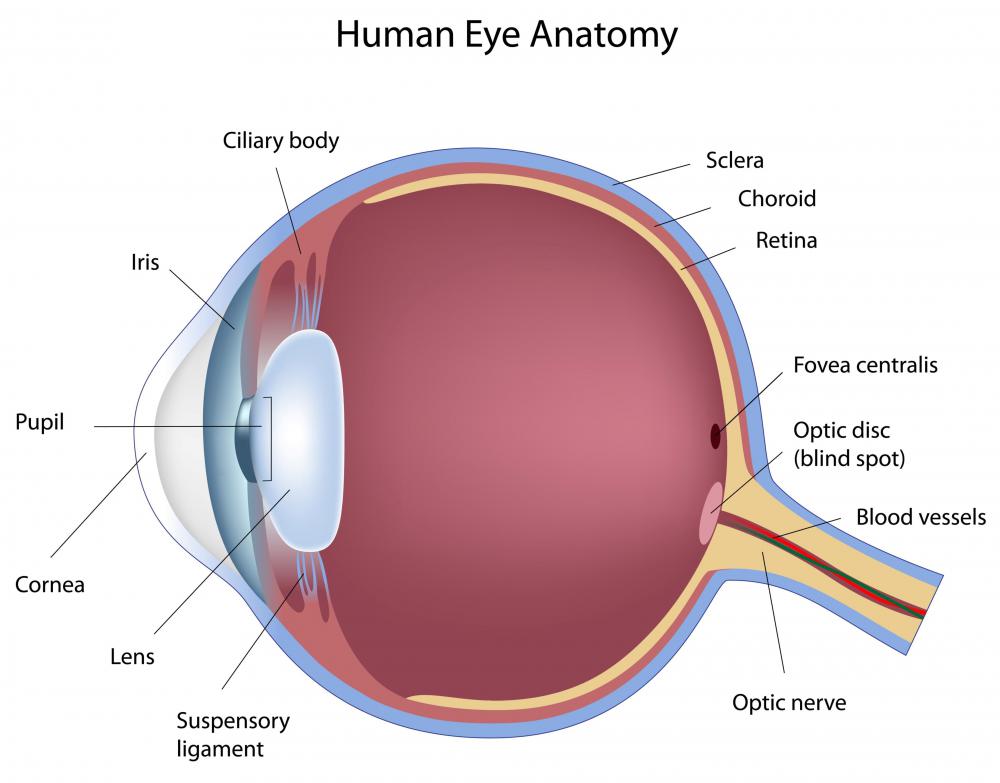
![Anatomy of the human eye.]()
Anatomy of the human eye. -
![Overexposure to sunlight can contribute to eye problems.]() By: miikoOverexposure to sunlight can contribute to eye problems.
By: miikoOverexposure to sunlight can contribute to eye problems. -
![Using an umbrella to block the sun can help avoid serious sunburns.]() By: ButchUsing an umbrella to block the sun can help avoid serious sunburns.
By: ButchUsing an umbrella to block the sun can help avoid serious sunburns. -
![People should typically wear sunglasses when they are outdoors.]() By: MiravisionPeople should typically wear sunglasses when they are outdoors.
By: MiravisionPeople should typically wear sunglasses when they are outdoors. -
![The eyes should be protected from strong sunlight.]() By: Sergey FurtaevThe eyes should be protected from strong sunlight.
By: Sergey FurtaevThe eyes should be protected from strong sunlight. -
![Dryness, itching and burning are all signs of sunburned eyes.]() By: chuugoDryness, itching and burning are all signs of sunburned eyes.
By: chuugoDryness, itching and burning are all signs of sunburned eyes. -
![Cataracts occur when part of the eye is damaged and the eyes' lenses become cloudy.]() By: rob3000Cataracts occur when part of the eye is damaged and the eyes' lenses become cloudy.
By: rob3000Cataracts occur when part of the eye is damaged and the eyes' lenses become cloudy.






Discussion Comments
I went fishing yesterday with my dad and we didn't have on sunglasses or hats or sunscreen -- dumb us. When we got home our faces were dark red and my eyes were burning and I tear up really easily. How do you fix the sunburn on your eyes?
I've been trying to get my friend to believe that it is possible to sunburn your eyes, so I'm printing off this page to show him tomorrow.
yes, san diego beach, salty ocean fun and an overdose of sun. My eyes had constant tears and I was unable to open my eyes beyond a burning and blurry squint. just a day or less of that.
My seven year old son skied recently on a sunny day for four or five hours and got sunburn. By evening, his eyes were pink and by night it was worse. He complained of a burning sensation and the feeling of foreign objects in his eyes and sensitivity to light. It continued the next morning but got better by night. Never heard of sunburn in eyes before. Doctor warned us to use sunglasses next time in snow.
maybe four or five days. I stupidly went onto the ice on a sunny day without any eye protection and got sunburned eyes. That night was when i first noticed my eyes were burnt. The next day or two I couldn't stand light- had to wear sunglasses all the time -- even when I was indoors. It took another few days for my eyes to be back to normal. Since then, I am more careful to wear sunglasses when I go outside.
I live in central Florida and helped a buddy put up a fence over the weekend. I did not have a shirt on and got a mild sunburn on my already moderately tanned skin. About an hour after sunset, my eyes got red and teary and it felt like I had a foreign body in one of my eyes. I was miserable that night, a bit light sensitive during the day and the next day and then it all started over in the the evening. Got up this morning and they felt and looked OK. As I have started to wake up, they are starting to smart and tear again. Had glasses with UV protection on, but the angle I was working let the sun hit them directly. How long will this last?
Goggle Sunglasses would work great for your jr. Life Guard. They have a close fit, not bulky and the soft adjustable strap allows her to run without the feeling of them falling off. My teenagers wear them and they come in a few colors. The straps can adjust to fit a 5 year old to an adult.
Goggle-Sunglasses by Zoro
They are very inexpensive and can be found on many Web sites.
Unfortunately the only way to protect his eyes in the water is to wear some type of swim goggles with UV protection, if they make such a thing for surfing, but he likely won't find them very cool looking. You might check out the local surf shop to see if they have such a beast... they will probably be costly, but if he'll wear them, it would be worth the cost.
My 10 year old son burns his eyes when he surfs for too long. He is an avid surfer. Is there anyway to protect his eyes while surfing? He also has a fair skin which is protected by sunscreens. Obviously, these are no good for eye protection.
Has she tried getting those cords that keep your sunglasses on? All sorts of athletes use them (and they have them available now that don't like old granny eyeglass cords). Kayakers and lifeguards and all sorts of people use them to keep their sunglasses on. It's important that she protect her eyes!
my 11 year old daughter burns her eyes (the white part) every time she goes to the beach. She just started 3 weeks of jr life guard and she says she can't run with sunglasses on. what else can protect her eyes?
Post your comments